






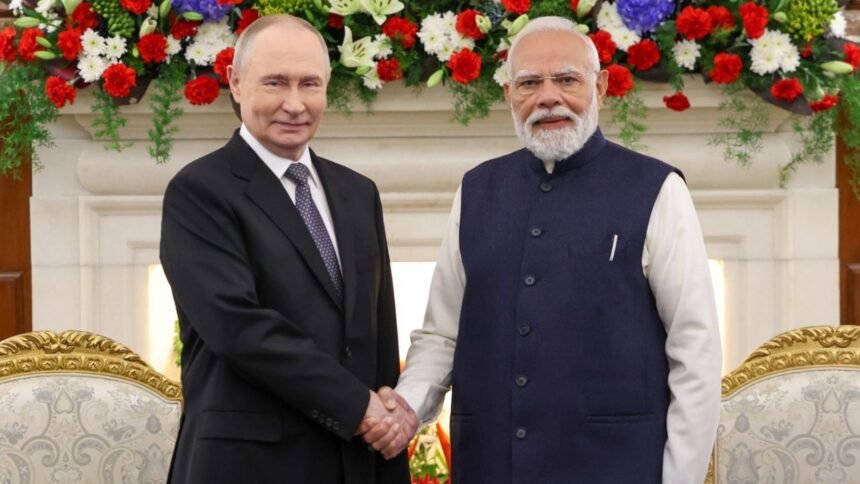
New Delhi: Russian President Vladimir Putin and Indian Prime Minister Narendra Modi held summit talks in New Delhi today, agreeing to deepen bilateral cooperation in trade, defence, energy and economic sectors, and signing multiple agreements as part of a fresh push to broaden ties beyond traditional oil and arms dealings.
Putin, making his first visit to India in four years since the start of Russia’s war in Ukraine, offered India a guarantee of continued — “uninterrupted” — fuel supplies. He emphasized that Russia remains committed to supplying oil, gas, coal and other energy resources to India despite Western pressure on energy trade with Moscow.
Under a newly agreed economic cooperation programme valid through 2030, the two countries aim to expand bilateral trade to US$ 100 billion, alongside measures to diversify trade flows beyond energy and defence sectors. The cooperation plan spans agriculture, fertilizers, labour mobility, healthcare, ship-building, and joint ventures.
On defence cooperation, the summit participants agreed to reshape ties with a focus on joint research and development, as well as the domestic production of spare parts, components and assemblies — aimed at enhancing self-reliance while maintaining long-standing strategic partnership.
Prime Minister Modi underlined the enduring strength of India-Russia relations, calling them a “guiding star” based on “mutual respect and deep trust.” He reaffirmed India’s support for a peaceful resolution of the war in Ukraine, while welcoming the renewed cooperation commitments.
The summit featured a ceremonial welcome for Putin at the forecourt of Rashtrapati Bhavan, including a 21-gun salute and a visit to Raj Ghat where Putin laid a wreath, before moving on to delegation-level talks at Hyderabad House.
In a joint statement, both leaders emphasized that “in the current complex, tense and uncertain geopolitical situation,” the India–Russia partnership remains resilient to external pressure.
As India courts economic engagement from the West, including ongoing trade talks with the United States, New Delhi now faces a delicate balancing act deepening traditional ties with Moscow on energy and defence, while simultaneously navigating Western scrutiny and sanctions aimed at Russia.