






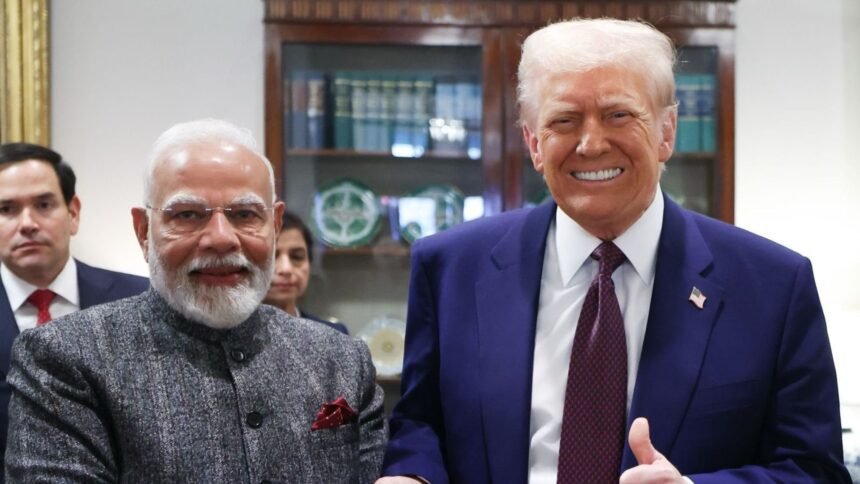
India rejected U.S. Commerce Secretary Howard Lutnick statement that the India-U.S. trade deal fell through due to Prime Minister Modi not calling U.S. President Trump when it was agreed. Ministry of External Affairs spokesperson said the comments were “inaccurate” pointing out that the two leaders have spoken eight times in 2025.
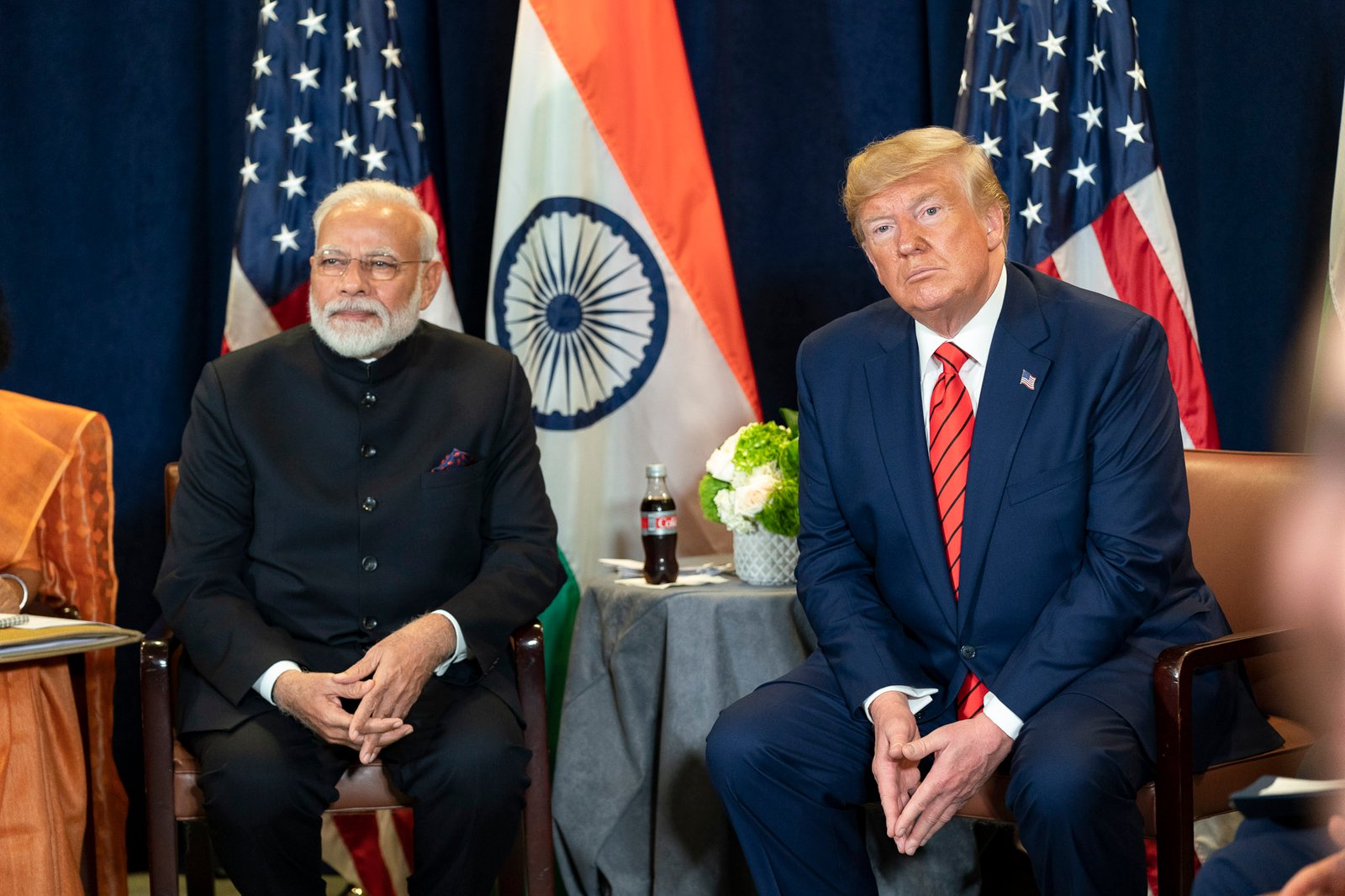
Lutnick said, ‘Modi didn’t call Trump’
Speaking on a podcast, Lutnick said the framework of the agreement had already been prepared. However, he noted that it was clearly understood from the beginning that the final approval depended on a single individual who had the authority to formally seal such agreements.
Lutnick said he told the Indian trade delegation that Prime Minister Narendra Modi needed to personally call the US President to move the trade deal forward. However, Indian officials were reportedly uncomfortable with the request, and Prime Minister Modi did not call President Donald Trump.
“As a result, the process stalled. In the following days, we moved ahead with other countries. Deals were announced with Indonesia, the Philippines, Vietnam, and Malaysia over the next week”, Lutnick added.
He also revealed that it was the US that backed off from the finalised agreement. He said,
India remembers the deal we agreed to. I remember it. They tell me you agreed to this deal. I told them I agreed then. Not now. Modi didn’t call Trump. We did a bunch of deals after that. And later India called and said okay we’re ready. And I said ready for what? You’re ready for the train that left the station three weeks ago?
MEA dismisses the claims
The Ministry of External Affairs, however, stated that the characterisation by US Commerce Secretary Howard Lutnick was ‘not accurate’ and both countries had been close to a trade deal on several occasions.
MEA Spokesperson Randhir Jaiswal said at the weekly presser,
On several occasions, we have been close to a deal. The characterization of these discussions, the reported remarks, is not accurate
“Our position on the larger question of energy sourcing is well known. In this endeavor, we are guided by the evolving dynamics of the global market and by the imperative to secure affordable energy from diverse sources to meet the energy security needs of our 1.4 billion people,” the MEA said.
The response comes after US President Donald Trump “greenlit” a bipartisan Russia sanctions bill that could penalise Moscow’s trading partners, including India, China and Brazil, for continuing purchases of Russian oil.
US official’s statement debunks Trump’s claim
US Commerce Secretary’s statement, however, contradicts US President’s claim on January 7, 2026 that Prime Minister Narendra Modi had requested a meeting with him, expressing displeasure over Washington’s decision to impose a 50% tariff on India. Trump said the tariff was imposed because of India’s purchase of Russian oil.
According to news agency PTI, Trump made this remark on Tuesday at a meeting with members of the House Republican Party in Washington.
Trump also said,
PM Modi himself came to meet me. He came up to me and said, Sir, may I meet you? And I said, yes.
Trump has imposed a total 50% tariff on India, of which 25% extra tariff was applied due to the purchase of Russian oil.
India proposed final offer for trade deal
India has presented its final proposal to the US in trade talks. India seeks to reduce the total 50% tariff imposed on it to 15% and to completely remove the extra 25% penalty on crude oil purchases from Russia. The ongoing talks between the two countries raise hopes of a concrete decision in the new year.
Negotiations are underway for a comprehensive bilateral trade agreement (BTA) between the two countries. Commerce Secretary Rajesh Agarwal said that consensus on the agreement could be reached soon, although he did not specify any timeline.
This week, the trade teams of India and the US met in Delhi. The talks are focused on two issues: first, a large and permanent trade agreement, and second, a framework agreement to remove or reduce the 50% tariff imposed on India by the US.
500% traffis on India and China?
The bill, chiefly written by Graham and Democratic Senator Richard Blumenthal, allows the administration to impose tariffs and secondary sanctions up to 500 per cent on countries that purchase Russia’s oil, gas, uranium and other exports. Doing so is meant to cut off the source of financing for much of Russia’s military actions.