







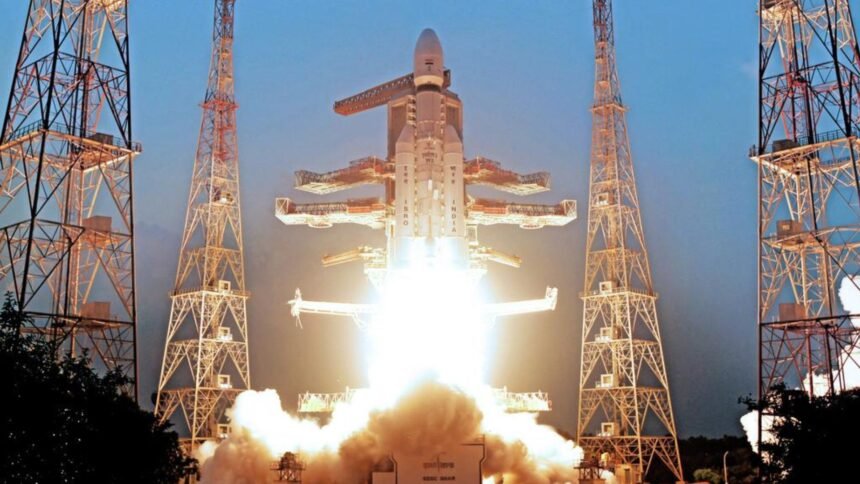
Sriharikota: The Indian Space Research Organisation (ISRO) scripted a new chapter in space history on Sunday, November 2, 2025, by successfully launching India’s heaviest-ever communication satellite, CMS-03. The liftoff occurred at 5:26 pm from the Second Launch Pad at the Satish Dhawan Space Centre in Sriharikota, Andhra Pradesh, aboard the LVM3-M5 rocket.
India’s ‘Bahubali’ Achieves Landmark Success
According to ISRO, the 4,410-kilogram CMS-03 satellite was placed into Geosynchronous Transfer Orbit (GTO), representing a critical milestone for India’s space mission goals. This is the heaviest communication satellite ever launched to GTO from Indian soil. The 43.5-meter-tall LVM3 rocket successfully deployed the satellite approximately 16 minutes after liftoff.

ISRO engineers have nicknamed this powerful rocket “Bahubali” due to its heavy-lifting capacity—capable of launching payloads that previously required foreign launch vehicles.
Major Leap Toward Self-Reliance
For decades, India’s largest communication payloads had to rely on foreign rockets, such as Ariane-5 launched from French Guiana. According to sources and agency reports, previously heavy satellites like GSAT-11 (weighing 5,854 kg) had to be launched by foreign vehicles. However, CMS-03 has been launched entirely from Indian soil using India’s indigenous LVM3, breaking this dependency.
Satellite Capabilities
CMS-03 is a sophisticated multi-band communication platform designed to provide extensive telecommunication coverage across India and its surrounding oceanic regions. It is equipped with transponders supporting voice, data, and video links across C, extended C, and Ku communication bands.
Also referred to as GSAT-7R, the CMS-03 satellite will play a critical role in enhancing India’s maritime defense capabilities. It will provide secure communication links among Indian Navy ships, aircraft, and submarines, enabling uninterrupted communication across remote maritime regions.

Following Chandrayaan-3’s Success
The previous LVM3 mission successfully launched Chandrayaan-3 in July 2023, through which India became the first country to land successfully near the lunar south pole. This marks the fifth operational flight and eighth overall flight of the LVM3 launch vehicle.
The launch vehicle stood 43.5 meters tall with a total liftoff mass of 642 tonnes. The vehicle utilized three stages of propellants to enable the satellite to reach Geosynchronous Transfer Orbit. CMS-03 separated from the vehicle at an altitude of approximately 179 kilometers at a velocity of around 10 kilometers per second.
National Security and Development
By bolstering communication capabilities, CMS-03 will enhance India’s maritime security and disaster management efforts, making it a vital asset for national defense and development. The satellite will provide services over a wide oceanic region including the Indian landmass.
Union Minister Dr. Jitendra Singh congratulated the ISRO team on social media, stating that India’s “Bahubali” has scaled the skies. He emphasized that this is the heaviest communication satellite ever launched from Indian soil.
Looking Ahead
With CMS-03’s success, ISRO has proven the LVM3’s versatility and strengthened the foundation for future missions—from advanced communication satellites to deep-space exploration. The agency’s upcoming plans include manned missions under Gaganyaan and next-generation navigation systems, both relying on similar heavy-lift capabilities.
This achievement represents more than just a technical triumph—it’s a strategic leap demonstrating that India has evolved from launching small satellites in the 1980s to deploying world-class communication systems entirely through domestic capability. The successful launch reinforces India’s position among elite spacefaring nations and showcases the country’s commitment to achieving complete self-reliance in space technology.
Also Read | India’s Maritime Might Gets a Boost: GSAT-7R Satellite Takes Naval Communications to New Heights