






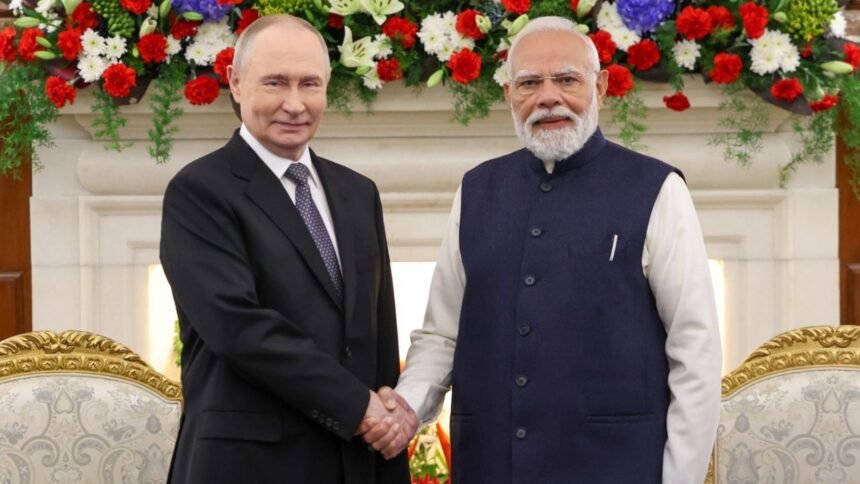
New Delhi, December 5: Russian President Putin landed in New Delhi on December 4, 2025, for a two-day state visit his first to India since the Russia–Ukraine war began. He was greeted at the airport by Prime Minister Modi himself, a gesture that underscored the personal warmth and strategic importance attached to the visit.
Accompanied by senior ministers and a large Russian business delegation, Putin’s visit had broad ambitions: to move beyond traditional energy and defence cooperation, and expand into other sectors such as trade, industry, agriculture, labour, and nuclear energy.
Key Outcomes and Agreements
- Economic Cooperation Programme until 2030: The two sides agreed on a comprehensive economic cooperation programme extending through 2030. Their joint target: increase bilateral trade to US $100 billion a significant rise from the ~ US$69 billion recorded in 2024–25.
- Broadening trade basket: Rather than continue dependence on oil and defence alone, the plan includes expanding cooperation into fertilizers, agriculture, shipping, healthcare, pharmaceuticals, industry, and labour mobility. Among the agreements: a joint-venture fertiliser plant, easier movement of Indian workers to Russia, and cooperation in agriculture, shipping, and other commercial sectors.
- Energy & Nuclear Cooperation: Putin assured “uninterrupted fuel supplies,” reaffirming Russia’s commitment to servicing India’s energy needs. In addition to oil, the countries highlighted continuing cooperation on civil nuclear energy notably the ongoing collaboration around the nuclear power plant at Kudankulam Nuclear Power Plant.
- Defence and Technology Collaboration: The summit also emphasised deepening defence ties via joint research & development, co-development and local production of military equipment and components in India. This aligns with India’s push for self-reliance in defence manufacturing.
Geopolitical Context Western Pressure and India’s Balancing Act
The summit takes place against the backdrop of increasing pressure from the West especially the Donald Trump administration in the US on India to cut back on Russian oil imports. In August 2025, the US imposed punitive tariffs (up to 50%) on Indian exports in response to New Delhi’s continuing trade with Moscow.
Despite that, both leaders used the summit to reassert the strength and resilience of the India-Russia relationship. In a joint statement, they underscored that bilateral ties remain “resilient to external pressure.”
For Russia, India represents a crucial buyer for its energy and goods vital given the constraints imposed by Western sanctions. For India, the relationship offers a way to diversify trade, secure energy supplies, and deepen strategic autonomy.
What Didn’t Change and What Remains Unclear
While the summit laid down a broad roadmap, no specific new weapons procurement deals were announced publicly. Earlier hopes had included accelerated delivery of systems like the S-400 Triumf air-defence system and upgrades for jets like the Su-30MKI. However, officials had indicated such announcements might not come during this visit.
Moreover, though trade expansion and diversification were emphasized, it’s unclear how quickly non-oil trade will scale up and how much Russia’s imports from India will grow to reduce trade imbalance. The target of US$100 billion by 2030 is ambitious and will require sustained efforts from both sides.
Also Read | PM Modi Welcomes President Putin as Russian Leader Arrives in Delhi for Two-Day Summit