







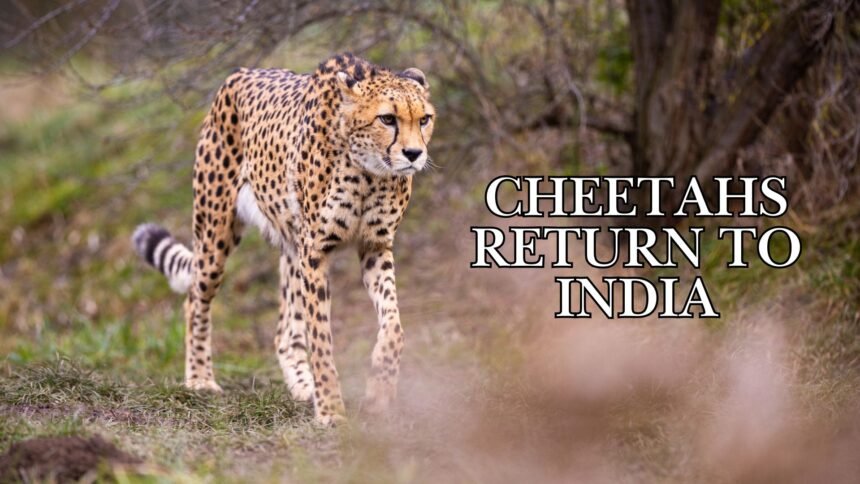
New Delhi: After seven decades of absence, the distinctive roar of cheetahs echoes once again through Indian forests. What began at Madhya Pradesh’s Kuno National Park has now opened its doors to tourists, offering wildlife enthusiasts an extraordinary opportunity to witness these magnificent big cats in their natural habitat since October 1, 2025, when India’s first cheetah safari was launched.
How Many Cheetahs Are in India?
As of November 2025, India is home to 27 cheetahs: 24 at Kuno National Park and 3 at Gandhi Sagar Wildlife Sanctuary, both in Madhya Pradesh. These African cheetahs were brought from Namibia and South Africa as part of Project Cheetah. The current population includes 11 adults (those originally imported) and 16 cubs born on Indian soil a remarkable achievement considering the project is barely three years old.
Project Cheetah Timeline
The historic journey began on September 17, 2022, when Prime Minister Narendra Modi released eight Namibian cheetahs (five females and three males) at Kuno National Park on his 72nd birthday. These were the first cheetahs to set foot in India in over 70 years. In February 2023, a second batch of 12 cheetahs arrived from South Africa (seven males and five females), bringing the total to 20 imported adults.
The project’s biggest success came on March 29, 2023, when a Namibian female named ‘Jwala’ gave birth to four cubs the first cheetah births in India since the 1950s. Since then, 26 cubs have been born in total, with 16 surviving. A landmark moment occurred on September 30, 2025, when ‘Mukhi’, a cub born in March 2023, became the first India-born cheetah to reach adulthood at 30 months.
The Story of Extinction
Cheetahs once roamed freely across India, from the northwestern plains to the Deccan Plateau. However, excessive hunting during the British Raj, royal coursing traditions, habitat loss, and prey depletion led to their extinction. The last three Indian cheetahs were shot in 1947 by the Maharaja of Surguja in present-day Chhattisgarh. A female cheetah was spotted for the final time in 1951 in Koriya district. In 1952, India officially declared the cheetah extinct making it the only large mammal to disappear from independent India.
Why Bring Cheetahs Back?
The reintroduction serves multiple purposes beyond species conservation. Cheetahs are apex predators crucial for maintaining ecological balance in grassland and savanna ecosystems. Their presence helps protect endangered prey species like blackbuck, chinkara, and nilgai. The project also aims to restore India’s degraded grasslands and open natural ecosystems.
Additionally, Project Cheetah has significant socio-economic benefits. It’s boosting eco-tourism, creating local employment through the ‘Cheetah Mitras’ program (400+ trained volunteers from 51 villages), and generating revenue for surrounding communities. Over ₹112 crore (approximately $13.5 million) has been invested in the project so far.
Visiting the Cheetahs: Tourist Information
Great news for travelers you can now see cheetahs in India! The country’s first cheetah safari launched at Kuno National Park on October 1, 2025. Bookings can be made 120 days in advance at kunocheetahjunglesafari.com or at the park gates on a first-come, first-served basis.
- Safari Timings: Morning (6:00-10:30 AM) and evening (3:00-7:00 PM, closed Wednesday evenings).
- Cost: ₹4,500 per gypsy vehicle (accommodates up to 6 passengers).
- Entry Gates: Ahira Gate and Peepalwadi Gate are open for cheetah safaris.
Important Rules: Vehicles must maintain speeds below 20 km/h; visitors must remain inside vehicles at all times; music devices are prohibited; touching or disturbing animals is strictly forbidden; and government-issued ID proof is mandatory (passport for international tourists).
Best Time to Visit: October to March offers pleasant weather. The park closes during monsoon season (July-September). Note that cheetah sightings aren’t guaranteed as many remain in acclimatization enclosures for monitoring. However, Kuno also hosts leopards, spotted deer, nilgai, sloth bears, and over 200 bird species.
Current Status and Challenges
The project has faced challenges alongside successes. Of the 20 imported adults, 9 have died, and 10 of the 26 cubs born have not survived. Deaths have resulted from heat stress, tick infections, radio collar complications, mating conflicts, and predation. In September 2025, a 20-month-old female became the first cheetah killed by a leopard a stark reminder of the high leopard density (approximately 90 leopards) in Kuno.
However, the survival rate has improved dramatically. In 2024, cub survival reached 76%, up from just 25% in 2023. The government claims this 61% overall cub survival rate exceeds the global standard of 40%.
Future Conservation Plans
The project is expanding rapidly. In April 2025, two male cheetahs were relocated to Gandhi Sagar Wildlife Sanctuary, followed by a female in September 2025. Nauradehi Wildlife Sanctuary is being prepared as the third site, and Gujarat’s Banni Grasslands will host a breeding center for up to 16 cheetahs.
Eight more cheetahs from Botswana are expected to arrive by December 2025, with ongoing negotiations with Kenya and South Africa for additional batches. The long-term vision involves creating a metapopulation of 50-70 cheetahs across the Kuno-Gandhi Sagar landscape within 25 years, connected by a 17,000 sq km wildlife corridor linking Madhya Pradesh and Rajasthan.
How to Reach Kuno
- By Air: Gwalior Airport (170 km, 4 hours) or Indore Airport (330 km).
- By Train: Shivpuri Station (65 km) or Sheopur Kalan Station (50 km).
- By Road: From Delhi (~450 km, 8-9 hours), from Gwalior (170 km, 4 hours), from Jaipur (6-7 hours). Accommodation options include the upcoming Kuno Retreat, eco-lodges, and camping facilities near the park.
A Global Conservation Milestone
Project Cheetah represents the world’s first intercontinental translocation of a large wild carnivore. While challenges remain, the project has achieved several milestones: surviving adults have established home ranges, successful breeding in India, and the first India-born cheetah reaching adulthood. The project is being closely watched globally as a potential model for carnivore reintroduction efforts.
For wildlife enthusiasts and travelers, visiting Kuno National Park offers a unique opportunity to witness conservation history in the making. Whether you spot a cheetah or enjoy the park’s diverse wildlife, you’re contributing to one of the world’s most ambitious rewinding projects the restoration of a species that vanished from Indian soil 70 years ago.
Also Read | Top 5 National Parks in India to Visit This November for Ultimate Safari Adventures