





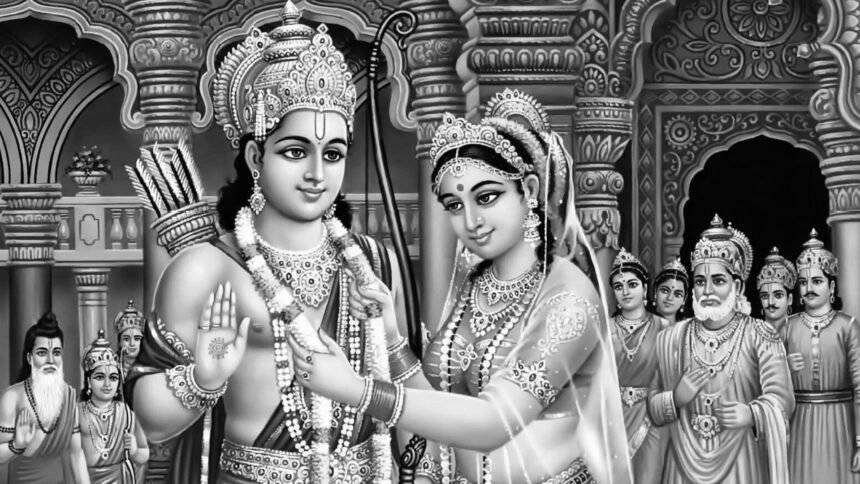
Tuesday marks the auspicious celebration of Vivah Panchami, observed on the fifth day of the bright fortnight in Margashirsha month. This sacred day commemorates the divine wedding of Lord Rama and Goddess Sita that took place in Treta Yuga at Janakpur, the capital of King Janaka’s Mithila kingdom. This year the Panchami Tithi begins at 9:22 PM on November 24 and concludes at 10:56 PM on November 25.
Spiritual perspective: Union of Dharma and Shakti
Vivah Panchami transcends historical narrative it symbolizes the sacred union of Dharma (masculine principle) and Shakti (feminine energy). Lord Rama embodies righteousness, justice, and duty as Maryada Purushottam while Goddess Sita personifies patience, devotion and purity.
According to Yoga philosophy, this marriage represents the cosmic union of Shiva (consciousness) and Shakti (energy) in human form. Just as the universe functions through the synthesis of Purusha and Prakriti, marital harmony in Grihastha Ashram emerges from the balance of both partners.
Tantric philosophy connects this to the Ardhanarishvara concept. A complete human embodies both masculine and feminine qualities in balance Rama’s valor with Sita’s grace, Rama’s wisdom with Sita’s compassion.
The Swayamvar narrative in Valmiki Ramayana
Maharshi Valmiki elaborates in Balakanda how Sage Vishwamitra brought princes Rama and Lakshmana to Mithila. King Janaka had declared that whosoever could lift and string Lord Shiva’s Pinaka bow would wed his daughter Sita.
This bow was no ordinary weapon it symbolized ego and pride. Numerous powerful kings arrived filled with arrogance about their strength, yet failed to even move the celestial bow. Rama approached it with humility and selflessness and lifted it effortlessly. This demonstrates that life’s formidable challenges can only be overcome by those possessing humility, not ego.
The bow’s breaking symbolizes liberation from old conditioning and bondage. Marriage marks the beginning of a new life where two souls relinquish their individual egos to embark on a shared journey.
Sacred Sanskrit verses and their deeper meaning
Valmiki Ramayana’s Balakanda, Sarga 73, verses 26-27 contain King Janaka’s words:
abravījjanako rājā kausalyānandavardhanam |
iyaṃ sītā mama sutā sahadharmacarī tava ||
pratīccha caināṃ bhadraṃ te pāṇiṃ gṛhṇīṣva pāṇinā |
pativratā mahābhāgā chāyevānugatā sadā ||
Meaning:
This is Sita, my daughter, who will be your Sahadharmachari (partner in dharma). Take her hand. She is devoted to her husband and will accompany you like a shadow forever.”
The term ‘Sahadharmachari’ holds profound significance it means partner in dharma, neither servant nor master. This establishes the principle of equality and partnership. Marriage unites not two individuals, but two souls who walk together on the path of dharma.
Verses 28-29 describe how gods showered flowers, gandharvas sang, and apsaras danced. This represents cosmic approval when two souls unite with pure intention the entire universe rejoices.
Vivah Panchami worship rituals and psychological impact
Morning ablutions signify not merely physical cleansing but washing away mental negativity. Wearing fresh clothes symbolizes new resolve.
Worship procedure:
- First, Ganesha worship to remove obstacles
- Yellow garments for Rama symbolizing knowledge and wisdom
- Red garments for Sita symbolizing energy and devotion
- Panchamrit Abhishek purification through five elements
- Tulsi offering symbol of purity and devotion
Chanting “Om Janaki Vallabhaya Namah” 108 times brings mental peace and stability. This mantra facilitates harmony in male-female relationships.
Cultural significance: Foundation of Indian marriage customs
Vivah Panchami has profoundly influenced Indian matrimonial culture:
- Swayamvar tradition: The bride’s right to choose her life partner evidence of women’s autonomy. Sita herself garlanded Rama.
- Merit-based selection: Not royal wealth but character, virtues, and capability were valued. Rama won Sita through his prowess, not riches.
- Seven vows tradition: Hindu marriage’s Saptapadi originates here companionship for seven lifetimes, seven promises.
- Sanctity of Kanyadan: King Janaka bestowed his daughter with utmost respect showing daughters are not burdens but family jewels.
Celebrations in Ayodhya and Janakpur
Ayodhya hosts grand celebrations on Vivah Panchami. Temples are adorned like wedding venues. The Ram Baraat procession features Rama dressed as the groom seated in a palanquin, accompanied by representations of Lakshmana, Bharata, and Shatrughna.
Janakpur, Nepal celebrates with a seven-day festival:
- Day 1: Phulbari Lila (first meeting of Rama-Sita)
- Day 3: Dhanus Yagya (re-enactment of bow-breaking)
- Day 5: Tilakotsav (King Dasharatha’s arrival)
- Day 6: Complete Vedic wedding ceremony
Streets decorated with rangoli, illuminated with lamps, resonating with folk songs this symbolizes cultural unity between both nations.
Scientific perspective: Astrology and Astronomy
Significance of Margashirsha month:
This period marks late autumn transitioning to early winter. Atmospheric humidity decreases, sunlight becomes gentle. This proves conducive for physical and mental well-being.
Science of Panchami Tithi:
On Shukla Paksha Panchami, the moon is 30% illuminated. This phase is considered optimal for mental stability and emotional balance. Lunar gravity affects water elements, comprising 70% of the human body.
Nakshatra influence:
During Vivah Panchami, Rohini or Mrigashira nakshatras dominate the sky. Both symbolize love, beauty and arts. Astrological texts consider them highly auspicious for marriages.
Psychology:
Vivah Panchami rituals awaken positive mental states:
- Fasting: Enhances self-control and willpower
- Worship: Concentrates the mind
- Ramayana recitation: Internalizes ideal life values
- Community celebration: Strengthens social bonds
Message for modern society
1. Equality principle: Rama-Sita’s marriage demonstrates that husband and wife are equal partners. Sita was called ‘Sahadharmachari,’ not ‘servant.’
2. Merit-based choice: In today’s era dominated by dowry and ostentation, Rama-Sita’s wedding teaches that character and capability matter most.
3. Family importance: Marriage unites not just two individuals but two families. The respect and affection between Kings Janaka and Dasharatha exemplifies this.
4. Lifelong commitment: Rama practiced Ekapatni Vrata (monogamy). This message resonates profoundly in today’s era of rapidly changing relationships.
5. Companionship in adversity: Sita accompanied Rama into forest exile. True love remains constant through joy and sorrow.
Health benefits of fasting
According to Ayurveda, digestive fire intensifies during Margashirsha month. Fasting during this period:
- Provides rest to the digestive system
- Eliminates accumulated toxins
- Enhances mental clarity
- Strengthens immunity
Consuming sattvic foods like bananas, milk, and apples during the fast purifies both body and mind.
Conclusion: An eternal inspiration
Vivah Panchami transcends religious observance it teaches the art of living. Rama and Sita’s life demonstrates that:
- Dharma is paramount: Every decision should be dharma-based
- Strength lies in surrender: Sita’s devotion was her strength, not weakness
- Dignity is essential: Rama was Maryada Purushottam (embodiment of dignity)
- Love requires sacrifice: Both made numerous sacrifices for each other
This festival teaches us that marriage is not merely a social institution but spiritual practice wherein two souls unite and progress toward the Divine.
Also Read | Dev Uthani Ekadashi: When Vishnu awakens from his slumber