







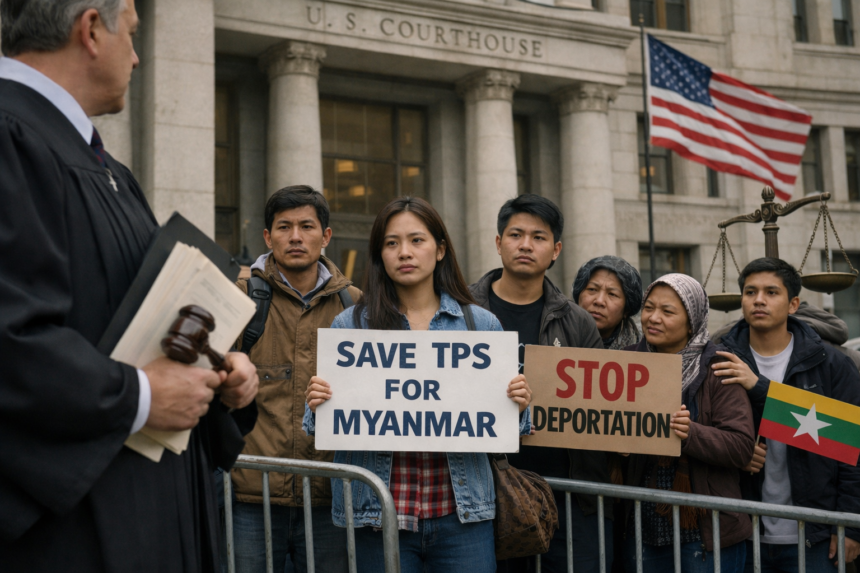
WASHINGTON – A judge in Chicago has temporarily blocked the Trump administration from ending Temporary Protected Status (TPS) for people from Myanmar. This means the government cannot remove these protections right now while a court case about the decision is still ongoing.
Because of this order, about 4,000 people from Myanmar who are living and working in the U.S. can stay legally and keep their work permits for now. Their protection was supposed to end on January 26, 2026, but that deadline is put on hold until the court gives a final decision.
In short: they are safe for now, but the final outcome will depend on what the court decides later.
What Happened: The Judge’s Decision and Legal Challenge
In November 2025, the U.S. government decided to end Temporary Protected Status (TPS) for people from Myanmar (Burma). TPS lets people stay and work in the U.S. when their home country is too dangerous to return to. Homeland Security Secretary Kristi Noem said Myanmar was now safe enough and that TPS was no longer needed.
Why was this challenged?
Many Burmese TPS holders strongly disagreed. They said Myanmar is still extremely unsafe, with ongoing violence, military conflict, and human rights abuses. They also argued that the government did not properly study the situation before ending TPS.
The court case
Six Burmese TPS holders filed a class-action lawsuit called Aung Doe v. Noem with the help of human rights and refugee organizations. They claimed the government broke the law by ending TPS without a real, careful review of conditions in Myanmar.
What did the judge decide?
On January 23, 2026, Judge Kennelly stopped the TPS termination for now. He said:
- The government did not seriously examine what is actually happening in Myanmar.
- There is no solid proof that the country is safe enough for people to return.
- Violence, instability, and rights abuses are still ongoing.
- The decision looked like part of a larger political push to end TPS programs, rather than a fair, legal decision based on facts.
What happens next?
The judge delayed the end of TPS and set another court hearing for February 6, 2026 to hear further arguments. Until then, Burmese TPS holders can continue to stay and work in the U.S.
The court said the government cannot end protection for vulnerable people just by claiming conditions have improved. It must prove it carefully, honestly, and according to the law
Voices from the Case: Plaintiffs and Advocates
Thura Doe, one of the people who filed the case, said she felt relieved by the judge’s decision. She explained that if she were sent back to Myanmar, the military government there could arrest her immediately.
Dinesh McCoy, a lawyer from AALDEF, said the ruling was an important step toward justice. He said the government ignored both the law and clear facts when it decided to end protection for people from Myanmar.
Megan Hauptman from IRAP said the decision shows that the government cannot unfairly take away immigrants’ legal status. She added that their fight in court will continue to protect immigrants’ rights.
Background: What Is TPS and Why It Matters
Temporary Protected Status (TPS) is a U.S. program that lets people from certain troubled countries stay and work in the United States for a limited time. It is meant for situations where going back home would be dangerous because of war, natural disasters, or other serious crises. People with TPS cannot be deported while the status is active and can legally work, but it does not automatically make them permanent residents or citizens.
Myanmar was given TPS in 2021 after the military coup, which led to violence, arrests, and instability. Because the situation in Myanmar remained unsafe, the U.S. government kept extending TPS under different administrations, including President Biden’s, so that people from Myanmar living in the U.S. would not be forced to return to dangerous conditions.
Country Conditions in Myanmar: Why This Matters
Critics said it was dangerous and unfair to end protections for people from Myanmar because the country is still violent and unsafe. A UN human rights expert warned that sending people back could expose them to torture, persecution, or even death, calling the move an attack on basic human rights.
Many countries and international observers also said the elections held by Myanmar’s military rulers were not real or free, and were only used as an excuse to justify changing policies.
Lawyers opposing the decision used these facts to argue that the government ignored the real situation on the ground. The judge agreed, concluding that the government had not followed the law properly when it tried to end the protections.
Legal and Policy Implications Going Forward
This case is part of a wider legal fight over the Trump administration’s attempt to end Temporary Protected Status for several immigrant groups. Courts across the U.S. have recently stepped in to block the termination of TPS for people from countries like South Sudan, Honduras, Nepal, and Nicaragua. Judges have said the government failed to properly explain its decisions and may have ignored legal and constitutional requirements. Because of this, the courts are increasingly acting as a safeguard against rushed or unsupported immigration policy changes.
For people from Myanmar, the next major moment will be the court hearing scheduled for February 6, 2026. At that hearing, the government will have to prove that conditions in Myanmar have improved enough to justify ending TPS and that the law was correctly followed. Those challenging the decision will argue that Myanmar remains unsafe and that the government did not rely on real evidence. Until the court decides otherwise, TPS protections remain in place.
The outcome of this case could have a wider impact on U.S. immigration policy. If the judge ultimately rules in favor of the TPS holders, people from Myanmar may be allowed to stay and work legally in the United States for months or even years. Such a decision could also make it harder for future administrations to end TPS without careful fact-based review and may encourage other affected immigrant groups to challenge similar rollbacks in court.
If the government eventually wins, it could slowly move forward with ending TPS, which may lead to deportations or removal proceedings unless higher courts intervene. For now, however, the judge has paused the government’s decision, giving roughly 4,000 people from Myanmar the chance to continue living and working in the U.S. while the lawsuit moves forward. The February hearing will be decisive and may shape how TPS decisions are handled in the future.
ALSO READ | Gujarat High Court Says: Government Bodies Can’t Treat Delay as a Privilege