








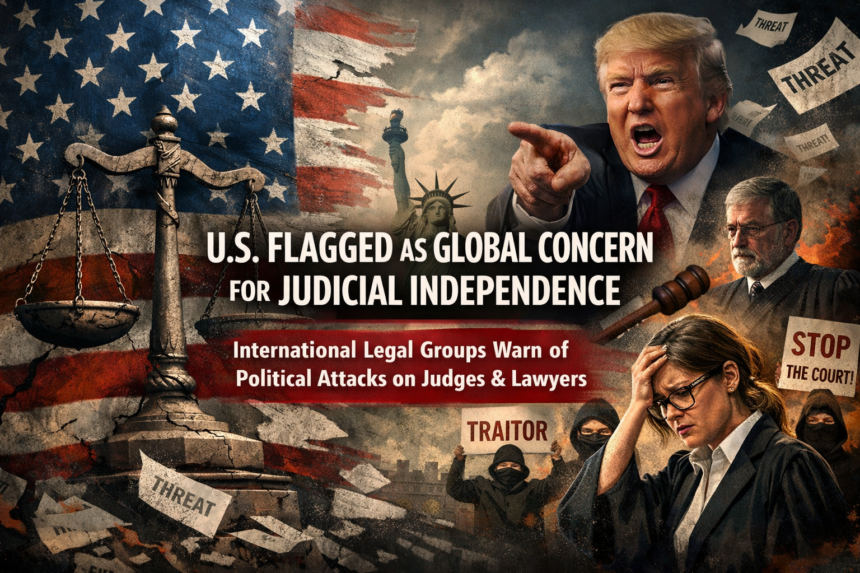
For decades, the United States has been seen as a model democracy, with courts that are independent and lawyers who can work without political interference. But now, that reputation is being formally questioned.
An international group made up of bar associations, human rights organizations, and legal watchdogs has named the U.S. as the focus of the 2026 International Day of the Endangered Lawyer. This honor is usually given to countries where lawyers and judges face serious threats and harassment. That the U.S. is included puts it in the same category as countries with authoritarian or partly authoritarian governments.
The group’s report is very direct. It says that political actions during President Donald Trump’s current term have weakened the independence of courts and made it less safe for lawyers handling politically sensitive cases. The report points out that this isn’t just a one-time problem it’s a structural issue. Judges are being publicly attacked, law firms are being pressured, and it has become normal for political leaders to label legal opponents as disloyal or working against the country.
What triggered the designation
The International Day of the Endangered Lawyer is observed every year to draw attention to countries where lawyers are under threat. In the past, it has focused on places like Turkey, China, Colombia, and Pakistan. This year, the U.S. being highlighted is unusual.
The group organizing the day points to several worrying trends in the U.S.:
- Attacks on judges: Top political leaders often criticize judges by name when they make rulings they don’t like, suggesting the judges are biased instead of neutral.
- Pressure on lawyers: Law firms representing political opponents, whistleblowers, migrants, protesters, or journalists face threats, investigations, loss of government work, or damage to their reputation.
- Negative portrayal of lawyers: Some leaders describe lawyers as helping enemies of the state, instead of seeing them as officers of the court doing their job under the law.
- Fear among younger lawyers: Young and public-interest lawyers report being scared of retaliation for taking on certain cases.
The coalition says that when judges and lawyers are publicly attacked for doing their job, the rule of law stops protecting people and instead can be used as a tool by those in power.
Why this is different from normal political conflict
Criticism of courts isn’t new in the United States. What worries people around the world now is that criticism is turning into intimidation. The report points out the difference between disagreeing with a court’s decision and trying to make the judiciary itself seem untrustworthy.
In the past, even when politics was very divided, U.S. leaders usually respected the line between politics and the courts. Today, that line is being intentionally blurred. Judges aren’t just criticized for their legal decisions anymore they are being painted as enemies supporting certain political sides. Lawyers are no longer seen as professionals arguing cases within the system, but as people working against the country’s interests.
This is similar to what has been seen in countries where democracy is weakening, where leaders try to weaken checks on their power by attacking the people and institutions that enforce the law.
International reaction and comparisons
International legal groups are now looking at the U.S. in the same way they look at countries where the rule of law is already weakening. This doesn’t mean the U.S. legal system has completely broken down courts still work, judgments are enforced, and constitutional rights still exist. The worry is about the direction things are going, not the current state.
These groups warn against being relaxed or thinking everything is fine. Democracies usually don’t collapse suddenly; they weaken slowly through constant pressure, repeated attacks, and gradually silencing people who speak out.
Legal organizations in Europe and Latin America have also said they’re worried. When a country that has usually been seen as a model starts allowing threats or pressure against lawyers, it sends a message that such behavior is acceptable elsewhere.
Legal and policy implications going forward
The title or designation might seem symbolic, but it actually has real effects.
- It draws more international attention to how U.S. courts handle cases, especially sensitive ones about elections, executive power, immigration, national security, or protests.
- It gives U.S. judges and lawyers more protection when they speak up internally. Knowing that the international community is watching can protect their reputation, even if they face domestic pressure.
- It can affect legal cooperation with other countries. Things like extradition, sharing evidence, or joint investigations depend on trust in judicial independence. If doubts persist, these collaborations become harder.
- It pushes professional organizations, like bar associations, to act more decisively when lawyers are targeted for their work, instead of staying cautious.
Conclusion
The U.S. being chosen as the focus country for the 2026 International Day of the Endangered Lawyer is a warning sign. It shows that international legal organizations now see threats to America’s system of laws as real, not just theoretical. This doesn’t mean the U.S. has become authoritarian, but it does mean that some of the protections that stop the government from going down that path are under pressure.
The rule of law doesn’t break when courts are closed. It breaks when courts stay open but face political punishment for doing their job.
ALSO READ | Supreme Court Confronts AI Deepfakes: A Legal Turning Point for Digital Evidence