








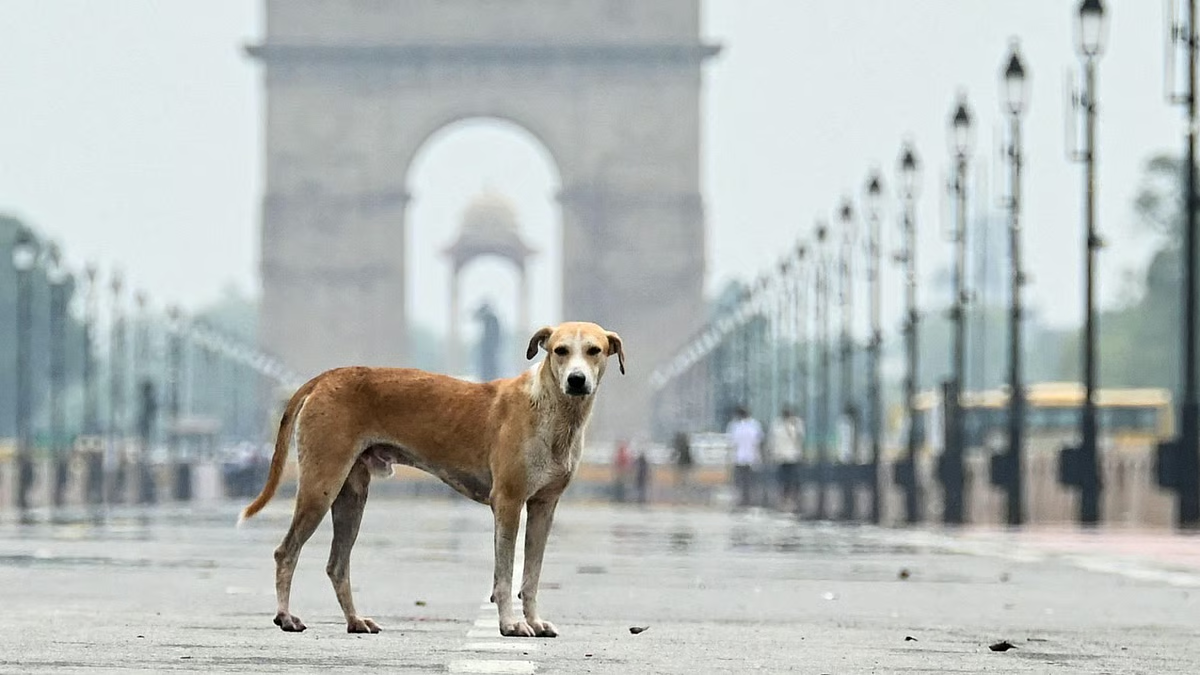
New Delhi: In July 2025, the Supreme Court of India started a case on its own after reading a newspaper report about how stray dogs were attacking children and people in cities. This kind of case, started by the court itself without anyone filing a complaint, is called a suo motu case. On July 28, 2025, the Court registered this case after noticing a Times of India article titled “City Hounded by Strays, Kids Pay Price.” The first hearing took place on August 11, 2025 before two judges, Justice JB Pardiwala and Justice R. Mahadevan. The judges were very concerned after seeing official data showing that more than 37 lakh people across India were bitten by dogs in 2024. To deal with this, the Court ordered authorities in Delhi-NCR to catch stray dogs, sterilize them, vaccinate them, and keep them in shelters. The judges clearly said that these dogs should not be released back onto the same streets after treatment. They also said the work must be done quickly, without delays or excuses. The Court strongly said that protecting people is more important, especially children, old people, and persons with disabilities. It said that public streets should be safe places, not places where people feel scared or at risk. Within days (Aug 22, 2025) a three-judge bench (Justices Vikram Nath, Sandeep Mehta, and N.V. Anjaria) modified the August 11 directives, effectively staying the permanent sheltering order while still emphasizing safety. The case then lay in abeyance over the fall, as states prepared affidavits on implementation.
Supreme Court Flags Stray Animal Menace as Threat to Public Safety, Issues Nationwide Orders
On 7 November 2025, the Supreme Court said that the growing number of dog attacks and accidents caused by stray animals is a serious danger to people’s right to life and safety. The Court ordered that places like schools, hospitals, stadiums, bus stands and railway stations must put proper fencing so that stray dogs cannot enter these areas. Local government bodies were told to catch stray dogs, sterilize them, vaccinate them, and move them to shelters. The Court clearly said that the dogs should not be released back on the streets. They must also start helpline numbers so people can quickly report dog-bite cases. All hospitals were ordered to always keep enough anti-rabies vaccines in stock so that bite victims can be treated without delay. The Court also spoke about stray cows and other animals on highways. It said that accidents caused by animals on roads show that the authorities are careless about public safety. Highway authorities were directed to remove stray animals from national and state highways. Finally, the Court gave governments and agencies about 6 to 8 weeks to follow these orders. If they fail, the Court warned that they could face contempt proceedings.
Court Raises Alarm Over Rising Dog Bites and Official Inaction During Ongoing Hearings
After the November order, the Court began hearing the case again on December 7, 2025 and then from January 7 to 13, 2026. It heard arguments from many people who wanted to take part in the case. The judges repeatedly pointed out that dog bite cases were increasing, that city and state authorities had ignored the Animal Birth Control Rules for a long time, and that people’s lives were at risk.
On January 13 and again on January 20–21, 2026, a bench of three judges asked for final written arguments. The next hearing is fixed for January 28. During all these hearings, the judges kept giving interim remarks reminding the authorities that public safety and responsibility were very important.
When Co-existence Meets Public Safety
The Supreme Court benches spoke very strongly on this issue. In its order dated August 11, 2025, the two judges said that their decision was not taken suddenly or lightly. It came after many years of failure by authorities to protect public safety.
The Court said it understands the need for people and animals to live together peacefully. But peaceful living does not mean that one life should be protected at the cost of another. Streets, the judges said, cannot become unsafe spaces, especially for vulnerable people like the visually impaired, children, and the homeless. The Court clearly stated that “no person is above the law” when public safety is concerned.
The judges also said that every citizen has a duty to help. They suggested that people who care about stray dogs should adopt them and keep them in their own homes instead of leaving them on the streets. The Court warned against showing sympathy only in words without taking real responsibility.
Finally, the Court encouraged citizens to support shelters and animal pounds by volunteering and helping them function properly, so that the system can work better for both people and animals.
Supreme Court Stresses Public Safety in Stray Dog Case
In January 2026, a Supreme Court bench made very strong and serious comments during hearings about stray dog attacks. Justice Vikram Nath said that when government authorities fail to act and children are harmed, the State may have to pay heavy compensation. He strongly criticised people who defend stray dogs while ignoring public safety. He asked,
“If you love these animals so much, why don’t you take them to your house? Why should these dogs roam around freely, bite people, and frighten them?”
Justice Mehta agreed and asked who should be responsible when a stray dog attacks a child. He said that stray dogs belong to no one, and that anyone who wants to keep a dog must take proper permission and a licence. When a lawyer suggested that these comments were made jokingly, Justice Nath clearly said that they were not joking at all and that the Court was speaking very seriously.
The judges made it clear that public safety comes first. They warned that States could be forced to pay large amounts of money if people die because of dog attacks. They also suggested that people who regularly feed stray dogs might be held legally responsible if a dog they feed attacks someone.
During the hearings, the Court repeatedly criticised municipal authorities for not doing their job properly. It said that vaccination and sterilisation of stray dogs was not being done regularly and properly. Because of this failure, people were not only being bitten by dogs, but were also dying in road accidents caused by stray animals. The Court reminded everyone that human life and dignity are most important under Article 21 of the Constitution. No policy or sympathy for animals can come before human safety. The judges said that now everyone government officials, local bodies, and even dog feeders must take responsibility and act seriously.
ABC Rules Support Community Dog Feeding, Counsel Argues
Lawyers representing people who feed street dogs and animal-welfare groups told the Court that feeding community dogs is a helpful public service, not a crime.
They said regular feeders understand dog behaviour well. Because they see the same dogs every day, they can quickly notice if a dog is sick or injured and help it get treatment. Feeding also reduces fights between dogs over garbage and lowers the spread of disease.
One lawyer explained that a serious feeder spends about ₹18,250 per year on one dog for food alone, showing personal commitment and responsibility.
He referred to Rule 20 of the Animal Birth Control (ABC) Rules, 2023, which says that local authorities and resident welfare associations must make proper arrangements for feeding community animals. He argued that feeders are acting according to the law and should be protected, not punished. He added that this approach matches constitutional values of compassion and care.
In a rhetorical remark, he questioned why public money should be used to remove dogs instead of helping homeless people, saying that funds could be better used to help vulnerable humans as well.
Finally, the lawyer stressed that “compassion cannot be punished.” He asked the Court to consider scientific evidence showing that humane methods are the best way to manage street dogs and protect both animals and people.
Why Treating and Sterilising Dogs Works Better Than Removing Them
Several lawyers spoke about successful dog sterilisation programmes in places like Jaipur and Goa. They said that even aggressive dogs can often be treated and trained instead of being caught and killed. Senior lawyer N.M. Kapadia told the court that a dog rehabilitation centre in Rajkot showed that violent dogs can improve with care. He also warned that mass killing of dogs in the past had failed badly — in Gujarat in 1994, it led to a rise in rats and even a plague outbreak.
Others suggested practical steps, such as fixing specific places where housing societies can feed stray dogs, so there is less conflict. Some lawyers questioned whether the animal birth control rules are being applied too strictly in all situations. One lawyer said that the Animal Welfare Board of India has very few staff outside Haryana, yet still blocks many local programmes.
Overall, the lawyers supporting animal welfare said that the best and most humane method is scientific “Trap-Neuter-Return” catching dogs, sterilising them, and returning them to their area. They argued that moving dogs away is cruel and does not work in the long run. As one NGO lawyer said, removing community dogs from schools and hospitals is worrying because when dogs are removed, new dogs soon enter the empty area, creating the same problem again.
Government and Municipal Accountability for Stray Dog Control
The Court strongly criticized both municipal bodies and state governments for not doing their job properly in controlling stray dogs. It said local authorities were careless and inconsistent in carrying out sterilisation and vaccination programmes, which are meant to reduce the number of stray dogs and protect people from danger. The Court made it clear that the state government is mainly responsible for keeping people safe. If officials fail to act, they could face legal trouble for negligence.
A senior lawyer argued that stray dogs do not have a legal right to stay in places like schools and hospitals. He said that if dogs are caught from such areas, they should not be put back there, because children, patients, and vulnerable people must be protected. The Court had already ordered that institutions should be fenced to keep dogs out. When states were criticised, the Court insisted on hearing directly from them. It said governments must show whether they actually have a proper plan to control the dog problem.
Overall, the message is simple:
Governments and municipal authorities must urgently make and carry out clear plans to control stray dogs and protect public safety. If they fail to act, they can be held legally responsible.
What Animal-Rights Groups Argued in Court
Animal-rights groups and lawyers argued strongly for protecting dogs and treating them humanely. Groups like People for Animals and individuals like Maneka Gandhi said that killing or removing dogs in large numbers would be wrong and dangerous.
Maneka Gandhi told the Court that decisions based on fear are bad policy. She warned that removing dogs suddenly is only a short-term solution that looks good but does not solve the real problem. According to her, the real causes – poor waste management, lack of sterilization, and weak veterinary services – must be fixed. Senior lawyer Pinky Anand reminded the Court that Indian law requires animals to be treated with compassion. She warned against harsh or inhuman methods. Experts also explained an important scientific point: street dogs are territorial. If dogs are removed from an area, new unvaccinated dogs and even rats may enter the empty space. This can actually increase health risks. They said the only proven long-term solution is large-scale sterilization and vaccination (ABC + vaccination).
Rule 20 of the ABC (Dogs) Rules – Feeding Dogs
A major issue in court was Rule 20 of the 2023 ABC Rules. This rule says that local bodies or Resident Welfare Associations (RWAs) must arrange feeding for community dogs and settle disputes between residents and feeders.
Some lawyers argued that people who feed dogs are doing a public service under the law and should not be punished. Others said feeding is allowed, but it must not create danger. The Court agreed that feeding is not illegal, but feeders must follow rules.
For example, feeding in public places without permission may not be allowed. The judges said that if you take responsibility for feeding, you must also ensure the dogs are controlled and managed safely. So, the Court’s view was: feeding is permitted, but it comes with responsibility.
Expert Committees and Use of Data
Some lawyers asked the Court to create an expert committee to study dog population control properly. They gave examples from cities like Jaipur and Goa where good sterilization programs worked well. Others said enough committees already exist and that governments simply need to implement existing plans properly.
The Court did not create a new committee immediately. Instead, it asked state governments to provide detailed data and plans showing what they are doing about sterilization, vaccination, and dog populations.
Legal and Constitutional Issues
The judges said that frequent dog bites affect the right to life and safety under Article 21 of the Constitution. They warned states that they may have to pay heavy compensation for every serious dog-bite case. They also pointed out that stray dogs cause road accidents, which also threaten public safety.
On the other side, animal-rights lawyers reminded the Court that the law forbids killing healthy dogs. Euthanasia is allowed only in rare cases, such as when a dog has rabies. They stressed compassion and humane treatment under the Prevention of Cruelty to Animals Act.
The Court made it clear:
- Public safety comes first
- Dangerous dogs must be handled
- But actions must strictly follow the ABC Rules
- There is no blanket ban on feeding and no order to remove all dogs
The judges repeatedly asked why existing laws were not being enforced properly.
Some observers warned the Court to be careful. In earlier environmental cases, the Supreme Court had passed strong orders without full data and later had to withdraw or change them. In stray animal cases, courts and international bodies like the WHO have long supported sterilization and vaccination, not killing, as the best method.
What This Case Could Change
This judgment may change stray-dog policy across India. If the Court continues in this direction:
- Municipal bodies will have to expand sterilization and vaccination programs
- More shelters and veterinary teams will be needed
- Governments may have to spend large amounts of money
- Feeding in public places may become more restricted
- States may be forced to pay compensation for dog-bite victims
For citizens, this may mean safer streets, especially for children and elderly people.
Concerns of Animal-Rights Groups
Animal-rights activists fear that strict orders could lead to mass round-ups, overcrowded shelters, and even cruelty. They warn that relocating dogs without sterilization will only bring new unvaccinated dogs and increase disease risk. They argue that without fixing waste management and veterinary systems, the problem will keep returning.
Their main message is simple:
Only high-coverage sterilization + vaccination works in the long run.
Anything else is temporary and ineffective.
This case is about finding a balance between:
- Human safety (protecting people from bites and accidents)
and - Animal welfare (protecting dogs from cruelty and killing)
The Court must decide:
- How dogs should be managed
- Who is responsible
- Where feeding is allowed
- Who pays when harm happens
The final order will likely shape India’s stray dog policy for many years – deciding how compassion and public safety can exist together.
Also read | Taliban’s Persecution of Women and LGBTQI+ Spurs Historic ICC Warrant Move