







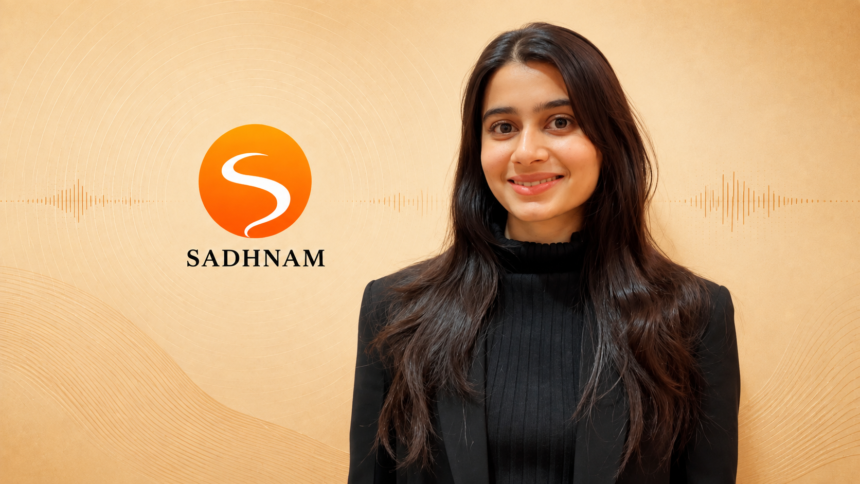
Mental health has moved from the margins of conversation to its centre. Stress, disturbed sleep, anxiety and emotional strain are now common across students, working professionals, homemakers and the elderly, and awareness of them is rising even as access to reliable support often lags behind. It is against this backdrop that Sadhnam, an India-rooted well-being ecosystem for mind and body, has placed contemporary mental health at the heart of its work rather than treating it as a secondary concern. Founded by philosopher & researcher Devrishi under the nonprofit Sanatan Wisdom, its work is available through sadhnam.org.
Psychology at the core, not the edge
Where many well-being platforms lead with practices and fold mental health in later, Sadhnam has built a dedicated mental-health research effort into its foundation, led by psychologist Ankita Goyal. Her team reviews current psychological research and is developing a structured knowledge base around the concerns that shape everyday life: stress, emotional well-being, behaviour, relationships, attention and lifestyle.
The emphasis is on rigour. This work is kept grounded in evidence-based psychology and is deliberately held distinct from Sadhnam’s separate research into mantra, sound and contemplative traditions. The two streams meet only where evidence allows, an approach intended to keep the mental-health work professionally sound rather than blurred into generalised wellness claims.
Modern life places real and specific demands on mental health, and those deserve rigorous, professional attention in their own right,” says Ankita Goyal. “Our commitment is to keep this work grounded in evidence, so that whatever Sadhnam offers rests on something people can trust.
A clear line between well-being and care
That discipline extends to a boundary Sadhnam treats as non-negotiable: the line between well-being and clinical care. Meditation, mantra, yoga and related practices, it stresses, may complement healthy living, but they are not presented as substitutes for psychological, psychiatric or medical treatment when professional care is required. Where a concern calls for clinical help, Sadhnam’s model is designed to point toward it rather than around it.
That framing matters in a wellness landscape often criticised for overpromising. By keeping psychology professionally grounded and drawing a firm line around clinical care, Sadhnam positions its mental-health work as a complement to professional support, not a replacement for it.
From knowledge to everyday life
Within Sadhnam’s five connected areas: learning, practice, consultation, structured programmes and research, mental health runs as a thread through each. The aim is to help a person move from understanding a concern, to reliable knowledge, to daily practices such as guided meditation, breathwork and movement, and to qualified professional guidance where it is needed, all within one connected space.
For its founder, the wider purpose is to make emotional well-being something people engage with early and openly, rather than only in crisis.
People do not experience the mind, body and lifestyle separately,” Devrishi says. “Well-being should not be fragmented either.
By anchoring an India-rooted well-being ecosystem in evidence-based psychology, Sadhnam is making a quieter argument about where wellness is heading: that taking mental health seriously means treating it with the same rigour as any other part of health, and knowing where practice ends and professional care begins.
If you or someone you know is struggling with mental health, it is best to reach out to a qualified mental-health professional or a recognised helpline.
Also Read: Can India’s Ancient Sound Traditions Speak to a Restless Modern Mind? Sadhnam Is Trying to Find Out