






Jain scriptures incorporate large chunks of cultural material that appears in Hindu epics like Mahabharat and Ramayan. They are not treated as a divine revelation, but rather rewrites them under a non- theistic , karmic and nonviolent framework. These jain puranas use the same civilizational stories, lineages, and geographical settings, but exclude gods, miracles, avatars, and supernatural interventions. The main aim is to document the cycle of major human figures.
Events are perceived as a historical scaffolding and is interpreted around Karma, rebirth and the fixed catalog of 63 Śalākāpuruṣa. In Jain cosmology the Śalākāpuruṣa means “63 illustrious beings”. They are a fixed set of figures in every half cycle of time (Avasarpini or Utsarpini ) Their identities, roles, and life cycles are predetermined by karmic and cosmological law. The catalog includes:
24 Tirthankars who establish Jain Dharma as spiritual teachers in each era. They achieve enlightenment and omniscience ( kevel gyaan ) and guide others towards liberation from worldly life.
12 Chakravartis are universal emperors who rule all six continents, achieve this through non violence, diplomacy and wealth. Yet , remains subject to karma .
9 Baldevas, also known as Balabhadras, who are nonviolent heroes and brothers of the Vasudevas, their role is to defend, guide and support without killing .
9 Vasudevas (Narayanas) are violent world conquerors They rise to power through battles, killing adversaries, mainly Prativasadevas, political dominance. Their lives are depicted as cycles of political ambition, victory and eventual karmic consequence.
9 Prati-vasudevas (Prati-narayan) are antagonist of the vasudevas, and are not labelled as evil but to fulfill the role of rival power.
Jain puranas like Hemachandra ‘s Trishashti Śalākāpuruṣa charitra and Jinasena Harivamsa Purana has records of well known cultural figures like Krishna, Balarama, Jarasandha and how they are integrated into the catalog of 63 Śalākāpuruṣa.
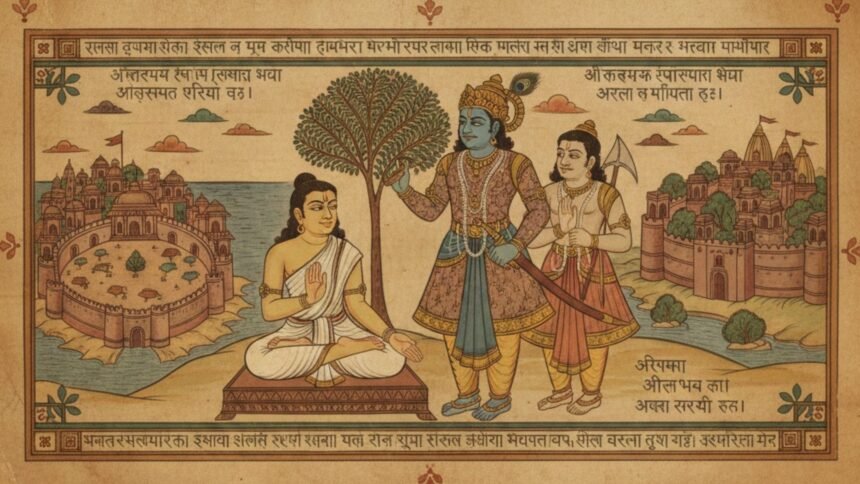
Jain Scriptures has prominently recognised Krishna’s character as the son of Vasudeva and Devaki belonging to the Yadava clan . His connection with the 22nd Tirthankar Neminath seen as Krishna’s cousin as their fathers, Samudravijay and Vasudeva are brothers. Jain texts highlights that Krishna was present in every key moment in Neminath’s life. Krishna witnessed Neminath’s renounces of worldly life, during his preparation of his wedding and Neminath s renunciation, a critical event in Jain history. Though the text do not assign Krishna as a spiritual authority his presence is descriptive, establishing the social and familial context rather than conveying doctrine.
Krishna’s life follows the archetypal path of a Vasudeva. Jain literature shows Krishna’s early struggle with Kans , his maternal uncle , his strategic relocation of the Yadava clan from Mathura to Dwarka and his conflicts with Jarasandha, king of magadha , and other rival kings, the Prati-vasudevas. As Krishna participates in the Mahabharata war his role as seen as a strategist and advisor to the pandavas.
Jain literature sees the war as an historical catastrophe emphasising the scale of destruction and human violence rather than any divine sanction. Each killing Krishna performs includes his confrontation with the Prati-vasudevas, produces karmic consequences , his status as vasudeva means he carries the burden of violence incorporated in the role. Every Vasudeva must kill the Prati-Vasudeva expand the political power and participate in destructive conflicts, these actions and violence produce Ayushya Karma and Nama Karma that later predetermines the next birth. Jain ethics classify all intentional violence , strategic, defensive or heroic as binding. Krishna’s involvement in Mahabharat increases the load. The narrative is not a moral judgement it is a mechanical causation. Vasudevas are designed to fall because the role requires violence.
Krishna is subjected to the seventh hell (Maha-Tamas) as a automatic result of the gathered violent Karma. Jain philosophy treats this as a temporary state. No soul is eternally damaged. After exhausting the karmic effects created through violence the soul rises again through future births. The fall is not about Krishna’s character, it is about structural nature of the Vasudeva role.
The destruction of Dwarka is another key historical event in Jain texts , quarrels among the Yadavas ,breakdown of the discipline and the external pressure leading to the city’s collapse. Krishna is present as the clan dissolves and disintegrates. The Puranas records Krishna’s death in the forest, struck by a Hunter’s arrow, as a ordinary human event with no supernatural framing.This event aligns with the wider cultural story while highlighting the role of karma in determining outcomes.
Krishna’s brother Balarama refrains from killing even when capable of military success. Is recorded as a Baladeva, Balarama supports Krishna strategically but avoids acts that causes destructive karma. Their action generates significantly less karmic burden, allowing their souls to ascend to higher birds or ultimately achieve liberation.This illustrates Jainism’s moral principle that is ethical restraint and non violence (ahimsa) produces positive karmic outcomes. The contrast of Krishna and Balarama role shows the pattern of Vasudeva-Baladeva pairing in Jain cosmology, illustrating both the inevitability of karma and possibilities of restraint.
Jain Philosophy treats karma as a physical substance that binds to the soul based on actions, intention, and passions of a human being. Every act of violence, deceit , attachment and greed gathers karmic particles into the soul, which then determines future experiences, birth and spiritual potential.This structure of karma is mechanical , impartial and inevitable, it does not require any divine judgement, rewards or punishment. No divine intervention can prevent the natural unfolding of the karmic law. All the souls are subjected to rise or fall strictly according to the weight and type of karmic matter bound during life. In this framework, Krishna s victories , his killing of Prativasudevas and his participation in large scale battles are necessary for the cosmic structure of the Vasudeva role, but simultaneously ensures his karmic descent demonstrating the impartiality and inevitability of karma in Jain cosmology.
Jain philosophy preserves Krishna’s era not to glorify it, but to show how a world can be understood through a different lens. The epic story of Mahabharata is retold without miracles or divine privilege ,this reveals its underlying pattern , how people navigate power, duty and kinship. Also , how every action is subjected to have its own consequence. The Jain version brings to light, the divine incarnations as participants in their lives historical landscape and timeline. This version also brings clarity on how their choices and conditions shapes their lives.
Also Read | Krishna’s Philosophy and the Environment: A Gita Jayanti Reflection Through the Kaliya Naag Story