






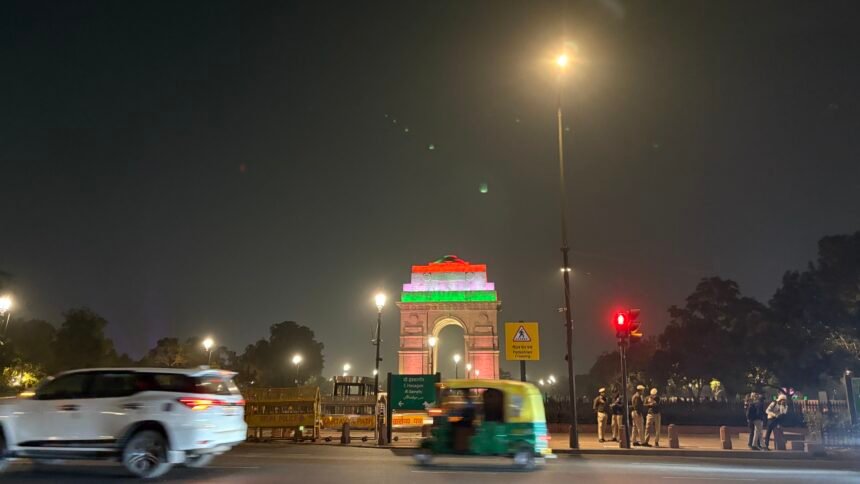
New Delhi, November 18: Delhi’s air quality crisis has entered its tenth consecutive year with little signs of relief, as toxic smog continues to trigger emergency responses from the Centre and judicial scrutiny from the Supreme Court. The situation escalated again after a Public Interest Litigation (PIL) filed by health coach Luke Christopher Coutinho, which states that 1.4 billion Indians are compelled to inhale toxic air daily due to regulatory failures.
Health Toll Mounts Despite Policy Interventions
Air pollution remains the fifth largest cause of death in India, claiming 2 million lives annually, according to WHO data. India also records the world’s highest mortality from chronic respiratory diseases and asthma.
The Great Smog of 2016 pushed PM2.5 levels far beyond survivable limits, forcing the Centre and states to adopt emergency control measures.
A 2018 report by the Ministry of Health Sciences found:
- 41% pollution from vehicular emissions
- 21.5% from dust
- 18% from industrial sources
The director of the Central Centre for Science and Environment alleged that the SIAM (Society of Automobile Manufacturers) says it’s “against the report” because it was “inconvenient” to the automobile industry.
Supreme Court’s Continuing Oversight
On November 25, 2019, with Delhi’s AQI touching 399, Justice Arun Mishra remarked that “Delhi is worse than hell, pushing pollution into the national political and legal spotlight.”
Stubble Burning: Satellite Evasion & Underreporting Persist
Despite heavy mechanisation subsidies, stubble burning accounted for 38% of Delhi’s pollution in 2023.
A three-judge bench led by CGI B.R. Gavai, along with Justices K. Vinod Charan and Justice N.V. Anjarya addressed this issue in court. The Supreme Court has declined a blanket construction ban, noting that millions of livelihoods are linked to the sector, and called for a balanced approach between environmental control and economic activity.
In a hearing on November 12, 2023, Advocate Aprajita Singh informed the Court stating that“Agriculturists wait for the surveillance satellite to pass overhead before putting the lighted match to the stalks, delaying the burning in tune with the movement of the satellites, farmers pull back if they are paid ₹100 per quintal”.
On November 17, the amicus curiae told the Court that actual burning incidents are underreported, and machinery worth thousands of crores has not led to measurable ground impact.
Monitoring Gaps Highlight Systemic Weakness
Additional Solicitor General Aishwarya Bhati admitted gaps in satellite-based detection and said ISRO is working with the Centre to upgrade protocols.
Serious concerns were raised regarding:
- Outdated air quality monitoring equipment
- Allegations of water sprinkling near sensors to reduce reported AQI values
Advocate Sankaranarayana says that GRAB(Greater Response Action Plan) has to be placed throughout the year.
The Supreme Court has directed Punjab and Haryana chief secretaries to cooperate fully with the Commission for Air Quality Management (CAQM).
Pandemic Lockdown Offered Temporary Relief
During the COVID-19 lockdown, Delhi recorded its cleanest air in over a decade due to minimal vehicular and industrial activity.
In December 2019, IIT Bombay and Washington University (St. Louis) jointly launched an aerosol and air quality research facility to strengthen scientific assessment, but impact on policy outcomes remains slow.
Episodes of severe smog continue to disrupt life. In 2021, schools and offices were shut for a week as AQI again reached hazardous levels.
Legal Push in 2025 Highlights Regulatory Failures
On October 24, 2025, Coutinho’s PIL argued that the Air Act, Environment Protection Act, and NCAP have failed to protect citizens. The petition, filed through advocate Rooh-e-Hina Dua, demands accountability for enforcement lapses and calls for centralised pollution mitigation protocols.
Outlook: Policy, Enforcement, and Technology Must Converge
With emissions from vehicles, construction, industries, and agriculture intersecting across state boundaries, experts say Delhi’s air crisis cannot be solved without integrated regional coordination.
Judicial pressure and upgraded satellite tools may aid enforcement, but long-term improvement hinges on political will, economic incentives, and strict execution of existing laws.
India’s capital remains trapped in a recurring toxic haze with public health, productivity, and economic stability increasingly at risk.
Also Read | Delhi’s Air Quality Remains ‘Very Poor’ As Temperatures Dip To Season’s Lowest