






New Delhi: Millions of Indians celebrate Diwali every year as the festival marking Lord Rama’s return to Ayodhya, but recent research and archaeological evidence reveal a startling fact: Valmiki’s Ramayana contains no mention whatsoever of Diwali or lighting of lamps. Moreover, according to the epic itself, Rama returned to Ayodhya in Chaitra month (March-April), not on Kartik Amavasya (October-November) when Diwali is celebrated today.
This six-month gap and the absence of diyas has puzzled scholars for decades. Now, studies from the Bhandarkar Oriental Research Institute, research papers from Sahapedia and JSTOR have collectively shed new light on Diwali’s actual origins.
2,000-Year-Old Agricultural Roots
According to groundbreaking 1945 research by Indian scholar P.K. Gode, Diwali originated as an agricultural harvest festival in North India. The oldest documented reference appears in Vatsyayana’s Kamasutra (3rd century CE), where it’s called “Yaksharatri”—the night of the Yakshas.
This ancient text describes lighting lamps in rows, bonfires, and gambling—all elements that remain part of Diwali today. But there’s no mention of Rama or any deity.
“Diwali coincided with the end of rice harvest and onset of winter. This was a matter of life and death for agricultural communities,” Gode’s research states.
The Bastar tribal community still celebrates “Diyari Tihar” for 1.5 months after rice harvest—possibly Diwali’s most primitive form.
Rama’s Return and Diwali: A Medieval Addition
Valmiki Ramayana’s Yuddha Kanda explicitly states that Rama reached Ayodhya on the 5th day of Chaitra month’s bright fortnight. He killed Ravana in Ashwin month and returned immediately via Pushpak Viman. The entire description contains no mention of diyas, festival of lights, or any Deepavali celebration.
Robert P. Goldman, translator of the critical edition of Valmiki Ramayana, confirms this absence even in the most ancient manuscripts.
“The Rama-Diwali connection is a medieval mythological overlay on a pre-existing seasonal festival,” explains scholar Natasha Mikles. “Rituals existed first; mythological meanings were added later.”
The connection gradually formed during the Bhakti movement in North India as Rama worship spread, prioritizing symbolic meaning over historical accuracy.
Goddess Lakshmi’s 6th-Century Entry
Diwali’s first clear association with Goddess Lakshmi appears in the 6th-7th century Kashmir Nilamata Purana. It prescribes worship of the wealth goddess on Kartik Amavasya.
By the 10th century, archaeological inscriptions mention “Dipotsava” and “Dipavali.” A 13th-century temple inscription at Srirangam describes it as “the auspicious festival of lights which disperses profound darkness.”
Bengal’s Kali: An 18th-Century Innovation
While most of India worships Lakshmi, Bengal venerates Kali on Diwali—a tradition that is surprisingly recent.
According to historians, Raja Krishnachandra of Nadia (1710-1783) transformed Kali worship from secretive Tantric practice to public celebration. The first ritual text for Kali puja was written only in 1777.
Columbia University scholar Rachel Fell McDermott explains, “Textual evidence suggests Bengali Hindus worshipped Lakshmi before the colonial era. Kali puja is a 20th-century mass phenomenon.”
The two goddesses have distinct theological meanings: Lakshmi offers material prosperity supporting righteous living, while Kali grants spiritual liberation transcending material bondage.
Jain Claim: Oldest Religious Association
The Jain community claims that on Kartik Amavasya in 527 BCE, Mahavira attained moksha—centuries before any Hindu textual reference. According to Kalpasutra, 18 kings institutionalized Deepavali as a “spiritual practice” that night.
Scientific Research: Diwali Strengthens Social Bonds
A 2020 study published in the Royal Society’s journal scientifically proved that time invested in Diwali rituals directly correlates with enhanced social bonding, positive affect, and subjective health.
This research explains why Diwali spread across religious boundaries—it’s a powerful expression of community cohesion.
Scholars’ Conclusion
Contemporary researchers now reject the search for a single “true” Diwali origin. Instead, they see it as a living tradition with multiple layers of meaning accumulated over 2,000 years.
“Diwali is a palimpsest—a manuscript where every generation has added meanings without erasing previous ones,” says Pankaj Jain of the University of North Texas.
This research shows Diwali survived because each era adapted it to their needs—from harvest festival to devotional practice, from royal ceremony to democratic celebration.
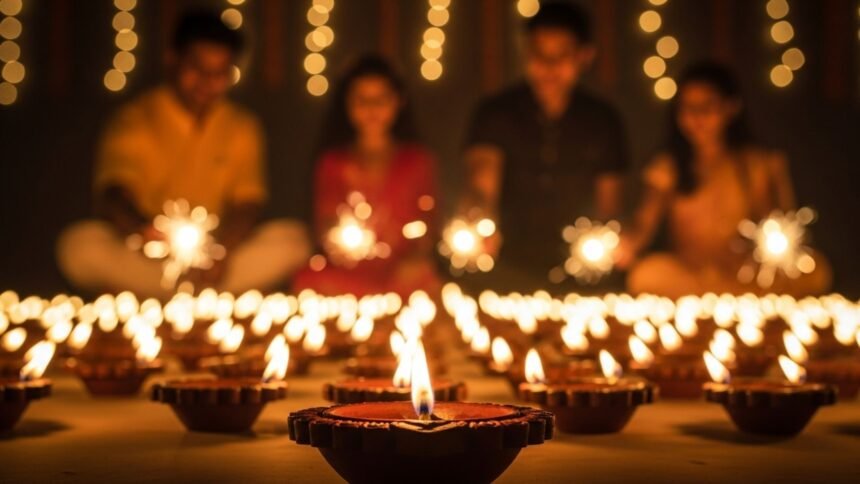
Even today, diaspora communities are creating new Diwali traditions, environmental consciousness has sparked a return from fireworks to clay lamps, and in pluralistic societies, it’s becoming a symbol of interfaith harmony.
Diwali’s real magic may lie precisely here—it’s a festival that constantly changes while preserving its core message: knowledge triumphs over ignorance, light over darkness, and community over isolation.
Also Read | Ayodhya Breaks Two Guinness Records as 2.6 Million Lamps Light Up Saryu Ghats