






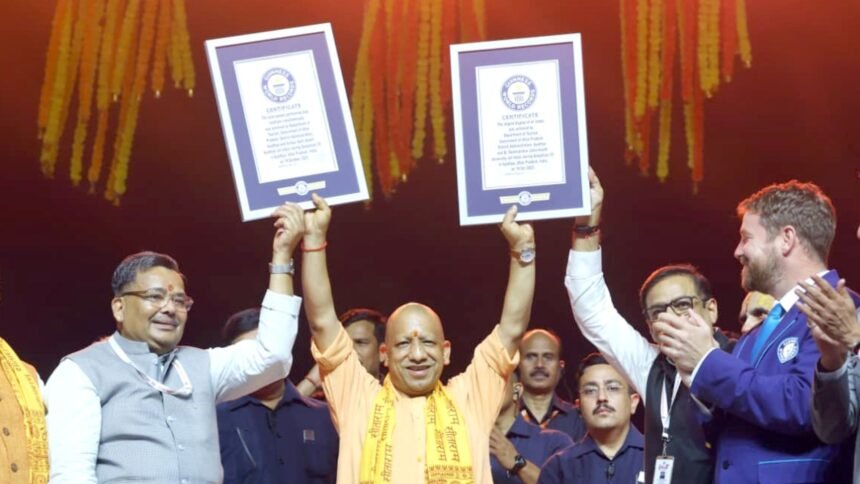
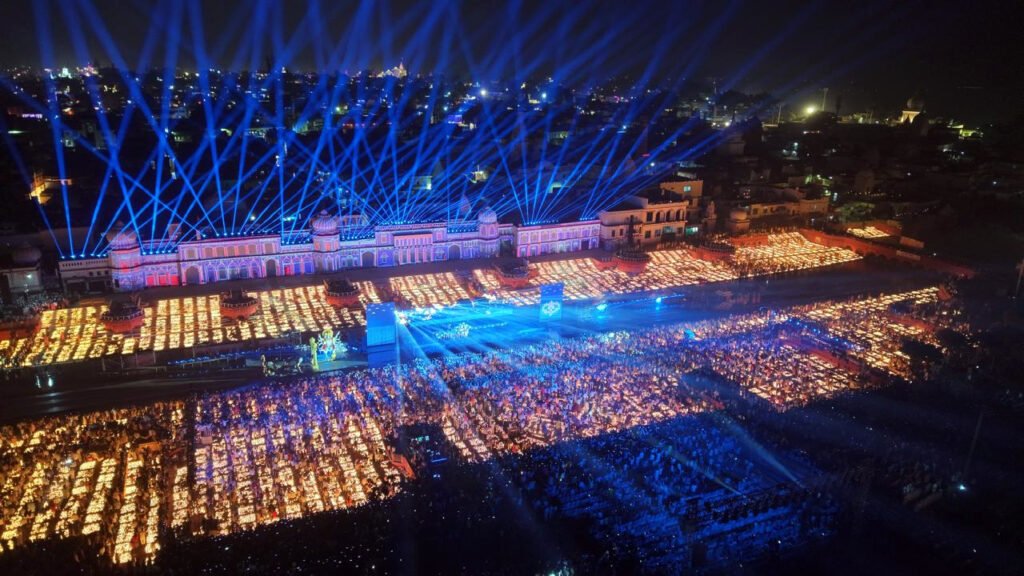
Ayodhya: Something remarkable happened here on Saturday night. More than 2.6 million earthen oil lamps flickered to life across 56 ghats. That wasn’t all 2,128 people performed aarti at the exact same moment. Two Guinness World Records. One incredible evening.
This is the ninth year Ayodhya has done this. But each year somehow feels bigger than the last. Chief Minister Yogi Adityanath showed up at Ram Ki Paidi and actually pulled a massive 32-foot chariot through the crowds himself.
“Look at these lamps,” he told everyone there. “Every single one represents 500 years of faith that refused to die.”
He’s not wrong. This year’s Deepotsav celebration means more than usual. Why? Because the Ram Mandir finally opened its doors on January 22, 2024. After five centuries of waiting, Lord Ram came back to his temple. This is just the second Deepotsav since that happened.
The Guinness people came prepared this time. Swapnil Dangarikar and Nischal Barot flew in to verify both records. Richard Stenning started checking everything the day before. They brought drones to count lamps from the sky. Smart move nobody’s counting 2.6 million lamps by hand. QR codes tracked the aarti participants.
Pravin Patel verified last year’s event. He said something interesting: “Numbers are important, sure. But you have to follow the rules too. Ayodhya nailed both.”
The certificates got handed over to CM Yogi. Tourism Minister Jaiveer Singh was there. So was Principal Secretary Amrit Abhijat. Last year they lit 2.512 million lamps. This year topped that by over 100,000. The aarti crowd almost doubled from 1,121 people to 2,128.
Where did all these lamps go? Ram Ki Paidi took the biggest chunk 1.6 million lamps right there. Extended Paidi got 425,000. Then Chaudhary Charan Singh Ghat had 475,000. Bhajan Sandhya Ghat displayed 525,000. Laxman Kila Ghat wrapped things up with 125,000 lamps.
Think about the logistics here. They used 73,000 liters of oil. Needed 5.5 million cotton wicks. Local potters spent months making 1.6 million lamps by hand. Families from Ayodhya, Jaisinghpur, Pura Bazar, and Gosaiganj all pitched in. Women’s groups across UP made the rest.
Prof. Sant Sharan Mishra from Dr. Ram Manohar Lohia Avadh University ran the show. He coordinated 33,000 volunteers. Students, teachers, regular folks from the neighborhood everyone helped out. Plus 10,000 security people kept things running smooth. They split the whole area into zones with people watching everything happen in real-time.
Back in 2017, they started with just 171,000 lamps. Watch how it grew: 301,000 in 2018. Then 404,000 in 2019. The first official world record came in 2020—606,000 lamps. That’s when they started using drones for counting.
Things really took off after that. Hit 941,000 in 2021. PM Modi came in 2022 when they reached 1.576 million. Diplomats from 54 countries showed up in 2023 to see 2.223 million lamps. Last year’s 2.512 million came right after the temple opened.
Do the math that’s 267 percent growth between 2020 and 2023. Growth has cooled off lately though. Went up 13 percent in 2023-24. Just 4 percent this year. Makes sense. The ghats only have so much space.
They really mixed the old with the new this time. A ‘Digital Bhavya Ramayana’ told ancient stories through 3D projections on huge screens. The drone show stole the spotlight 1,100 ‘Make in India’ drones drew Ramayana scenes across the night sky.
CM Yogi pulled that big Pushpak Viman chariot personally. Actors playing Ram, Sita, and Lakshman rode inside. Eighteen different displays showed Ram’s whole life story. Artists flew in from Myanmar, Nepal, Thailand, Malaysia, Cambodia, and Indonesia. Sixteen Indian states sent performers too.
The previous day, 21,000 devotees did Saryu Aarti all together. Another record there. Everything stayed eco-friendly—biodegradable materials only.
The Ram Mandir changed Ayodhya’s fortunes completely. Get this 238.2 million visitors came in just the first half of 2025. That beats the entire year of 2024, which saw 164.4 million people. Compare that to 2017 when only 17.8 million showed up for the whole year.
The city itself looks totally different now. Fresh highways connect it to major cities. A brand-new airport started operating. The train station got a full makeover. Local businesses can’t keep up with demand. Handmade lamps fly off the shelves. The hotel and restaurant business created 15,000 new jobs.
PM Modi called last year’s celebration “amazing, incomparable and unimaginable.” He added: “After 500 years, we’re celebrating with Shri Ramlala back in his magnificent temple. Ayodhya feels joy. All of India takes pride in this.”
This whole festival celebrates an ancient moment. Lord Ram returned home after spending 14 years in exile. He’d just defeated the demon king Ravana. The people of Ayodhya lit earthen lamps across their entire kingdom to welcome him back. That tradition became what we now call Diwali.
“Look what faith can do,” CM Yogi said to the crowds. “Took us centuries. But we brought back what we lost. Today Ayodhya shines bright. The whole world’s paying attention.”
Those 2.6 million tiny flames dancing along the riverbank tell quite a story. They speak about faith that survived 500 years. They speak about dreams that finally came real.
Also Read | Tiny Tuvalu Becomes Milestone 100th Nation to Join WHO’s Climate-Health Alliance