






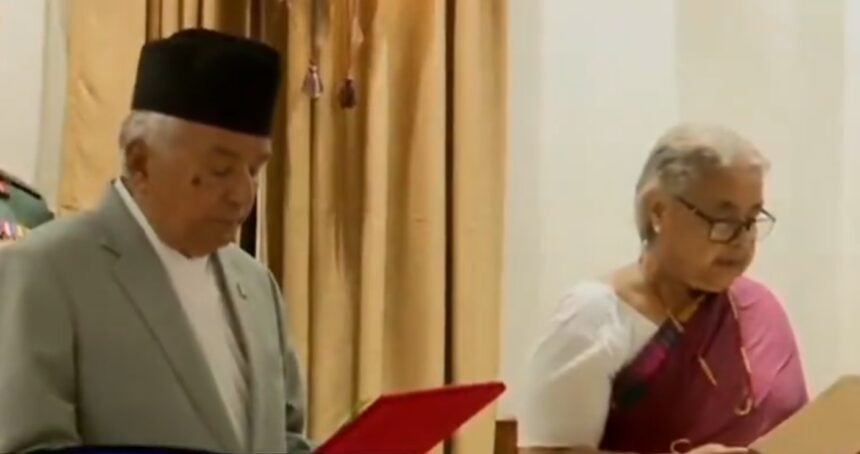
Kathmandu: In a historic development, Nepal has appointed Sushila Karki (73) as its interim Prime Minister, making her the country’s first-ever woman to hold the post. Karki, who earlier served as Nepal’s first woman Chief Justice, was administered the oath of office by President Ram Chandra Poudel late Friday evening after extensive consultations with protest leaders, constitutional experts, and the army chief.
Her appointment follows the dramatic collapse of the KP Sharma Oli government earlier this week, triggered by violent Gen-Z-led protests demanding accountability, good governance, and an end to corruption.
Appointment Under “Principle of Necessity”
Karki’s selection comes despite constitutional hurdles. Article 76 of Nepal’s Constitution allows only members of the House of Representatives to hold the post of Prime Minister, while Article 132(2) explicitly bars former Chief Justices from government office.
However, invoking the “principle of necessity”, authorities cleared the way for Karki’s appointment — a practice that has occasionally been used in Nepal’s history since the 1950s.
Mixed Legal Opinion, Broad Support
Constitutional expert Bipin Adhikari warned that reliance on necessity may erode constitutional norms: “If we abandon the Constitution under one pretext or another, a habit develops of violating it.” Still, he acknowledged Karki’s integrity and urged that the arrangement remain temporary until fresh elections are held.
Former Chief Justice Kalyan Shrestha described Karki as reliable and principled, while former Prime Minister Baburam Bhattarai lauded her appointment as a “positive and appropriate choice backed by the Gen-Z movement.”
Turbulent Backdrop
The protests that paved the way for Karki’s rise have left 51 people dead, including security personnel, and caused large-scale damage to property. Protest leaders insisted on new elections and a non-political interim head of government, ultimately settling on Karki as a consensus figure.
Observers stress that her interim government must not only prepare for polls but also prosecute those responsible for violence and address the protesters’ anti-corruption demands.
A Trailblazing Career
Born in 1952 in Biratnagar, Karki studied law at Tribhuvan University and political science at Banaras Hindu University before beginning her practice in 1979. Rising through the judiciary, she became Nepal’s first woman Chief Justice in 2016.
Her landmark rulings include the disqualification of anti-corruption chief Lok Man Singh Karki in 2017. Though she faced an impeachment motion that briefly suspended her, the Supreme Court reinstated her, solidifying her reputation as a defender of judicial independence.
Karki’s husband, Durga Subedi, was a Nepali Congress leader involved in Nepal’s first plane hijacking in 1973 to fund resistance against the Panchayat regime.
Looking Ahead
As Nepal’s first woman Prime Minister, Sushila Karki symbolizes both the turbulence and the hope of a nation in transition. While her appointment may be constitutionally unconventional, many see it as the product of a generational movement seeking a cleaner, more accountable Nepal.
— With inputs from IANS