






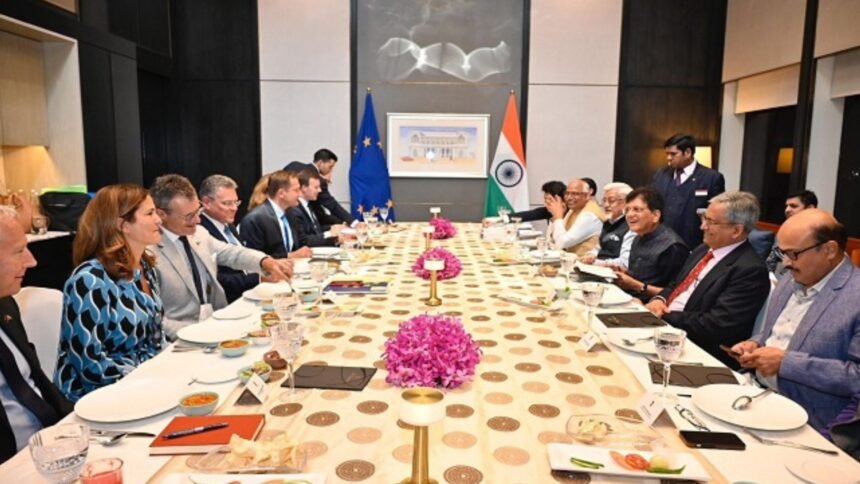
New Delhi: In a significant step towards reshaping global trade architecture, India and the European Union (EU) have reaffirmed their commitment to conclude the long-pending Free Trade Agreement (FTA) negotiations at the earliest. The announcement came after a high-level meeting in New Delhi, led by Commerce and Industry Minister Piyush Goyal and senior EU leaders.
The Core of the Negotiations
The FTA negotiations, ongoing for several years, are seen as crucial to bridging two of the world’s largest markets. Representing the EU side are Maroš Šefčovič, Commissioner for Trade and Economic Security, and Christoph Hansen, Commissioner for Agriculture and Food. Their two-day visit to India (September 12–13) underlines the urgency attached to the talks.
Piyush Goyal emphasized that the agreement, once finalized, would be “balanced and mutually beneficial,” offering opportunities for businesses and citizens across both regions. “A balanced FTA will open new avenues for trade, investment, and people-to-people engagement,” he said in a social media post after hosting a dinner for the EU delegation.
Why This Matters
- Economic Gains: A successful FTA could significantly reduce tariff and non-tariff barriers, boosting exports from both sides. For India, sectors like textiles, IT, and pharmaceuticals could see expanded market access. For the EU, agricultural products, high-tech goods, and sustainable energy technologies stand to benefit.
- Strategic Importance: At a time when global supply chains are being restructured post-pandemic, an India EU partnership could serve as a counterbalance to China’s manufacturing dominance.
- Sustainability Focus: Both sides have stressed the importance of incorporating environmental and labor standards, ensuring that trade growth aligns with sustainability goals.
The Diplomatic Dimension
The India–EU FTA is not just about economics it is about diplomacy. For India, closer alignment with the EU strengthens its global standing, diversifies its trade dependencies, and signals openness to new alliances. For the EU, partnering with India offers a strategic foothold in the Indo-Pacific, where geopolitical competition is intensifying.
Looking Ahead
While optimism is high, challenges remain. Contentious issues such as agricultural subsidies, data protection rules, and intellectual property rights continue to be debated. Yet, both sides appear determined to bridge differences in the spirit of cooperation.
If concluded, this FTA could reshape not only India–EU relations but also the global trade map, reinforcing the role of trade diplomacy as a key driver of 21st-century geopolitics.
— Source: Hindusthan Samachar