






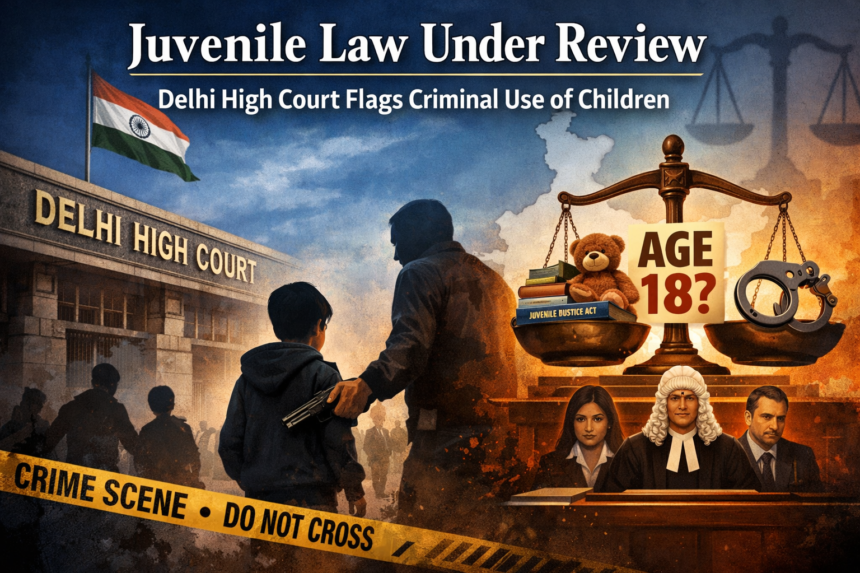
New Delhi, August 2025 – The Delhi High Court has raised serious concern over a growing problem: criminal gangs are increasingly using children to commit crimes. Because of this, the court suggested that India may need to rethink how the law defines who is considered a “juvenile.”
The issue came up during a case where an accused person was alleged to have used a child to transport a large quantity of illegal liquor. The court refused to grant him anticipatory bail.
While rejecting the bail request, Justice Girish Kathpalia pointed out that this is not an isolated problem. According to the court, children are being used not only to carry liquor or drugs, but also in cases involving weapons and even very serious violent crimes.
The judge said that forcing or encouraging children to take part in crime is more serious than the crime itself. He warned that criminal groups may be deliberately using minors because they know children are treated more leniently under the law.
Because of this growing misuse of children by organised criminals, the court said society may soon have to seriously reconsider whether the current age limit for juveniles under Indian law is still appropriate.
At the centre of this issue is how Indian law defines a “juvenile.” Under the Juvenile Justice (Care and Protection of Children) Act, anyone below 18 years of age is treated as a child in conflict with the law. However, if a child between 16 and 18 commits a very serious offence, the Juvenile Justice Board can first assess their mental and physical maturity. Based on this assessment, the child may be tried as an adult.
The current form of this law came in 2015, after the 2012 Delhi gang rape case, which triggered intense public debate. The law was shaped by the need to balance two concerns: protecting children and holding them accountable for serious crimes.
Over time, debates on juvenile justice in India have moved back and forth between being protective and being strict. Supporters of the law say it focuses on reforming young offenders and helping them return to society, which matches international standards like the UN Convention on the Rights of the Child. Critics, however, argue that using a fixed age limit of 18 can be too rigid. They say it does not always reflect how adolescents actually think, behave, or the ways in which they may be influenced or exploited by adults.
The High Court has not actually created or ordered the creation of any expert committee in this case. What the judges said came up while deciding a bail matter, not while hearing a separate case about whether someone should be treated as a juvenile.
Media reports about the order also do not mention any deadlines, committee members, or a formal plan to review the law. They mainly reflect the judges’ concern and frustration that courts are increasingly dealing with situations where juveniles are getting involved in serious crimes that are usually committed by adults and the law does not always handle these situations smoothly.
Basically, the court was expressing concern, not announcing a concrete legal reform
Voices Inside the Legal Debate
Courts and legal experts across India have been thinking carefully about how juvenile justice laws should be used. Many judges have said that these laws are meant to protect children, not punish them.
For example, in cases involving teenage relationships, some Delhi High Court judges have pointed out that the law should stop real exploitation, not turn consensual relationships between adolescents into criminal cases especially when there is confusion or uncertainty about age.
Courts have also stressed that juvenile law comes with strict safeguards. The Juvenile Justice Act clearly says that a child’s identity must not be revealed, so their privacy is protected. Judges have also ruled that once a Juvenile Justice Board decides someone is a juvenile, that decision cannot be casually changed or reopened.
All of this shows that the legal system is trying to find a balance between protecting children’s rights and ensuring responsibility where real harm exists. In some cases, when evidence was weak or unclear, high courts have acquitted adults accused under POCSO and similar laws. These judgments highlight the importance of strong proof and the need to clearly separate genuine abuse from consensual conduct.
Context Within Juvenile Justice System Trends
The Delhi High Court’s remarks come at a time when the juvenile justice system is already under heavy pressure. Across the country, thousands of cases involving children accused of offences are still pending before Juvenile Justice Boards. Because of these delays, many children wait for long periods before their cases are decided, which goes against the very purpose of the Juvenile Justice Act.
These delays are not happening without reason. Many Juvenile Justice Boards do not have enough members, basic facilities are lacking, and procedures move slowly. As a result, the system meant to protect and reform children often ends up keeping them stuck in the process for years.
This discussion is also not limited to Delhi alone. Courts across India, including the Supreme Court, have been examining similar issues under laws like the POCSO Act. Judges have raised questions about whether legal age limits and protections should better reflect how adolescents actually live and behave today while still ensuring that children are protected from abuse and exploitation.
This debate has now reached the highest court in the country and has led to calls for law reforms based on proper data and research, rather than assumptions, so that child protection laws remain fair, effective, and realistic.
Legal and Policy Implications
Changing the age that decides who is treated as a juvenile would affect many parts of the system.
The police and prosecutors would need clear rules to decide when a young person should be treated as an adult and when they should stay within the juvenile system. Juvenile Justice Boards would also see major changes in the number of cases they handle and how they make decisions.
This kind of change cannot happen without new laws. Parliament would need to amend the Juvenile Justice Act and possibly other laws like the POCSO Act and parts of the Indian Penal Code that depend on age limits. These changes would have to be drafted very carefully. Many experts warn that lowering the age could weaken the protections meant to keep children away from harsh punishment, unless the law also strongly focuses on reform and rehabilitation.
Local systems would also feel the impact. Juvenile homes, probation officers, and child welfare committees would need more staff, better training, and more resources to deal with the new rules and increased workload. Social services may come under extra pressure if more adolescents are pushed into systems designed mainly for adults.
Conclusion
The Delhi High Court’s concern about children being used by criminal gangs has started an important and sensitive debate about whether India’s current age limit for treating someone as a juvenile is still right. This issue is not simple. Any change to the law must be based on real data, an understanding of how children grow and think, and a careful balance between protecting children and holding them responsible for serious harm. In the coming years, it will become clear whether the court’s observations lead to actual changes in the law and a rethinking of how India deals with young people who come into conflict with the criminal justice system.
ALSO READ | Supreme Court Warns Airlines Over Festival Fare Hikes, Seeks Centre’s Stand