








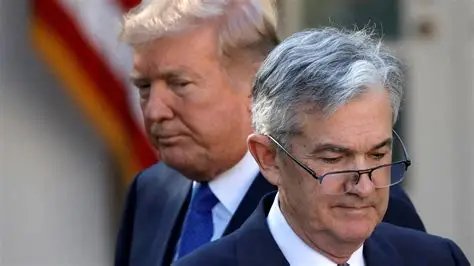
The latest clash between U.S. President Donald Trump and Federal Reserve Chair Jerome Powell marks the most serious escalation yet in a long-simmering conflict over U.S. monetary policy.
Powell said the Department of Justice on Friday served the Fed “with grand jury subpoenas threatening a criminal indictment related to my testimony before the Senate Banking Committee last June.” Federal prosecutors are conducting a criminal investigation of Powell relating to the $2.5 billion renovation to the central bank’s headquarters in Washington, D.C., and his related testimony to Congress.

The dollar weakened against major currencies, with the dollar index sliding 0.2 per cent in early trade. Sterling gained nearly half a cent to $1.3440, reflecting rising concerns that political interference may undermine the credibility of US monetary policy. On the other hand, the dollar also fell against risk-sensitive currencies like the Australian and New Zealand.
How and why Trump is breaking in the Fed
Trump’s confrontation with the Fed has followed a consistent pattern of public criticism, personal attacks on Powell’s competence and persistent demands for lower interest rates. What distinguishes the current episode is the shift from rhetorical pressure to the use of legal mechanisms. By opening a criminal probe tied to Powell’s official duties, the administration appears to be delegitimising the Fed’s leadership while building a narrative that justifies Powell’s removal or marginalisation.
Powell’s term as chair ends in May but he will remain on the board till 2026. Even if Trump lacks the legal authority to force Powell off the Board of Governors before 2028, sustained pressure could make Powell’s continued presence politically costly or operationally difficult. The broader message aimed not only at Powell but at all current and future Fed officials is: independence will be tolerated only so far as it aligns with Trump’s aims.
Trump is trying to break in the Fed before he faces mid-term elections by year-end. His desperation for lower interest rates is based on his hopes of a quick and easy rebound in the American economy.
Trump equates economic success with headline growth, rising stock markets and easy financial conditions. Lower interest rates deliver all three quickly. They stimulate credit, lift asset prices and support consumption, even if the underlying productivity gains are modest. For a president who treats markets as a real-time approval rating, rate cuts are the fastest way to engineer visible economic momentum. They work within months and are far easier than structural reforms.
The U.S. government is now carrying historically high levels of debt. Lower interest rates dramatically reduce the cost of servicing that debt, at least in the short run. Every percentage point cut in average borrowing costs translates into hundreds of billions of dollars in interest savings over time. Thus low rates allow more fiscal spending without immediate political pain. Also, lower interest rates tend to weaken the dollar. Trump has consistently complained that a strong dollar hurts U.S. exporters and worsens the trade balance.
Trump’s background in real estate shapes his worldview. Lower interest rates directly boost property prices, refinancing activity and construction. Trump believes that cheap money equals prosperity, even if it raises long-term risks.
If investors begin to believe that rate cuts are being forced prematurely, inflation expectations could rise even if headline inflation remains contained. Over time, this would demand higher risk premiums on long-term bonds, pushing up yields and increasing borrowing costs across the economy. Ironically, an attempt to engineer easier monetary conditions through pressure could result in tighter financial conditions as markets compensate for diminished trust in the Fed’s independence.
How will this affect India?
For India, the immediate consequences would come through global financial channels. A sharp fall in the U.S. dollar, combined with expectations of aggressive Fed easing, could initially benefit emerging markets by boosting capital inflows and supporting currencies like the rupee. Indian equities and bonds often respond positively when U.S. rates fall or are expected to fall, as global investors search for yield.
Lower U.S. rates directly reduce returns on dollar assets. Pension funds, hedge funds, sovereign wealth funds and global ETFs base their strategies on interest-rate differentials, currency expectations and growth prospects. If the Fed caves in to Trump’s bullying and cuts aggressively, U.S. Treasury yields will fall, dollar assets will become less attractive and capital will look for higher returns elsewhere. India, with higher real rates and deep markets, will attract capital flows from the U.S. And that’s just what it needs right now, after the record outflow of money in 2025.
Also Read| Donald Trump Declares Himself ‘Acting President of Venezuela, Incumbent January 2026’ in Viral Post