








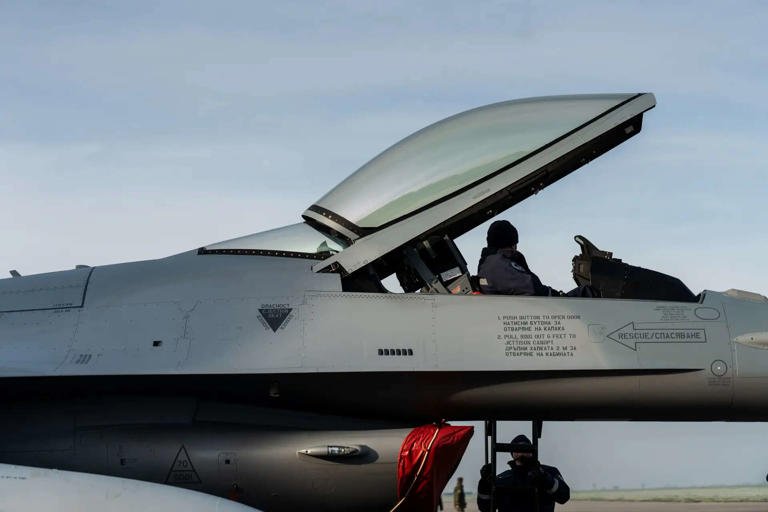
The Russia-Ukraine war escalated further as Russian forces claimed to have shot down a Ukrainian F-16 fighter jet, marking a significant blow to Ukraine and its Western allies. The F-16, a multi-role fighter supplied by the United States, was reportedly destroyed by Russia’s S-300 air defense system using just two missiles.
In an interview with Rossiya 1 TV, a Russian commander stated that the operation required extensive preparation, with the first missile damaging the aircraft and the second ensuring its complete destruction. “The enemy claimed this fighter jet could not be shot down, but in reality, they fall out of the sky like any other aircraft,” he said.
F-16 Loss Follows Missile Strike
Ukraine began receiving F-16 jets in August 2024. To date, Kyiv has received 44 of the 87 F-16 aircraft promised by European countries. Russia confirmed that this is the fourth F-16 lost in combat since deliveries began. This incident follows Russia’s recent use of the Oreshnik hypersonic missile in retaliation to a Ukrainian drone attack on President Vladimir Putin’s residence. The intermediate-range missile, capable of speeds ten times that of sound, can carry nuclear warheads, though no such warheads were reported in this attack.

The Russian Defense Ministry said the assault targeted critical infrastructure and included long-range drones and land and sea-based weaponry. The incident underscores the growing intensity of the conflict and raises questions about the effectiveness of air defenses and Western military aid in the ongoing war.
Ukrainian response
Ukraine’s military has not confirmed the Russian account. Instead, similar claims circulated on social media and Russian channels were labelled as disinformation by the Center for Countering Disinformation under Ukraine’s National Security and Defense Council (NSDC).
The NSDC noted that Russian sources have repeatedly spread unverified or false reports about F-16 losses, which Ukrainian forces have publicly debunked in recent months.
Ukraine’s Air Force emphasized that its F-16 pilots continue operations, and highlighted the aircraft’s broader role in air defence missions,including intercepting missiles and drones, rather than frequent air-to-air combat.
F-16s in the Ukraine war
Since their arrival, F-16 jets have been an important component of Ukraine’s aerial defence, supplementing Soviet-era systems and helping to plug gaps in counter-air operations. Ukrainian pilots have credited these fighters with intercepting hundreds of incoming missiles and drones during Russian offensives, even scoring “historic” successes in shooting down multiple cruise missiles in a single sortie.
Officials from Ukraine’s Air Force have also discussed the unique challenges of adapting NATO-style tactics to the reality of the conflict, including building new combat methods suited to missile-heavy engagements.
Conflicting reports
Disentangling fact from propaganda is particularly difficult in the Ukraine conflict, where both sides operate information campaigns alongside kinetic operations. Russian assertions about downed F-16s have precedents dating to earlier in the war, including claims that were repeatedly refuted by Ukrainian officials and independent observers due to lack of evidence.
At the same time, earlier confirmed incidents show that F-16 losses have occurred during combat operations, such as past missions where Ukrainian pilots were killed after jets were downed, though those involved distinct circumstances often attributed to intense Russian missile and air defences.
Why verification matters
From a strategic perspective, the actual loss of an F-16 would carry operational and symbolic significance. Ukraine’s F-16 fleet remains relatively small, reportedly dozens of aircraft, compared with the scale of Russia’s air defence and fighter forces. Any confirmed loss reduces defensive depth at a time when aerial threats remain intense.
Both Moscow and Kyiv seek to use reports of battlefield events to influence domestic and international audiences. Confirmed losses can shape foreign perceptions of air power effectiveness.
Western partners closely monitor how advanced systems like F-16s perform, informing decisions on further military aid and training programs.
Also Read| Indian Army Chief Shares ‘2 Turning Points’ During Operation Sindoor That Made Pakistan Surrender