







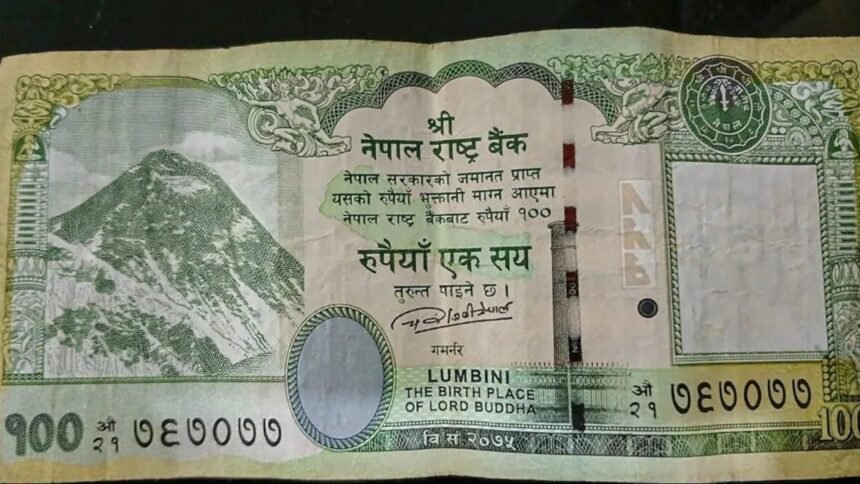
New Delhi: Nepal has introduced a redesigned ₹100 currency note featuring a political map that claims Limpiyadhura, Kalapani and Lipulekh—territories administered by India—within its borders. The new banknote, unveiled by the Nepal Rastra Bank on Thursday, incorporates the map that Kathmandu adopted in 2020 through a constitutional amendment, a move India had firmly rejected at the time as an artificial expansion unsupported by historical or administrative evidence.
India’s Response
India has issued a strong response to this development. In an official statement, the Ministry of External Affairs said, “Nepal is well aware of India’s consistent position on this matter and we urge the Government of Nepal to refrain from such unjustified cartographic assertion and respect India’s sovereignty and territorial integrity.” External Affairs Minister S. Jaishankar had earlier made it clear that “Nepal’s decision won’t change the facts on the ground.”
New Delhi’s position has remained unchanged since 2020—that the areas shown in Nepal’s map fall squarely under India’s sovereign jurisdiction in Uttarakhand’s Pithoragarh district. Indian officials have consistently argued that historical records, treaty interpretations and administrative continuity are in India’s favour, and that any boundary issue must be addressed through dialogue rather than unilateral moves.
Nepal’s Position
Nepal, for its part, maintains that the 1816 Sugauli Treaty identifies Limpiyadhura as the origin of the Kali River and therefore places the adjoining territory under Nepalese control. The government argues that the currency redesign merely aligns the national currency with the map already endorsed by the elected Parliament. Officials familiar with the matter in Kathmandu say this was a “constitutionally mandated update”, though analysts note that the timing revives a dormant dispute at a moment when Nepal is witnessing shifting political alignments internally.
Technical Details
The new note bears the signature of former Governor Maha Prasad Adhikari and is dated 2081 BS (Bikram Sambat), corresponding to 2024. The design features Mount Everest on the left side and a watermark of the rhododendron, Nepal’s national flower, on the right. At the center is a faint green map of Nepal along with the Ashoka Pillar, beneath which is inscribed “Lumbini, the birthplace of Lord Buddha.” The reverse side depicts a one-horned rhinoceros.
The contract for printing was awarded to China Banknote Printing and Minting Corporation, which was commissioned to produce 300 million notes at a total cost of approximately USD 8,996,592 (over NPR 1.2 billion).
Strategic Implications
The decision carries implications beyond symbolism. India and Nepal share an open border and deep cultural and economic linkages, and any move touching sensitive boundary issues often triggers public reactions on both sides. The inclusion of the disputed map on a circulating banknote could influence perceptions, especially in regions bordering the Himalayan frontier, where narratives of territory and identity often intersect with domestic politics.
The trilateral geography of the Lipulekh-Kalapani region also adds complexity, as the area lies close to the India-China-Nepal trijunction. While there is no direct evidence of external pressure behind Nepal’s decision, strategic observers say the political signalling could resonate beyond bilateral relations and may require careful diplomatic handling.
The Core Dispute
The disagreement stems from differing interpretations of the 1816 Sugauli Treaty, which established the Kali River as the western boundary between Nepal and British India. The crux of the dispute lies in identifying the precise origin of the Kali River. Nepal argues that the river originates at Limpiyadhura, placing approximately 370 square kilometers of territory—including Kalapani and Lipulekh—within its borders. India, however, maintains that historical surveys and the Governor General’s ruling of 1817 identified the Kalapani fountain as the source, placing these areas under Indian administration.
Expert Opinion
Foreign Affairs expert Robinder Sachdev cautioned, “India’s reaction should not be much louder or rhetorical, otherwise, political parties in Nepal will turn it into an issue of nationalism, especially those who are anti-India.” Former diplomat K.P. Fabian called for Nepal to “engage with India diplomatically, not just put an updated map on its currency.”
Congress leader Pawan Khera criticized the government, saying, “This is absolutely shocking. The government of India needs to act smart and tough.”
The Road Ahead
With the new currency now in circulation, attention turns to New Delhi’s forthcoming actions. India has already issued a formal protest urging Nepal to “create a positive atmosphere for diplomatic dialogue to resolve the outstanding boundary issues.” However, Indian officials may also weigh the broader political context before deciding on further engagement.
The two countries have not held structured border talks since the map dispute emerged in 2020, and the latest development could either reopen diplomatic channels or harden positions on both sides. India reiterated in August this year that border trade between India and China through Lipulekh Pass, which commenced in 1954, would continue, and that Nepal’s territorial claims remain “neither justified nor based on historical facts and evidence.”
For now, the redesigned ₹100 note stands as Nepal’s most visible declaration of its territorial claim—one that reignites an old disagreement and introduces a new layer of complexity to one of South Asia’s most delicate boundary conversations.
Note: The dispute concerns a border that stretches over 1,850 kilometers, connecting five Indian states—Sikkim, West Bengal, Bihar, Uttar Pradesh, and Uttarakhand—with Nepal. Among various banknote denominations issued by Nepal (₹10, ₹50, ₹500, and ₹1,000), only the ₹100 note features the country’s map.
Also Read | Trump Says South Africa Will Not Be Invited to 2026 G20 Summit Hosted in Miami