







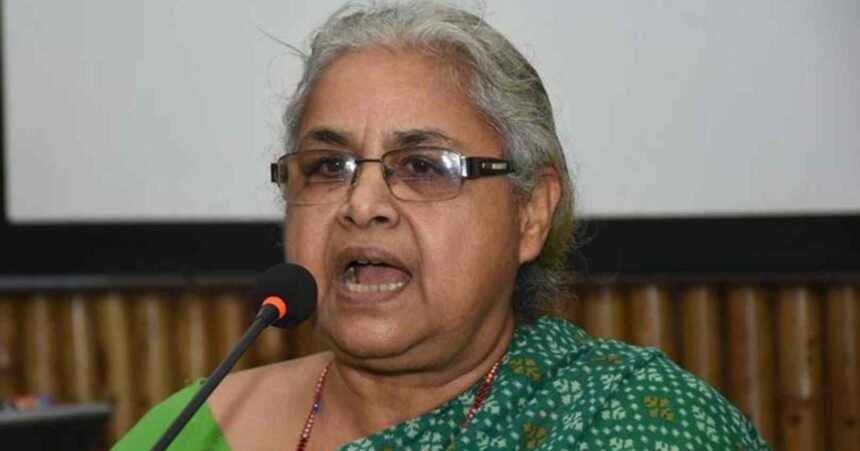
A jurist celebrated for integrity and independence, Sushila Karki now chosen by Gen-Z protesters may become Nepal’s first female interim Prime Minister.
Sushila Karki was born on 7 June 1952 in Biratnagar, Nepal. She pursued law at Tribhuvan University and later earned a Master’s degree in Political Science from Banaras Hindu University (BHU), India. After beginning her legal career in 1979, she steadily rose in the judicial ranks, becoming an ad-hoc Justice in 2009 and a permanent Justice in 2010 at Nepal’s Supreme Court.
On 11 July 2016, she was appointed as Nepal’s first female Chief Justice, a historic milestone for the country’s judiciary. Her tenure (2016–2017) was marked by landmark verdicts on corruption, transitional justice, and electoral disputes.
A Judge Known for Integrity
Karki’s tenure was not without challenges. In 2017, an impeachment motion was filed against her, widely criticized as politically motivated. Public outrage and judicial solidarity forced its withdrawal, solidifying her image as a defender of democracy and judicial independence.
Current Role Amid Crisis
Fast forward to 2025: Nepal is in turmoil after weeks of Gen-Z-led protests, violent clashes, and Prime Minister Oli’s resignation. The Army has stepped in to restore order, but protesters are demanding a non-partisan, trusted figure to lead a transitional government.
Among the names circulating, Sushila Karki has emerged as the leading choice. Protest leaders argue that her record of honesty, neutrality, and resistance to political pressure make her uniquely suited to guide Nepal through this crisis.
Why She Matters Now
Karki symbolizes something rare in Nepal’s politics—trust. At a time when political leaders are viewed as corrupt or compromised, she represents integrity and impartiality. Her potential appointment as interim Prime Minister would not only be historic but could also reset the trajectory of Nepal’s fragile democracy.
Conclusion
Sushila Karki’s story is one of resilience, courage, and moral authority. From breaking barriers as Nepal’s first female Chief Justice to now being considered for the country’s top political role, her journey embodies hope. For a nation battered by unrest, she may become the bridge between a turbulent present and a more accountable future.