





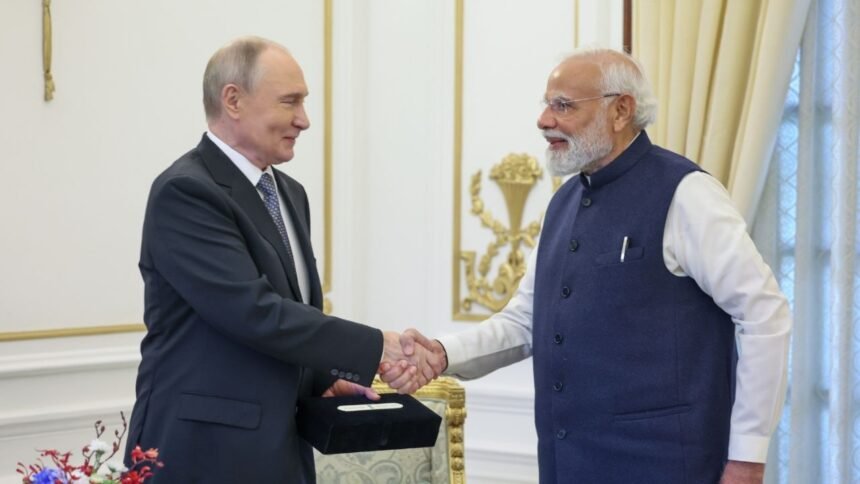
New Delhi, December 5: India and Russia on Friday concluded the 23rd Annual Bilateral Summit in New Delhi, reaffirming their long-standing “Special and Privileged Strategic Partnership” and unveiling an ambitious roadmap to deepen cooperation across defence, energy, trade, nuclear technology, space and emerging high-tech sectors.
Russian President Vladimir Putin visited India from December 4–5 at the invitation of Prime Minister Narendra Modi. The meeting marked the 25th anniversary of the Indo-Russian strategic partnership established in 2000, a milestone both leaders highlighted as a symbol of trust, mutual respect and shared geopolitical priorities.
A Relationship Resilient Amid Global Uncertainty
In their joint assessment, Modi and Putin noted that the India–Russia partnership has remained stable despite a turbulent international environment. They underlined that the relationship rests on “time-tested confidence,” respect for each other’s core interests, and complementary foreign-policy outlooks. Both leaders reiterated that their countries will continue working together to support global peace and stability based on equality, indivisible security and international law.
Major Agreements: Trade, Connectivity and Local Currency Settlement
The summit saw the adoption of the India–Russia Economic Cooperation Programme 2030, aimed at expanding bilateral trade, diversifying investment flows and accelerating industrial collaboration.
Key outcomes include:
- Commitment to balanced and sustainable bilateral trade, with priority on reducing tariff and non-tariff barriers.
- Agreement to strengthen logistics connectivity, especially via the International North–South Transport Corridor, the Chennai–Vladivostok maritime route, and the Northern Sea Route.
- Plan to expand local-currency trade settlement systems, linking national payment networks and exploring interoperability of digital currencies.
- Steps to secure India’s long-term fertilizer supply, including the possibility of joint ventures.
- New agreements enabling smoother skilled workforce mobility between both countries.
Both sides also welcomed the rise in business-to-business exchanges through platforms such as the St. Petersburg International Economic Forum and the Eastern Economic Forum.
Energy: Oil, LNG, Nuclear Power and Critical Minerals
Energy cooperation a pillar of the partnership received renewed focus.
- India and Russia agreed to ensure stable and uninterrupted supplies of crude oil, petroleum products, LNG and LPG to the Indian market.
- Discussions advanced on collaboration in underground coal gasification, petrochemical technologies and refinery investments.
- The leaders reviewed progress on the Kudankulam Nuclear Power Plant and confirmed timelines for equipment and fuel supplies.
- Both sides expressed interest in joint development of high-capacity nuclear reactors, localising components and expanding cooperation on the entire nuclear fuel cycle.
- They emphasised the strategic importance of critical minerals, agreeing to deepen joint exploration, processing and technology-sharing.
Defence and High-Technology: Co-Development at the Centre
The defence partnership historically the backbone of India–Russia relations is now shifting toward co-development and local manufacturing.
Highlights from the summit:
- Review of the 22nd meeting of the Inter-Governmental Commission on Military-Technical Cooperation.
- Agreement to advance joint R&D, co-production and technology transfer under the Make in India framework.
- Commitment to expand service, maintenance and spare-parts manufacturing for Russian-origin defence platforms in India.
- Continued participation in joint military exercises and exchanges between armed forces.
Space, Science and Emerging Technologies
India and Russia reinforced cooperation in:
- Human spaceflight, satellite navigation and planetary exploration.
- Joint work on rocket engine development and technology-sharing for advanced space systems.
- Collaboration in digital security, cybersecurity, critical infrastructure protection, and advanced materials.
- Supportive frameworks for start-ups, innovation ecosystems and high-tech manufacturing.
Cultural Exchange, Education and Tourism
Both leaders reaffirmed that people-to-people ties are central to the partnership. They welcomed:
- Rising cross-border tourism, supported by simplified visa processes including e-visa introduction by both nations.
- Plans for reciprocal cultural festivals, film cooperation and academic exchanges.
- Strengthened collaboration between universities, research centres and think tanks.
Shared Positions on Global Issues
India and Russia aligned their positions on several international concerns:
- Reform of the UN Security Council, with Russia reiterating support for India’s permanent membership.
- Combating terrorism and extremism, including condemnation of attacks in Pahalgam (India) and Moscow’s Crocus City Hall.
- Support for stability in Afghanistan, West Asia and the wider Indo-Pacific.
- Commitment to climate cooperation under the UNFCCC and the Paris Agreement.
- Continued collaboration in G20, SCO and BRICS.
Looking Ahead
President Putin thanked Prime Minister Modi for the warm hospitality and formally invited India to host the next annual summit in Russia in 2026.
The 2025 summit reaffirmed that despite global realignments and shifting geopolitical pressures, the India–Russia partnership remains broad-based, future-oriented and strategically significant grounded in a shared vision for a multipolar and stable world order.