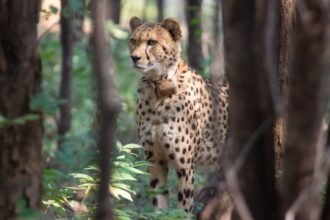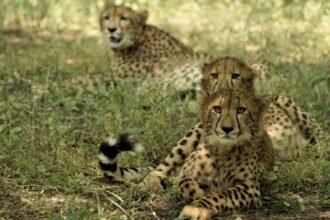








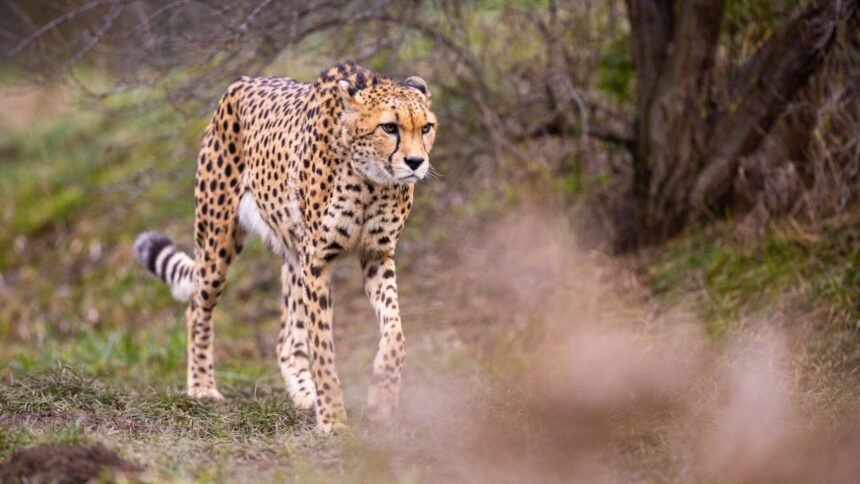
Bhopal/New Delhi: For the first time since cheetahs vanished from India’s forests in the early 1950s, the country now supports a growing population of these big cats. Under Project Cheetah, India currently has 27 cheetahs 11 adult animals brought from Africa and 16 cubs born in Indian habitats and is preparing to receive eight more from Botswana by December 2025.
The journey began in September 2022, when Prime Minister Narendra Modi released eight cheetahs from Namibia into Madhya Pradesh’s Kuno National Park on his 72nd birthday. It was hailed as the world’s first intercontinental relocation of a large carnivore. A second batch of 12 cheetahs from South Africa followed in February 2023, taking the total number of imported cheetahs to 20.
In the three years since, the project has been marked by both encouraging breakthroughs and painful setbacks. Around 27 cubs have been born in India so far, of which an estimated 16–19 are alive. This translates to a cub survival rate of about 61 percent — significantly better than the global average of around 40 percent. At the same time, nine of the original 20 adult cheetahs have died, due to complications linked to radio collars, difficulties in adapting to local climate conditions and other health and behavioural issues.
The first big turning point came in March 2023, when the Namibian female Jwala delivered the first cheetah cubs born in India in more than seven decades. Since then, four other females Aasha, Gamini, Veera and Nirva have successfully raised litters. In March 2024, South African female Gamini drew particular attention when she gave birth to six cubs in her very first litter, an unusually high number for a first-time mother.
Kuno National Park, with a core area of 748.76 sq km, remains the main hub of Project Cheetah and currently holds 25 of the 27 cheetahs. As numbers began to climb and space pressures grew, the project moved into its next phase. In April 2025, two males, Pawak and Prabhash, were shifted from Kuno to Gandhi Sagar Wildlife Sanctuary, also in Madhya Pradesh. This was the first expansion of the cheetah programme beyond Kuno. At Gandhi Sagar, about 8,900 hectares have been readied specifically for cheetahs, and 1,250 spotted deer have been released to build up the prey base.
Tourism, too, has begun to feel the impact of the cheetahs’ return. In October 2025, Kuno opened India’s first dedicated cheetah safari to visitors, signalling a new chapter where conservation, tourism and public awareness intersect more directly.
Looking ahead, several more landscapes are being lined up to receive cheetahs. Gujarat’s Banni Grasslands the country’s largest grassland system was declared fully prepared in July 2025, with infrastructure and prey populations strengthened. Work is also underway to ready Rajasthan’s Desert National Park and Madhya Pradesh’s Veerangana Durgavati Tiger Reserve for future introductions, as authorities move towards a multi-site, meta-population strategy rather than concentrating all animals in one park.
In early November 2025, the Environment Ministry confirmed that eight cheetahs from Botswana are scheduled to arrive by December and are currently in quarantine there. A memorandum of understanding with Kenya for future translocations has been largely negotiated and now awaits formal approval from the Kenyan government.
Conservation scientists say the project’s report card so far is mixed but promising. On the positive side, the high survival rate of cubs and repeated successful breeding within a short span suggest that cheetahs can adapt to Indian conditions and hunt local prey species. On the other hand, adult mortality, limited space in Kuno and pressures on prey base and habitat remain serious concerns. Many experts view the shift towards multiple sites across central and western India as an essential course correction.
Financially, the government has invested about ₹112 crore in the project to date, covering translocation, habitat management, infrastructure, monitoring and community engagement. The long-term goal is to build a founder population of roughly 50 cheetahs spread across several landscapes, creating a stable, free-ranging population over the coming years.
Cheetahs were officially declared extinct in India in 1952, after the last three Asiatic cheetahs were shot in Koriya district. For many wildlife enthusiasts, Project Cheetah is an attempt to repair that historical loss and restore a missing piece of India’s biodiversity. Local communities have also been drawn into the effort: more than 400 residents from 51 villages have been trained as “Cheetah Mitras” (Cheetah Friends) to help monitor the animals, spread awareness and support conservation work on the ground.
Ultimately, the fate of Project Cheetah will hinge on how effectively India can expand and connect habitats, maintain genetic diversity through partnerships with African nations, and manage the delicate balance between tourism, human activity and ecological needs. As the country prepares to welcome the new arrivals from Botswana, there is a palpable sense of cautious optimism that the fastest land animal on Earth may one day again become a familiar presence on India’s grasslands.
Also Read | Cheetahs Return to India: Everything to Know About the 2025 Cheetah Safari at Kuno