







Perth, October 19: The 42,423 fans who packed Optus Stadium on Sunday came expecting fireworks. They got drizzle instead. And when cricket finally happened between the rain delays, India’s batting lineup imploded in ways nobody quite anticipated.
Australia won by seven wickets in a match that felt smaller than it should have—reduced to 26 overs per side because Perth decided to forget it’s supposed to be sunny. India limped to 136 for 9. Australia knocked off a revised target of 131 in the 22nd over. Mitchell Marsh remained unbeaten on 46, steering his team home without drama.
For India, it was the kind of day where everything that could go wrong did. And the things that went worst? The names everyone had circled on their calendar.
When Stars Don’t Shine
Rohit Sharma walked out looking ready. He’d shown off his fitness in the leadup, dispelling whispers about his form. That optimism lasted about ten minutes.
Eight runs. That’s what Rohit managed before Josh Hazlewood got one to kick off the pitch at an awkward height. The nick flew to second slip. Gone. The dismissal had that scratchy quality of someone not quite seeing the ball properly, the kind of innings that ends before it begins.
But Rohit’s failure was gentle compared to what happened to Virat Kohli.
Zero runs. Eight balls. One horrible moment.
Kohli has history with Optus Stadium—the good kind. A magnificent Test century in 2018. Another ton here last year. He’d looked sharp in practice all week. None of that mattered on Sunday.
Hazlewood and Mitchell Starc worked him over with relentless accuracy, pinning him in his crease, forcing him to play at deliveries he might have left on a better day. Finally, Starc got him to chase one wide, drawing the edge. Cooper Connolly dove forward at backward point and held a brilliant catch.
The crowd stood and applauded as Kohli trudged off. Part respect, part sympathy. If this turns out to be his last appearance in Perth, nobody wanted it to end like that.
Captain’s Curse
Shubman Gill arrived carrying serious momentum. Five Test centuries in 13 innings since becoming captain. A Test win over West Indies just days earlier. His ODI captaincy debut should have been a celebration.
Instead, it became another statistic in India’s collapse.
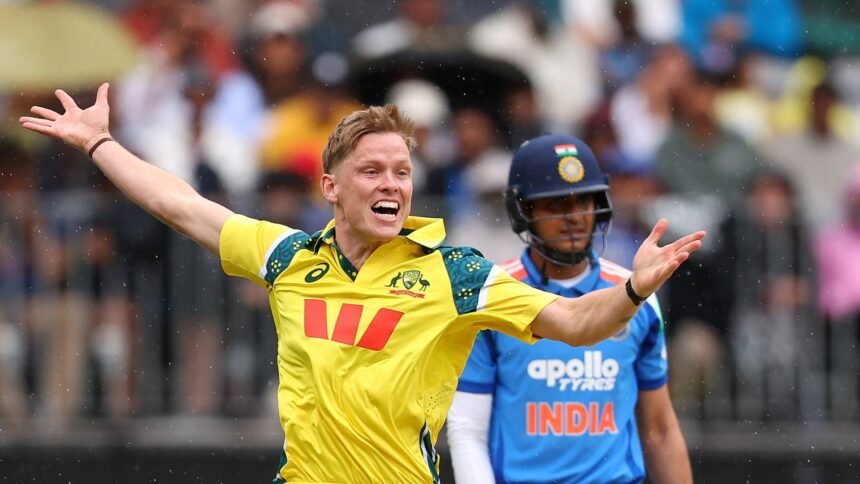
Gill started well enough—a gorgeous punch through the covers off Hazlewood showed his class. He battled through the tricky new-ball period, looking composed while wickets tumbled around him. Then Nathan Ellis came on and Gill tickled his very first delivery down the leg side.
Ten runs. One soft dismissal. First-ball wicket for Ellis.
India’s top four—Rohit, Kohli, Gill and Shreyas Iyer—combined for 26 runs. That’s not a batting order failing. That’s a batting order collapsing.
Hazlewood’s Masterclass
Some bowling performances are about wickets. Others are about control. Josh Hazlewood delivered both.
Two for 20 from seven overs tells part of the story. Thirty-five dot balls tells more. But watching him work was the real education—every delivery asking questions, exploiting Perth’s extra bounce, never letting batsmen settle.
Iyer fell to a nasty short ball that climbed on him, gloved to keeper Josh Philippe. Rohit got strangled by length and bounce. Both dismissals were textbook fast bowling on a helpful surface.
Left-arm spinner Matt Kuhnemann and debutant Mitchell Owen grabbed two wickets each as Australia’s attack carved through India’s lineup with surgical precision.
Rahul Fights Alone
KL Rahul top-scored with 38, which sounds modest until you realize nobody else crossed 40. With overs being chewed up by rain delays, Rahul knew caution was pointless. He smashed consecutive sixes that briefly woke up the predominantly blue-shirted crowd.
Axar Patel contributed at both ends—useful runs with the bat, decent control with the ball. ODI debutant Nitish Reddy provided a late cameo with some lusty hitting, but by then India were scrambling to reach 130.
They barely made it.
Australia’s Measured Chase
Chasing 131 should have been straightforward. Travis Head made it interesting by slashing Arshdeep Singh straight to deep third man early. Head’s been struggling lately, and Sunday didn’t help his case.
Marsh took his time initially—just two runs from his first nine balls. Once settled, though, he opened up. A massive six off Arshdeep over midwicket announced his intentions. Then came a helmet blow from Mohammed Siraj that would have rattled lesser players. Marsh shook it off like an inconvenience.
Matt Short wasted his opportunity at number three, falling tamely for 8 to Axar Patel, who was India’s best performer by a distance.
Josh Philippe made the most of his ODI recall after four years away. Thirty-seven off 29 balls, all swagger and timing. Earlier, he’d kept wickets cleanly, taking some sharp catches that helped Australia maintain pressure.
Matt Renshaw—making his ODI debut nearly nine years after his Test debut, which might be some kind of record—stayed unbeaten on 21 to finish things off alongside Marsh.
The Weather Story
Perth doesn’t do this. Rain delays. Covers coming out. Overs being reduced. It happens in Melbourne, sure. Sydney, occasionally. But Perth?
Sunday marked the first time since 1983 that an ODI in Perth was shortened by rain. It was also the first time Optus Stadium needed covers since opening in 2018. That’s how unusual these conditions were.
The stoppages clearly hurt India more than Australia. Every time they built a partnership, rain arrived to break momentum. Australia just had to knock off a modest total, and even they got interrupted mid-chase.
What It Means
For Australia, it’s the perfect series start—workmanlike, professional, job done. No heroics needed when the opposition hands you the game.
For India, the alarm bells are ringing. Champions Trophy winners in March, sure. But that feels like ancient history after watching your top four combine for 26 runs.
The series continues, and India will get chances to redeem themselves. But Sunday exposed uncomfortable truths. Rohit’s form remains questionable. Kohli’s vulnerability outside off stump hasn’t disappeared. Gill’s captaincy debut got swamped by batting failure.
The rain might have truncated the match, but it couldn’t hide India’s problems. Those will still be there when the next game rolls around, probably with sunshine and no excuses.
Australia won by seven wickets. The margin tells you nothing about how thoroughly they dominated.
MATCH SUMMARY: India: 136/9 (26 overs)
Top scorer: KL Rahul 38
Key dismissals: Rohit 8, Kohli 0, Gill 10
Best bowling: Josh Hazlewood 2/20 (7 overs, 35 dots)
Australia: 131/3 (21.5 overs)
Top scorer: Mitchell Marsh 46* (48)
Support: Josh Philippe 37 (29), Matt Renshaw 21* (32)
Best bowling: Axar Patel 1/28
Result: Australia won by 7 wickets
DLS Target: 131 runs from 26 overs
Venue: Optus Stadium, Perth
Attendance: 42,423
Also Read | Three Afghan Cricketers Die in Paktika Attack; Kabul Cuts Cricket Ties with Pakistan as India Offers Support