







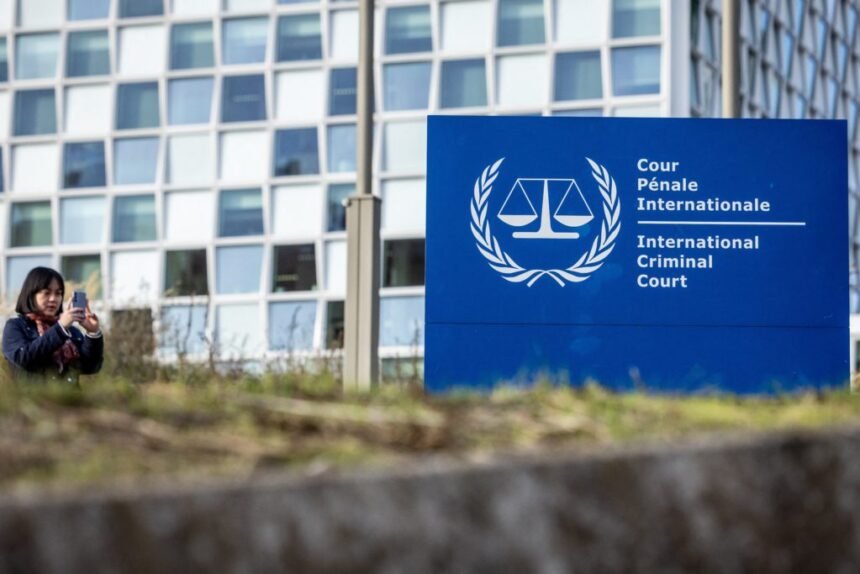
On 23 January 2025, the International Criminal Court (ICC) took an unprecedented step in the evolution of international criminal law. ICC Prosecutor Karim Ahmad Khan submitted formal applications to Pre-Trial Chamber II seeking arrest warrants for two of the most powerful figures in Taliban-ruled Afghanistan: Haibatullah Akhundzada, the Taliban’s supreme leader, and Abdul Hakim Haqqani, its chief justice. The applications allege that both men bear criminal responsibility for crimes against humanity arising from the systematic persecution of women, girls, and LGBTQI+ persons following the Taliban’s return to power in August 2021.
For the first time in the court’s history, the ICC explicitly framed gender-based and LGBTQI+ persecution as a central component of crimes against humanity, marking a decisive expansion in how international law understands and prosecutes structural oppression. The case signals that entrenched discrimination, when enforced through state-like power and coercion, is no longer merely a human-rights concern but a matter of international criminal responsibility.
Erasing Women from Public Life
Since the Taliban seized control of Afghanistan on 15 August 2021, the country haswitnessed a systematic dismantling of women’s and gender-diverse persons’ rights. According to the prosecutor’s filings, Taliban authorities imposed a dense web of decrees and practices that stripped women and girls of access to education, employment, freedom of movement, political participation, and bodily autonomy. Secondary and higher education for girls was banned, women were excluded from large sections of the workforce, and strict guardianship rules confined women to their homes unless accompanied by male relatives.
An Architecture of Gender Apartheid
These measures were enforced through intimidation, violence, and punishment. Women protesting peacefully against these restrictions were beaten, detained, and forcibly disappeared. Beauty salons were closed, public parks segregated or barred to women, and even women’s voices were ordered to be concealed in public spaces. Human-rights monitors have documented over one hundred Taliban decrees aimed at erasing women from public life, creating what many observers describe as an architecture of gender apartheid.
Targeted for Identity
For LGBTQI+ individuals, the situation has been even more precarious. Under the Taliban’s interpretation of Islamic law, same-sex relationships and gender non-conformity are criminalized, placing LGBTQ people at risk of violence, arbitrary detention, and execution. The ICC prosecutor’s application explicitly recognizes that individuals were targeted not only for who they are, but also for “not conforming to the Taliban’s ideological expectations of gender identity and expression.” This acknowledgment marks the first time the ICC has clearly situated LGBTQI+ persecution within the framework of crimes against humanity grounded in gender.
The Law Behind the Charges
The prosecutor’s case rests on Article 7(1)(h) of the Rome Statute, which defines persecution as the intentional and severe deprivation of fundamental rights against an identifiable group on discriminatory grounds. The filing argues that Taliban policies constitute gender persecution because they are widespread, systematic, and directed against civilians on the basis of gender, gender identity, and sexual orientation.
Importantly, the case does not isolate individual acts of abuse but treats the Taliban’s governance itself as a persecutory system. Alongside gender persecution, the prosecutor points to related crimes including murder, torture, enforced disappearance, sexual violence, and imprisonment, all committed as part of a coordinated attack on civilian populations.
Why the ICC Has Authority Over Afghanistan
Afghanistan’s legal relationship with the ICC provides jurisdictional grounding. The country acceded to the Rome Statute in 2003, granting the court jurisdiction over crimes committed on Afghan territory from May of that year onward. Although Taliban authorities reject the court’s legitimacy, the ICC’s jurisdiction remains unaffected by changes in government. Following years of preliminary examination and procedural delays, the investigation resumed in full in late 2022, culminating in the January 2025 warrant applications.
After reviewing the prosecutor’s submissions, ICC judges granted the requested arrest warrants on 8 July 2025. By doing so, the Pre-Trial Chamber formally recognized that there were reasonable grounds to believe Akhundzada and Haqqani committed crimes against humanity. While the warrants remain sealed for operational reasons, their authorization places both men under the shadow of international criminal accountability.
Justice Without Handcuffs
Enforcement, however, remains deeply challenging. The ICC has no police force and relies entirely on the cooperation of its member states to arrest suspects. The Taliban leadership remains within Afghanistan, beyond the court’s immediate reach, and has categorically rejected ICC authority. Nonetheless, the warrants significantly restrict theaccused’s international mobility and political legitimacy. Any travel through the territory of an ICC member state could result in arrest and transfer to The Hague.
Human-rights organizations and women’s advocacy groups have welcomed the ICC’s move as a long-overdue recognition of Afghan victims’ suffering.
Amnesty International described the applications as a source of hope for women, girls, and gender-diverse people who have endured years of repression without recourse. UN human-rights experts called the case a critical step forward, emphasizing that it confirms international law’s protection against persecution based on sexual orientation and gender identity. Afghan women’s rights activists, many now living in exile, have framed the warrants as a powerful moral and legal affirmation. For them, the ICC’s action punctures the Taliban’s claim to unchallenged authority and sends a message that silence and invisibility will not erase accountability.
Power Pushes Back
The Taliban, by contrast, dismissed the warrants as politically motivated and illegitimate, insisting that their governance is rooted in religious law beyond international scrutiny. Their rejection mirrors broader geopolitical tensions surrounding the ICC, which has faced criticism and sanctions from some non-member states unhappy with its pursuit of powerful actors. These pressures underscore the fragile position of international criminal justice in a world shaped by uneven political will.
Even if Akhundzada and Haqqani are never physically brought before the ICC, the significance of the case extends far beyond immediate enforcement. By recognizing systematic gender and LGBTQI+ persecution as crimes against humanity, the ICC has strengthened the normative boundaries of international law. It has affirmed that large-scale social exclusion, when imposed through coercive power, is not a cultural or domestic matter but an international crime.
Justice at the Edge of Power
The prosecutor has indicated that further applications against other Taliban officials may follow, expanding the scope of accountability. At the same time, parallel international mechanisms including UN treaty bodies and special procedures continue to scrutinize Afghanistan’s human-rights record, reinforcing pressure from multiple directions. The ICC’s pursuit of Taliban leaders exposes both the promise and the limits of international justice. Arrests may be difficult, trials uncertain, and political resistance intense. Yet the warrants themselves alter the legal and moral landscape. They signal that gender-based repression, even when normalized through governance, can trigger international criminal liability.
A New Chapter in Crimes Against Humanity
For Afghan women and LGBTQI+ individuals, the case represents more than legal symbolism. It marks a rupture in the cycle of impunity and affirms that their suffering is seen, recorded, and judged by the highest criminal court in the world. Whether or not the accused ever stands in a courtroom, the ICC’s action has already reshaped the global conversation on gender, power, and accountability and has written a new chapter in the law of crimes against humanity.
ALSO READ | Aravalli Hills in the Balance: Court Reconsiders 100-Metre Rule Amid Outcry