








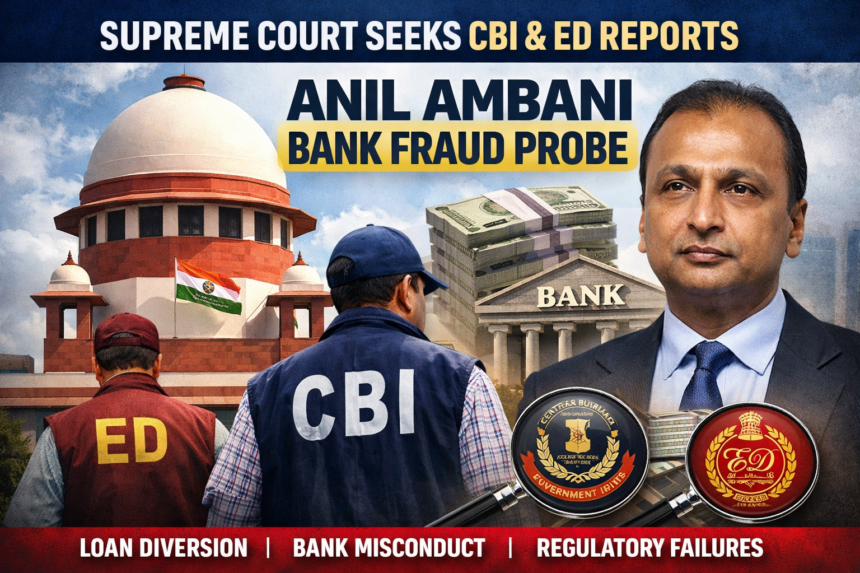
On 23 January 2026, the Supreme Court asked the CBI and the Enforcement Directorate to update it within ten days on how far they have progressed in investigating alleged large-scale bank fraud involving Anil Ambani and companies of the Anil Dhirubhai Ambani Group (ADAG). If the investigations are still not complete, the agencies have been told to submit their reports confidentially, in sealed cover.
The court also issued fresh notices to Anil Ambani and his group companies because they did not appear in earlier hearings.
The case is a public interest petition filed by former senior government official E.A.S. Sarma, who claims that this could be one of the biggest corporate banking frauds in India and has asked the court to closely monitor the investigation.
The matter was heard by a bench led by the Chief Justice of India, Surya Kant, along with Justice Joymalya Bagchi.
PIL and Advocate Submissions
Senior lawyer Prashant Bhushan told the court that the case is not about small irregularities, but about massive misuse of public money. He said that loans worth more than ₹1.50 lakh crore given by public sector banks to ADAG companies were later written off, meaning taxpayers ultimately bore the loss.
According to him, the money was allegedly moved around through shell companies and circular transactions to hide where it really went. He argued that the size and complexity of this alleged scam is even bigger than other well-known corporate fraud cases.
Bhushan also criticised the investigations by the CBI and the ED, saying they are too limited. He pointed out that these agencies are not examining the possible role of banks and their officials, even though banks had forensic audit reports flagging problems years ago. Despite this, no bank official or public servant has been made an accused so far.
Because of this, he asked the court to demand detailed reports from the CBI and ED explaining exactly what they have investigated and why action was delayed.
Solicitor General’s Position
The Solicitor General told the court that the Central Government, the CBI, and the ED were not disagreeing with the petitioner’s request for updated information. He explained that the case started after SBI carried out a forensic audit, which showed that money had been misused and diverted for purposes it was not meant for. Based on these findings, SBI filed an FIR with the CBI, which led to the investigation.
Notices, Non-Appearance and Next Steps
The court pointed out that even though notices were sent to Anil Ambani and his group in November 2025, they did not appear before the court or respond. The judges treated this as a serious issue. So, the court has sent fresh notices and asked the Registrar General of the Bombay High Court to personally make sure they are properly delivered and to report back to the court.
The court made it clear that this is the last chance for Anil Ambani and his group to appear and submit their replies. The case will be heard again after ten days. At that time, the court will look at confidential reports submitted by the CBI and ED, along with any replies filed by the respondents.
Background on the Allegations and Investigations
This case comes from serious allegations about how several Reliance group companies including Reliance Communications, Reliance Infratel, and Reliance Telecom took large loans from public sector banks, mainly State Bank of India, between 2013 and 2017.
Later, in 2020, SBI ordered a forensic audit. That audit reportedly found that loan money was misused and diverted, including being routed through related companies and fake or sham transactions. Even after these findings, SBI went to the CBI only in August 2025, which has raised concerns about why there was such a long delay and whether important lapses were ignored.
Based on media reports, the CBI’s FIR accuses the companies and individuals involved of criminal conspiracy, cheating, and breach of trust, causing an estimated loss of about ₹2,929 crore to banks. However, the petitioner argues that this amount may be only a small part of the actual wrongdoing and that the probe should also look at the role of bank officials and systemic failures that allowed this to happen.
At the same time, other agencies have been taking action. Over the past year, the Enforcement Directorate carried out raids at many locations linked to the Ambani group and has been investigating possible money laundering and loan diversion. The CBI has also registered other cases involving people connected to the group.
All these parallel investigations form the background against which the Supreme Court is now being asked to step in, to ensure a thorough and fair investigation into what went wrong and who is responsible.
Implications for Legal and Policy Landscape
The Supreme Court is making it clear that it wants to closely watch how big corporate fraud cases are being investigated, especially when public money and major institutions like banks are involved. By demanding regular progress reports and asking top corporate figures to personally appear, the Court is signaling that it will not blindly trust agencies and wants real accountability.
From a policy angle, if the Court decides to set up an independent expert panel or a court-monitored investigation, it could become a model for future cases involving large economic crimes. This would be especially important where agencies are accused of acting slowly, ignoring bigger links, or investigating only small parts of a larger fraud.
The case also raises uncomfortable questions about the role of bank officials, auditors, and regulators particularly why there are long delays between identifying fraud in audits and actually registering criminal cases. This could lead to stricter scrutiny of bank governance, compliance with RBI rules, and professional responsibility of those who were supposed to prevent or flag wrongdoing.
Right now, the matter is at a decisive stage. What the Court finds in the sealed reports and what comes out during upcoming hearings may determine whether it simply allows the investigation to continue or steps in with wider directions and systemic reforms to how economic crimes are handled in India.
ALSO READ | US Judge Blocks Deportation of Myanmar Migrants, Extends Protection Amid Ongoing Crisis