








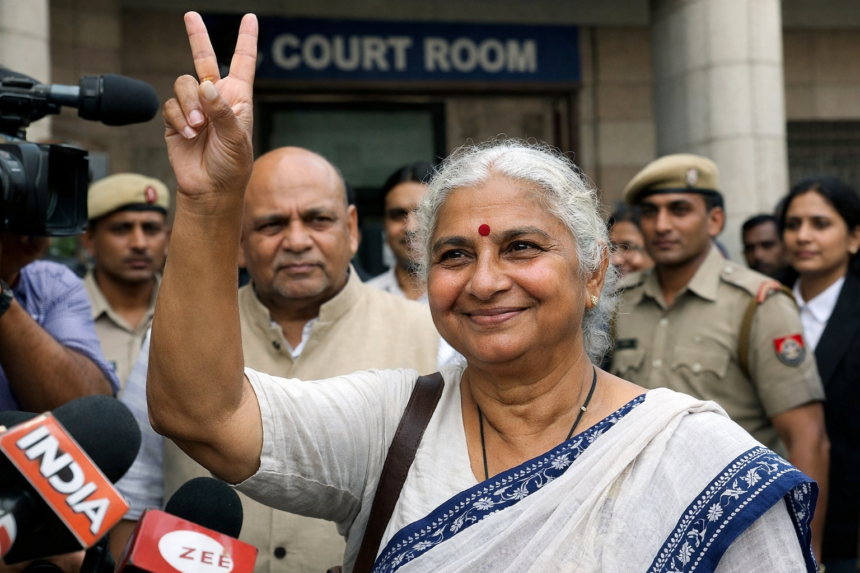
Introduction: A case that travelled two decades through Indian courts
This case shows just how tangled and long-drawn criminal defamation cases in India can be.
Medha Patkar, a well-known social activist, had been fighting a defamation case for almost 20 years. It started after a TV debate in 2006, where allegations were exchanged between her and V.K. Saxena, who is now Delhi’s Lieutenant Governor.
In January 2026, a Delhi court finally ended one part of this legal battle by clearing Patkar of criminal defamation in that case. This meant the court found that she should not be punished for what she said in that particular instance.
However, the story didn’t end there. In another connected case from the same dispute, the Supreme Court had earlier upheld her conviction but reduced the punishment by removing the ₹1 lakh fine.
Put together, these decisions show that criminal defamation cases in India can stretch over decades, move through multiple courts, and lead to different outcomes at different stages making the process slow, complicated, and emotionally draining for everyone involved.
Background: Who are the parties and what started the fight?
V.K. Saxena
At the time, V.K. Saxena was the President of the National Council for Civil Liberties (NCCL). He strongly supported the Sardar Sarovar dam project and openly opposed Medha Patkar and the Narmada Bachao Andolan. Later in his career, he became the Chairman of the Khadi and Village Industries Commission, and in 2022, he was appointed the Lieutenant Governor of Delhi.
Medha Patkar
Medha Patkar is a well-known social activist and the face of the Narmada Bachao Andolan. She has consistently opposed large dam projects, arguing that they displace poor communities and that the government has failed to properly rehabilitate affected people.
The Trigger Event: India TV programme, 20 April 2006
On 20 April 2006, India TV aired a show called “Breaking News”, hosted by Rajat Sharma. During the show, Medha Patkar was shown saying that V. K. Saxena had earlier published large newspaper advertisements against her. She said that she had filed a defamation case against him in a Delhi court in the year 2000, which was still pending.
She then alleged that although Saxena talked about civil liberties through an organisation, he had actually received civil construction contracts related to the Sardar Sarovar project. She claimed she had a CD and was ready to prove this allegation at any time.
V. K. Saxena immediately denied these claims on the same programme. Later, he stated that he had never received any contract connected to the Sardar Sarovar project. He said that Patkar’s statement was false, made without evidence, and that it harmed his public image and reputation.
Medha Patkar’s statement (as aired on TV):
Hindi:
“V. K. Saxena naam ke ek admi ne kuch salon pahle mere khilaf akhbaron me adha-2 page ke vigyapan diye the, jo purane patrakar hai unko malum hoga. 2000 ke saal me mene unke khilaf, delhi ke ek court me badnami ka a dawa lagaya hai jo abhi tak chal raha hai. Lekin V. K. Saxena ne baat ki National council of civil liberties ki lekin unhe mile sardar sarovar se sambhandit civil ke contracts, sardar sarovar se sambhandit civil ke contracts. Mai CD lekar ap sabke samne kisi bhi waqt prove karne ke liye tayar hun.”
English (rough translation):
“V.K. Saxena had given half-page advertisements against me in newspapers… In 2000, I filed a defamation case against him in a Delhi court… But V.K. Saxena spoke of National Council for Civil Liberties — yet he got civil contracts related to Sardar Sarovar… I am ready to prove this with a CD anytime.”
V.K. Saxena’s response:
Hindi (paraphrased from his denial):
“Maine Sardar Sarovar se sambandhit koi bhi contract nahi liya hai. Yeh dawa galat hai aur isne meri jan-samajh aur pratishtha ko nuksan pahunchaya hai. Yeh bayan bina kisi saboot ke diya gaya.”
English (translation):
“I never received any contract related to Sardar Sarovar. This allegation is false and has damaged my public reputation. The statement was made without any proof.”
Legal Action Begins: Criminal defamation complaint
A criminal defamation case started because someone allegedly committed defamation on 20 April 2006. The complaint was filed in June 2006. Later, the Supreme Court moved the case to a Delhi court in February 2010.
The case was filed under Section 500 of the Indian Penal Code (IPC), which deals with punishment for criminal defamation.
It eventually came before the JMFC-06 court in Saket, Delhi, with Judge Shri Raghav Sharma presiding. The case number was CC No. 618973/2016, and the final judgment was given on 24 January 2026.
What exactly was the legal issue?
To convict Patkar, the court had to prove three things:
- She made the statement on TV
- The statement was about Saxena
- She intended to harm, or knew it would harm, Saxena’s reputation
This follows the legal test under:
- Section 499 IPC – Definition of defamation
- Section 500 IPC – Punishment
Evidence from the prosecution (Saxena’s side):
- Saxena and his witnesses said that a TV clip showed Medha Patkar accusing him of getting contracts related to the dam.
- Saxena said he never got any such contracts.
- He claimed that because of this accusation, his reputation among friends and colleagues was harmed.
- To support his case, he presented:
- The TV footage showing the accusation
- Witnesses who said their opinion of him changed after seeing it
- A legal notice sent to Patkar asking her to provide proof of the claim
- In court, Saxena clearly stated:
“I have never received a single rupee from Sardar Sarovar Nigam for any contract.”
Defence side (Patkar)
Patkar’s lawyers attacked the case on multiple grounds:
- Incomplete and edited footage
- Only short clips were shown
- Full interview was never produced
- Context missing
- No proof of what question she was answering
- No proof of surrounding conversation
- No proof of intention to defame
- She said she was responding to allegations already made by Saxena
- Claimed public interest context
- Unreliable technical evidence
- Archive officer admitted raw footage was unavailable
- Differences in duration between copies
The India TV correspondent admitted:
“The complainant never asked for the unedited raw and complete footage… only the telecast version was given.”
Why Medha Patkar was acquitted:
- TV footage couldn’t be trusted
- The full raw video was never shown.
- Only short, edited clips were available.
- There were gaps and repeated parts, so it was impossible to see the full context.
- The court had doubts about whether the clips were authentic.
- No clear proof she meant to defame anyone
- For criminal defamation, it must be shown that someone knowingly made a false statement to harm another person.
- Patkar’s comments seemed to be part of a heated political debate, not an attempt to harm anyone.
- There was no proof she intentionally lied.
- Benefit of doubt goes to the accused
- In criminal cases, the court must be sure “beyond reasonable doubt” that the person is guilty.
- Since the prosecution couldn’t fully prove intentional harm, Patkar got the benefit of the doubt.
Final decision:
On 24 January 2026, the court said: “Accused is acquitted.”
The Supreme Court Angle: Conviction sustained, but fine removed
Earlier, Patkar was found guilty of defamation by a lower court. Later, when the case went to the Supreme Court:
- The Court agreed that technically, defamation had happened.
- But it cancelled the ₹1 lakh fine, saying it was too high.
This means the courts accepted that the law was broken but were careful not to punish too harshly, especially when it involved political speech.
Key judges, lawyers, and benches involved
Trial Court (Acquittal – 2026)
- Judge: Shri Raghav Sharma, JMFC-06, Saket Courts
- Complainant: V.K. Saxena
- Accused: Medha Patkar
Supreme Court (Earlier stage)
- Bench details not in this file
- Result: Conviction sustained, fine removed
Legal Principles Applied
Criminal defamation is hard to prove
- For someone to be convicted under Sections 499–500 of the IPC:
- The statement must be false.
- It must harm the person’s reputation.
- It must be made intentionally or knowingly.
- Just criticizing someone or accusing them politically does not count as defamation.
Electronic evidence must be complete and reliable
- Courts rely on Section 65B of the Evidence Act, which sets rules for electronic proof.
- Missing original footage raises doubts.
- Edited videos alone cannot be the only reason to convict someone.
- This is an important lesson for cases involving media or online content.
Political and Legal Implications Going Forward
Less fear in speaking freely
- The acquittal makes it safer for people to speak up in political debates.
- Activists and journalists get more protection.
- Politicians will have a harder time winning defamation cases.
Warning for media outlets
- Courts showed that sharing only part of a video can be risky.
- Full footage and proper context are important.
- Losing or mismanaging archives can ruin a case.
Defamation law discussions restart
- The case highlights that criminal defamation is often misused by powerful people.
- Long legal battles can feel like punishment on their own.
- Fines or jail for speech should be rare.
Conclusion
After 20 years of legal battles, the trial court acquitted Medha Patkar because the evidence against her was weak and incomplete. Earlier, the Supreme Court had upheld her conviction but reduced the punishment. The case shows that criminal defamation law often struggles when political issues are involved. In the end, the courts made it clear that false allegations can amount to defamation, but the evidence must be strong, the full context must be considered, and any punishment should be reasonable. This case will remain an important reference for political defamation, using media as evidence, and conflicts between activists and the state in India.
ALSO READ | UN Inquiry to Scrutinize Violence by State and Non-State Actors in Israel-Palestine