






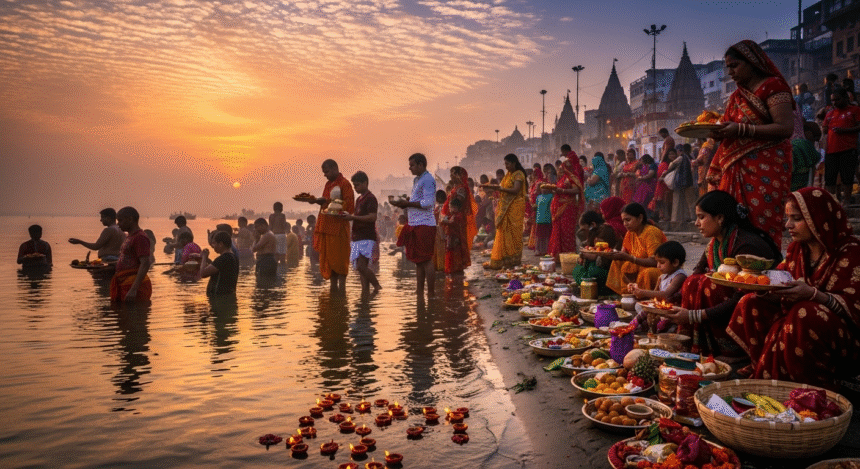
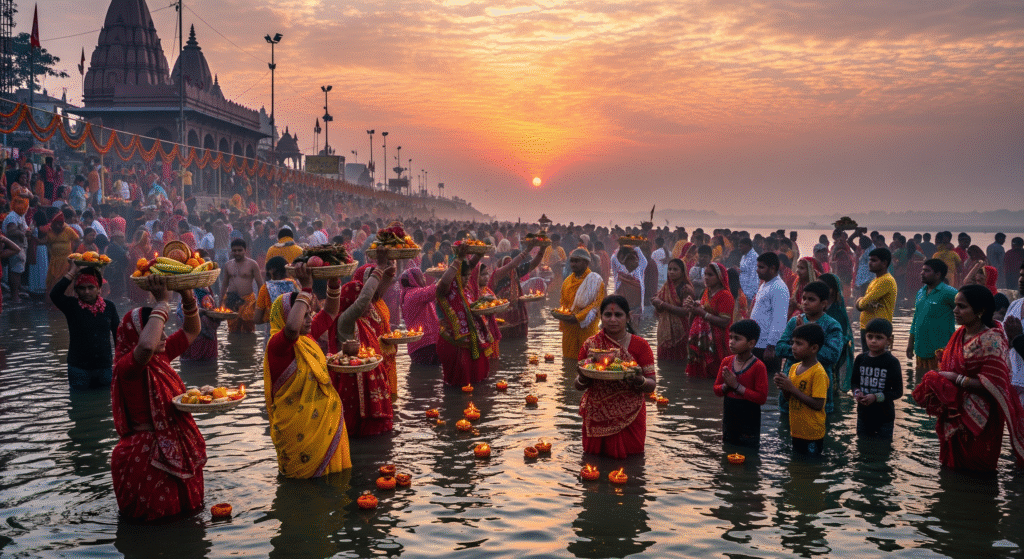
Patna: When entire Bihar descends to river ghats, when millions of men and women stand knee-deep in cold water offering arghya to the setting and rising sun, it’s no longer just a religious ritual. It becomes Bihar’s cultural heartbeat Chhath Mahaparva.
This is no ordinary festival. It’s a celebration where there’s no priest, no temple, no idol. Direct dialogue with nature. Direct salutation to the sun. And behind this lie thousand-year-old stories, deep scientific reasons, and an unbreakable social bond.
Tradition from Vedic Times
Chhath’s roots go back to the Rigveda. When Surya Suktas were written in the Vedas, the sun was considered the giver of life. But Chhath’s biggest specialty is that it needs no middleman. No priest, no temple. Directly under the open sky, in the open river, with an open heart offering to the Sun God.
“This tradition of water offering is part of that Vedic practice where natural forces were directly invoked,” explains Patna’s Vedic scholar Dr. Ramnath Jha.
Ram Also Observed Chhath Vrat
Mythology says that when Lord Ram returned to Ayodhya after conquering Lanka, he and Sita observed a fast on Kartik Shukla Shashthi. They worshipped the setting sun and offered arghya to the rising sun the next day.
In Bihar’s Munger, there’s still a ‘Sita-Charan Temple’ claiming to have Sita’s footprints. Local belief is that Sita performed Chhath puja for six days on the Ganga bank here.
Chhath is also connected to Mahabharata. Surya-putra Karna used to stand in water for hours daily offering arghya to the sun. Even today, the method of offering arghya in Chhath is considered Karna’s tradition.
Chhathi Maiya: The Goddess Who Protects Children
Chhath isn’t just sun worship, it’s also worship of Chhathi Maiya. Puranas tell of King Priyavad. He was childless. Through yajna he got a son but born dead. When he was about to sacrifice his life in the cremation ground, a goddess appeared from the sky Devi Shashthi.
“I emerged from the sixth aspect of creation’s original nature,” she said. “I am Brahma’s mental daughter Devsena. I protect all children.”
The king worshipped the goddess and got a healthy son. Since then the Chhath tradition began for protection and prosperity of children.
In folk belief, Chhathi Maiya is considered Sun God’s sister. That’s why her brother Sun is worshipped to please her.

Four Days of Rigorous Sadhana
Chhath isn’t a one-day festival, it’s four days of penance.
Day 1 (Nahay-Khay): Devotees take holy bath and eat satvik food. Day of purification.
Day 2 (Kharna): All-day waterless fast. Evening the fast breaks with jaggery kheer and roti. After this begins the 36-hour nirjala vrat—without food, without water.
Day 3 (Sandhya Arghya): Evening offering to setting sun. Going to the river with bamboo basket containing thekua, fruits, sugarcane. Standing knee-deep in water, offering water to the setting sun. All-night vigil.
Day 4 (Usha Arghya): Morning offering to rising sun. Only then the fast breaks. Prasad is consumed.
Science Also Acknowledges Chhath’s Benefits
From modern science’s perspective, Chhath is a perfect detox program.
36-hour fast: Scientific research shows long fasting activates the ‘Autophagy’ process. In this, body’s cells clean their own old, damaged material. New cells are formed. Immune system strengthens.
Sunrise-sunset timing: It’s no coincidence that Chhath offers arghya to the sun at these two times. At this time, sun’s ultraviolet rays are least harmful. Body’s Vitamin D synthesis is maximum. Bones strengthen. Mental health improves.
Water therapy: Standing in cold water for hours is a type of hydrotherapy. Blood circulation improves. Muscle tension reduces. Water’s calming effect relaxes the mind.
“Chhath is a carefully designed four-day psycho-physical rejuvenation therapy,” says AIIMS Patna’s Dr. Anil Kumar.
Beyond Caste-Class: Festival of Equality
Chhath’s greatest strength is its egalitarian nature. At the ghat, there’s no difference between rich-poor, high caste-low caste. All standing in the same water. All offering arghya to the same sun. Everyone holding similar prasad.
“At the river ghat, someone’s a CEO, someone’s a laborer but both are equal. This breaks social barriers,” says sociologist Dr. Priya Singh.
Sharda Sinha: Voice of Chhath
Chhath’s soul resides in its songs. ‘Kelwa Je Farela Ghawad Se’, ‘Kaanch Hi Baans Ke Bahangiya’ these songs echo in every home. And these songs were immortalized by ‘Bihar Kokila’ Sharda Sinha.
For decades, her voice was synonymous with Chhath. For migrant Biharis, her songs are a medium to remember home and connect with culture.
From Ganga Ghat to Global Stage
Today Chhath isn’t limited to Bihar. In Delhi, Mumbai, Bangalore on Yamuna and lakes. In America, UK, Australia, Dubai in parks and artificial ponds. Wherever migrant Biharis went, they took Chhath along.
On urban apartment rooftops, Chhath is being celebrated with inflatable pools. Live streaming is happening on social media. Politicians are arranging special facilities at ghats.
This evolution is proof of Chhath’s vitality. But with it comes a challenge how to preserve its original folk character. The river’s collective experience, simplicity, priest-free tradition how to save all this?
A Living Heritage
Chhath isn’t just a festival, it’s a life philosophy. It teaches respect for nature, power of discipline, divinity in simplicity.
Today when the whole world talks about sustainability and wellness, Chhath has been doing this for thousands of years. Without any show-off. Without any commercials.
Just one sun, one river, one arghya. And an unbreakable faith.
Also Read | Where Two Rivers Meet to Form Ganga: The Timeless Story of Devprayag