








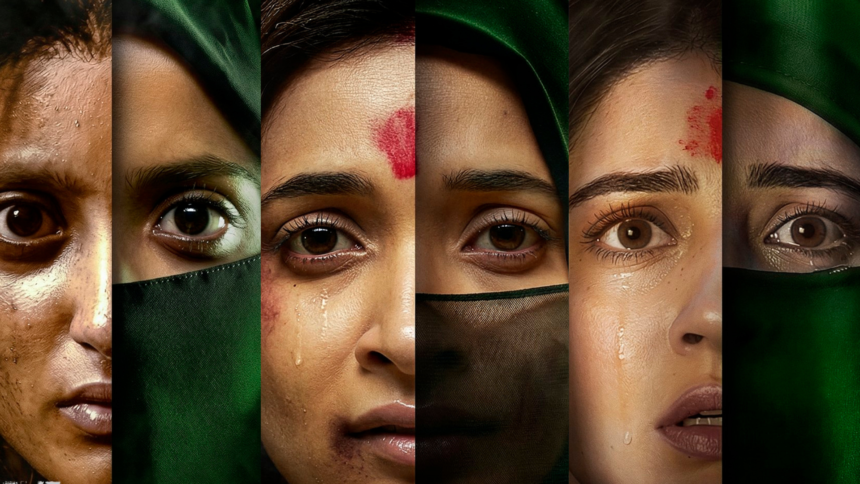
When The Kerala Story released in 2023, it did not arrive quietly. Rather, it directly plunged into one of the largest political and cultural hurricanes that Indian cinema has experienced in decades. Almost three years later the news of its follow-up The Kerala Story 2 has once again reopened that debate.
The central question now is simple yet powerful: can controversy alone carry a film into a franchise?
A Film That Divided the Nation
Directed by Sudipto Sen and produced by Vipul Amrutlal Shah, The Kerala Story claimed to tell the story of young women from Kerala who were allegedly coerced into religious conversion and radicalisation. The film also caused widespread outrage even prior to its theatrical release in part due to its initial suggestion that 32,000 women had been impacted.
This figure was instantly disputed by the journalists, fact-checkers, and political leaders, who noted that there was no proven information to prove such a significant figure. The makers responded to the backlash by revising their promotion and explaining that the story was based on a handful of individual cases, and not thousands.
Despite these clarifications, protests erupted across multiple states. Kerala Chief Minister Pinarayi Vijayan came out strongly to condemn the movie terming it as politically inclined and likely to break social peace. Legal petitions were also lodged and in certain places the movie was screened provisionally, but finally courts permitted release of the film.
What Was the Film Really About?
The Kerala Story, at its most basic, was a fictional account of the lives of three women whose lives run out of control after they were purportedly manipulated and radicalized. The movie placed itself as a warning story, with emotional pain, loss of identity, and individual tragedy.
The film was applauded by its supporters as it has brought attention to the issues of radicalisation and human trafficking and is a bold and necessary film. Critics, though, suggested that it depicted an whole community in a bad light and was based on overstated assertions, simplifying a complex issue into a simple political message instead of an actual story telling.
Controversy as a Box Office Engine
Ironically, the intense storm surrounding the film became its strongest promotional force. Made on a relatively modest budget, The Kerala Story went on to collect over ₹300 crore worldwide, emerging as one of the highest-grossing Hindi films of 2023. The movie subsequently won National Film Awards in the category of Direction and Cinematography which once again sparked political and societal controversy.
This trajectory closely mirrored earlier controversial hits, where polarisation created massive public curiosity, and that curiosity translated directly into ticket sales.
Critics vs Audience: A Sharp Divide
While box office figures told one success story, public opinion painted a far more complex picture. Numerous critics termed The Kerala Story as propaganda-based, saying it overstated serious matters and endangered communal conflict. These concerns were reflected in several publications abroad apprehending the extended social consequences of such narratives.
On the other hand, a significant portion of the audience was on the side of the film, claiming that it was courageous, eye-opening and socially significant. This intense polarization gave rise to intense arguments in news outlets and social media, and ensured that the film remained high on the agenda even long after its premiere.
In a word, the film became a cultural flashpoint rather than just a cinematic event.
Why a Sequel Was Almost Inevitable
In commercial cinema, controversy combined with massive profits usually signals one thing: a sequel. It is now reported that The Kerala Story 2 was shot in high security and will be released in theaters in February27, 2026. The makers have promised a darker and more intense narrative, although storyline details remain tightly guarded.
According to early teaser responses, the sequel will take what it established in the previous instalment and drive it to even greater extremes, making the movie once again the focus of ideological discussion. In the case of producers, it is a simple game of logic: once a controversial story has proven to be commercially successful, it is time to develop the narrative into a franchise.
Do Polarising Films Naturally Turn into Franchises?
Not always, but recent trends suggest a growing pattern.
Films that are based on politically charged storylines do well on the debate front. Strong support from one section of society and intense criticism from another create sustained attention, ensuring prolonged visibility and conversation.
This environment naturally supports sequels, as emotional investment already exists, whether in admiration or opposition. The risks are however equally great. Follow-ups can be easily undermined by audience fatigue, a growing degree of scepticism, and possible backlash.
Can The Kerala Story Truly Become a Long-Term Franchise?
The success of The Kerala Story 2 will likely depend on two crucial elements: storytelling depth and emotional sensitivity.
When the sequel becomes excessively shock-centered and ideological, it might not be able to replicate the box office success of the original film. Nevertheless, when it aims at more in-depth character lines, emotional realism, and subtle narration, it may attract viewers on either side of the polarisation.
What remains undeniable is that The Kerala Story is no longer just a film. It has become an icon of a great cultural and political sign, and its follow-up now has to bear the burden of this heritage.
Final Word
The journey from The Kerala Story to The Kerala Story 2 reflects a significant shift in Indian cinema, where controversy is no longer seen purely as a risk but increasingly as a business strategy.The question of whether this model will be able to maintain a long-term franchise is yet to be answered. However, there is one thing that is definite and that is the polarising of cinema has changed the way stories are sold, watched and discussed in India.
And in that sense, The Kerala Story 2 is not merely a sequel. It is a litmus test of how far controversy can carry a cinematic universe.
Also Read | The Kerala Story 2 Goes Beyond: Makers Unveil Intense Character Posters of Ulka Gupta, Aishwarya Ojha and Aditi Bhatia