








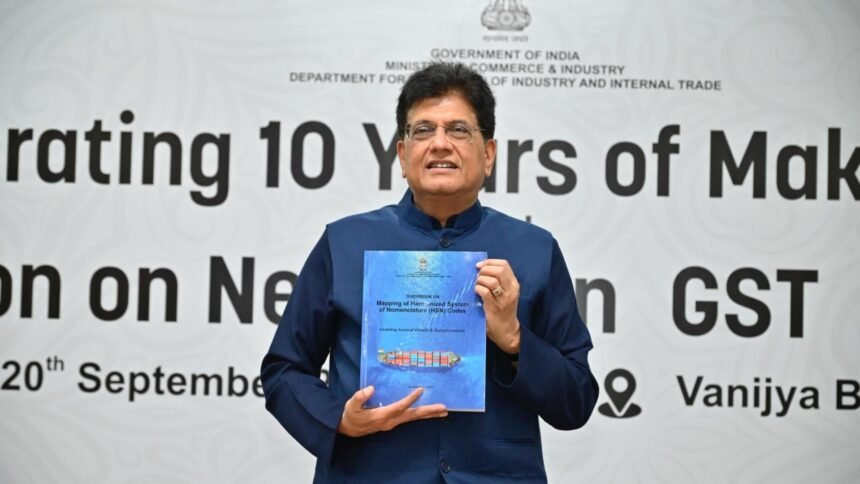
New Delhi: Union Minister of Commerce and Industry, Shri Piyush Goyal, has unveiled the Guidebook on Mapping of Harmonized System of Nomenclature (HSN) Codes, a milestone initiative prepared by the Department for Promotion of Industry and Internal Trade (DPIIT). The guidebook, launched on September 20 during an event marking 10 Years of Make in India and Next Gen-Reforms 2.0 in New Delhi, provides the allocation of 12,167 HSN Codes to 31 Ministries and Departments, ensuring sharper policy interventions and more effective trade negotiations.
Highlighting its significance, Shri Goyal emphasized that the guidebook represents a crucial step in strengthening domestic manufacturing capabilities, streamlining regulatory processes, and enhancing the ease of doing business. By identifying the relevant Ministry or Department for each HSN Code, the initiative resolves persistent challenges faced in trade negotiations, import substitution, and industry redressal, where unmapped codes often created confusion and were relegated as “residual products.”
The DPIIT undertook a comprehensive process to develop the guidebook, including value-chain and use-case analysis of each HSN Code sourced from the CBIC Tariff Manual, a detailed review of the Allocation of Business Rules, 1961, and extensive consultations. More than 300 one-on-one meetings with Ministries and Departments, multiple Joint Working Group sessions, and industry stakeholder discussions were held to ensure that the mapping reflected ground-level realities.
The final outcome, mapping all 12,167 HSN Codes, stands as a foundational resource for building a competitive and resilient manufacturing ecosystem. To support effective implementation, the guidebook introduces three operational pillars: Manufacture in India to position India as a global manufacturing hub; Strengthen Brand India to enhance the credibility of the ‘Made in India’ label; and Make for the World to strengthen trade negotiations and expand India’s share in global markets.
Concluding the launch, Shri Goyal noted that this guidebook is not just a classification document but a strategic instrument to shape the industrial future of India. By aligning policy, investment, and trade efforts, it will play a pivotal role in realizing the vision of Viksit Bharat by 2047, equipping India to transform industrial ambition into international leadership.