







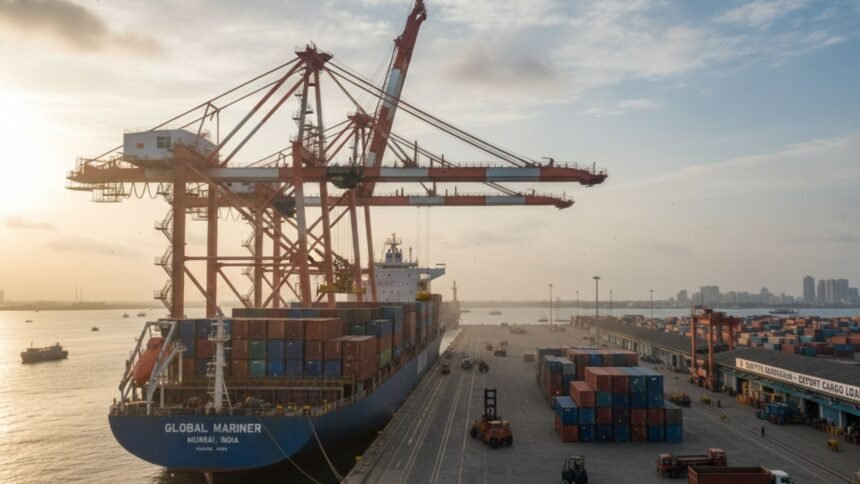
New Delhi, November 13: In a move aimed at resetting India’s export strategy for the next decade, the Union Cabinet has approved the ₹25,060-crore Export Promotion Mission (EPM) a unified, technology-driven framework designed to sharpen the competitiveness of Indian exporters and expand their footprint in global markets.
The mission, announced earlier in the Union Budget 2025–26, replaces a patchwork of fragmented schemes with a consolidated, outcome-oriented mechanism that can adapt swiftly to global trade volatility. It will operate from FY 2025–26 to FY 2030–31.
A Digital-First, Single-Window Export Ecosystem
Under the new structure, all approvals, applications, reimbursements and monitoring will flow through a dedicated digital platform managed by the Directorate General of Foreign Trade (DGFT). The system will be integrated with existing trade and logistics databases to reduce delays and improve transparency.
A collaborative architecture involving the Department of Commerce, Ministry of MSME, Ministry of Finance, state governments, EPCs, commodity boards and financial institutions makes this one of the most expansive inter-ministerial export missions undertaken in recent years.
Two Flagship Sub-Schemes: Niryat Protsahan & Niryat Disha
The mission will run through two connected tracks:
1. Niryat Protsahan — Trade Finance at Lower Cost
Designed primarily for MSMEs, this component eases access to affordable credit by offering:
- interest subvention
- factoring support
- collateral-free guarantees
- credit cards for e-commerce exporters
- credit enhancement tools for market diversification
2. Niryat Disha — Market Readiness and Global Visibility
This track strengthens non-financial enablers through:
- export quality and certification support
- branding and packaging assistance
- participation in international expos
- warehousing, logistics and inland transport reimbursements
- trade intelligence and capacity building
EPM also consolidates existing schemes such as Interest Equalisation Scheme (IES) and Market Access Initiative (MAI), aligning them with current trade dynamics.
Addressing India’s Core Export Bottlenecks
The Cabinet note highlights four structural issues the mission directly targets:
- high cost of compliance with international standards
- limited access to low-cost trade finance
- weak branding in international markets
- logistics disadvantages, especially for hinterland districts
Priority support will go to sectors hurt by recent tariff hikes globally textiles, leather, gems & jewellery, engineering goods, and marine exports.
Boost for District Exports and Job Creation
The government expects EPM to:
- expand exports from non-traditional districts
- generate employment across manufacturing, logistics and allied services
- enhance global market access for Indian products
- strengthen MSME resilience through easier financing and compliance support
Officials believe the mission will also help sustain India’s export momentum at a time when global demand remains uneven.
Aligned with Viksit Bharat 2047 Vision
The scheme positions export growth as a central pillar of India’s transformation plan for the next two decades. With a strong digital backbone and streamlined financial support, EPM aims to build an inclusive and globally competitive trade ecosystem.
Also Read | Cabinet Cuts Royalty Rates for Key Green-Energy Minerals to Boost Domestic Production