







New Delhi: Haridwar known today as the gateway to salvation carries within it stories far deeper than pilgrim rituals and evening aarti lamps. Beneath its spiritual surface lies a legacy of kings, poets, and monks that connects the sacred Ganga Valley with the royal plains of Malwa.
An Ancient City That Predates Myth
According to Prof. Ajay Parmar, an expert in North Indian dynastic history, Haridwar’s antiquity stretches back to 1700 BCE, as revealed by terracotta artefacts unearthed near the old settlements.
It was never just a pilgrimage town,” he says. “It was part of a civilization that linked the Himalayas to the Gangetic trade routes, carrying both faith and commerce.”
The city’s dual name, Har-dwar (gateway of Shiva) and Hari-dwar (gateway of Vishnu), reflects what Parmar calls
India’s oldest symbol of religious harmony where Shaivite and Vaishnavite beliefs merge into one geography of faith.”
From Kings to Yogis The Bharthari Legacy
Author Shriram Tiwari, whose recent book From Bharthari to Vikramaditya explores the spiritual politics of the Malwa lineage, recounts a forgotten legend:
“King Bharthari of Ujjain the elder brother of the legendary emperor Vikramaditya renounced his throne and came to Haridwar to meditate on the banks of the Ganga.”
In local lore, Bharthari’s meditation site still survives as ‘Bhartrihari’s Cave’, a place where seekers light fires and chant verses from the Vairagya Shatak.
“It’s not just poetry,” Tiwari notes, “it’s the living echo of India’s earliest philosophy of renunciation.”
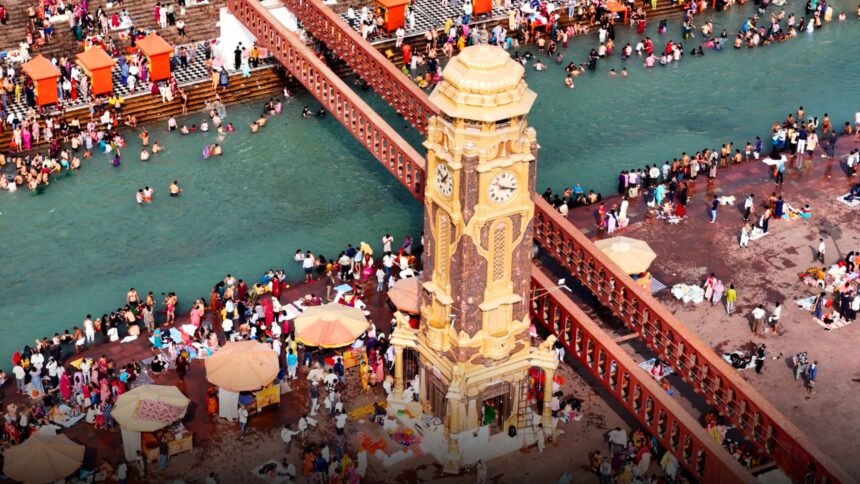
He adds that after Bharthari’s passing, his brother Vikramaditya commissioned the construction of the now-famous Har Ki Pauri ghat. “That act was both personal and political a way of inscribing Malwa’s royal influence into the sacred geography of the north.”
A Dynastic Bridge from Malwa to the Himalayas
Professor Parmar further explains how this link deepened over time.
The Parmar dynasty of Malwa didn’t just rule central India; one of its royal branches travelled north and founded the Pawar dynasty of Garhwal,” he says. “Prince Kanakpal of Malwa came to Haridwar on pilgrimage, married the daughter of a local ruler, and established the Garhwal kingdom around the 8th century CE.”
This connection, he notes,
made Haridwar not just a gateway to the gods but a bridge between the political power of Malwa and the spiritual heart of the Himalayas.”
Kumbh: The Sacred Mirror of Ujjain
Tiwari highlights that both Ujjain and Haridwar share the rare privilege of hosting the Kumbh Mela a sign of their enduring religious parity.
Through the ages, the Kumbh became not just a spiritual fair but a massive economic gathering. Traders from as far as Arabia came to Haridwar’s ghats,” he says.
The festival’s scale and history, he adds, show
how the sacred and the secular have always coexisted in this ancient city.”
Faith, Industry, and the Modern Paradox
Modern Haridwar, however, stands at a crossroads. The city now houses SIDCUL, an industrial hub that has brought jobs but also new ecological strains. Prof. Parmar warns,
If the Ganga loses its purity, Haridwar loses its soul.”
During the COVID-19 lockdown, when factories paused, the river turned clear for the first time in decades
“a divine reminder,” he says, “that the city’s future depends on balance, not expansion.
The Living Heritage of a Sacred City
Both scholars agree that Haridwar is more than a destination it is a dialogue between history and faith. Bharthari’s cave, Vikramaditya’s ghat, Kanakpal’s dynasty and the eternal Ganga together they form a civilizational thread that still flows, unbroken.
“Haridwar,” says Tiwari,
is where mythology turns into memory, and memory becomes the map of India’s timeless soul.”
Also read | Why Rishikesh Truly Deserves a Spot on Every Yoga Lover’s Travel List