








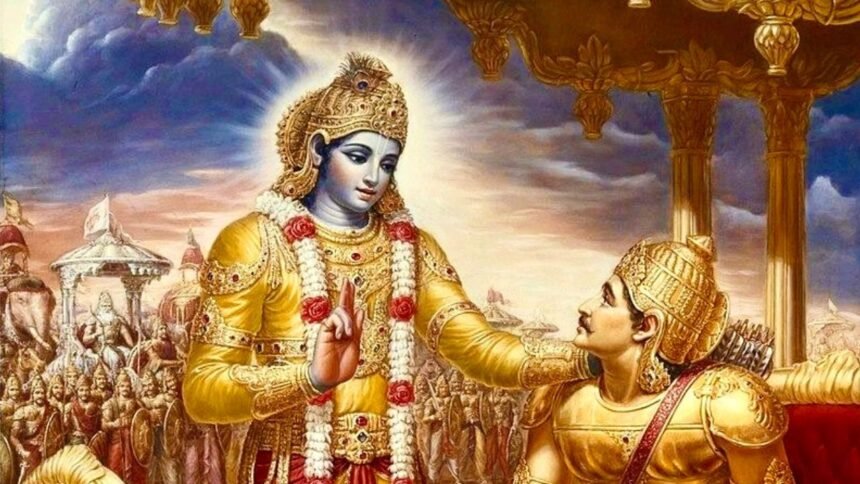
The Bhagavad Gita is not merely a religious scripture but a complete practical pedagogy of living that can transform every dimension of human life, from work and duty to love, stress and self-knowledge. Though born on the battlefield of Kurukshetra, its real arena is the conflicted human mind where every day the struggle between dharma and adharma or in the contemporary context, accountability and escaping, unfolds. Arjun’s dilemma before the war becomes a mirror for modern humans frozen before difficult choices being overwhelmed by moral confusion. Krishna’s teaching thus functions less as sectarian doctrine and more as a universal psychology and ethics of action for any age.
At the core of this teaching stands the insight that we are not merely perishable bodies but immortal and conscious selves; propounding that the right understanding of this truth changes how one relates to the feelings of fear, loss and death. From this metaphysical ground, the Gita unfolds three interwoven paths: karma, jnana, and bhakti as complementary disciplines of action and devotion that together enable holistic self-management. To bring it in practical application- Wisdom doesn’t mean much if we keep it locked inside, effort just leads to burnout if we don’t have a map. And passion is dangerous if we don’t keep our eyes open. Our soul is led towards the real meaning of life when we learn to balance what we know, what we do, and what we believe in.
The point where this synthesis becomes most concrete is the doctrine of ‘Nishkama karma’, action without attachment to results. Krishna’s famous instruction to Arjun crystallises this ethic: कर्मण्येवाधिकारस्ते मा फलेषु कदाचन। मा कर्मफलहेतुर्भूर् मा ते सङ्गोऽस्त्वकर्मणि॥ (2.47)
You are entitled to action, never to the fruits; hence, do not see yourself as the cause of results, nor cling to inaction. In contemporary terms this shifts attention from outcome-obsession and result-based anxiety to process-excellence. This allows any professional, let’s say a surgeon, teacher, manager, or student to work with full intensity yet with psychological lightness. Another verse that captures this ideal is: योगः कर्मसु कौशलम् (2.50) meaning that ‘yoga is skill in action’, suggesting that true professionalism is inseparable from inner equilibrium which is attainable only when one practices selfless attitude throughout life which is the primary teaching of Gita.
This ethic of detached excellence is deepened by the idea of ‘swadharma’, one’s own inherent duty aligned with temperament, capacity, and social context. The Gita insists that even an imperfectly performed swadharma is better than flawlessly imitating the role of another because authenticity and inner congruence matter more than external success. In the modern organizational or educational life this translates into role clarity and vocation: choosing and inhabiting work that resonates with one’s nature rather than copying fashionable models or succumbing to social pressure
Alongside this ethics of action, the Gita offers a remarkably precise psychology of mental downfall and stress. It describes how continuous thoughts on objects and related pleasure leads to attachment followed by desire, desire leads anger, anger to delusion, delusion to memory dysfunction, and finally the destruction of pragmatic intelligence. The chain is captured in the paired verses: ध्यायतो विषयान्पुंसः सङ्गस्तेषूपजायते। सङ्गात्सञ्जायते कामः कामात्क्रोधोऽभिजायते॥ क्रोधाद्भवति सम्मोहः सम्मोहात्स्मृतिविभ्रमः। स्मृतिभ्रंशाद् बुद्धिनाशो बुद्धिनाशात्प्रणश्यति॥ (2.62–63).
This anticipates modern cognitive behavioral insights by locating the root of suffering in patterns of thought and attachment rather than in outer situations alone.
Yet, the Gita does not ask us to flee the world in order to find peace; it asks us to refine our way of participating in it. A pivotal verse states that one who moves among sense-objects with disciplined, non-reactive senses is free from attraction and aversion and only he legitimately attains inner serenity: आत्मवश्यैर्विधेयात्मा प्रसादमधिगच्छति॥ (2.64). Here prasad is not ritual food but a state of luminous tranquillity that melts sorrow and stabilises the intellect.
To support such inner mastery, the sixth chapter elaborates dhyana-yoga as a disciplined way of purifying and steadying the mind. The text clearly acknowledges that the mind is restless, powerful and hard to restrain, yet insists that it can be brought under control through the twin disciplines of sustained practice (abhyasa) and detachment (vairagya). Krishna’s injunction highlights radical self-responsibility- उद्धरेदात्मनात्मानं नात्मानमवसादयेत्। आत्मैव ह्यात्मनो बन्धुरात्मैव रिपुरात्मनः॥ (6.5)
One must lift oneself on his own; the mind can become either our greatest ally or our fiercest enemy depending on how we train it.
From inner life the Gita naturally extends its vision to relationships, love and social ethics. Considering Krishna as the indwelling ‘Self’ of all beings, as suggested by the given Shloka: “अहमात्मा गुडाकेश सर्वभूताशयस्थितः… ” (10.20), dissolves the sharp boundary between “I” and “other,” opening the way to universal compassion. The marks of a dear devotee are the qualities of being free from hatred, a compassionate nature and a complete selfless attitude without being captured by possessiveness or ego. This devotee eventually becomes steady, whether in joy or sorrow and a template for mature friendship, family life and partnership. In this light, love is redefined from ownership and emotional dependence to selfless care rooted in inner freedom and devotion to the divine in the ‘other’.
Across these intertwined strands of nishkama karma, swadharma, psychological insight, meditative discipline and purified love; the Gita emerges as a “manual for living” rather than a text for mere ritual recitation. Its closing assurance, “मा शुचः” (do not grieve), is not a sentimental consolation but the logical culmination of a life in which one recognizes one’s true nature, performs one’s duty without clinging to the material pleasures and rests in equanimity amid change.
When applied with sincerity in contemporary life, the teachings of Gita once imparted by Krishna promise not miraculous escape from difficulty but a deep transformation of how we tackle anything that weighs us down and cope with unwanted situations: with clarity, courage, and unshakeable inner peace. Krishna became the charioteer of Arjun once; leading his way out of the moral dilemma he faced on the battleground but what he left in the form of Bhagavad Gita is the ultimate way to lead a blissful life, making his guidance as indispensable to us today as Arjun in Kurukshetra!
Also Read | Krishna Through Jain Eyes: A Non-Theistic Retelling of Karma, Conflict and Cosmic Order