








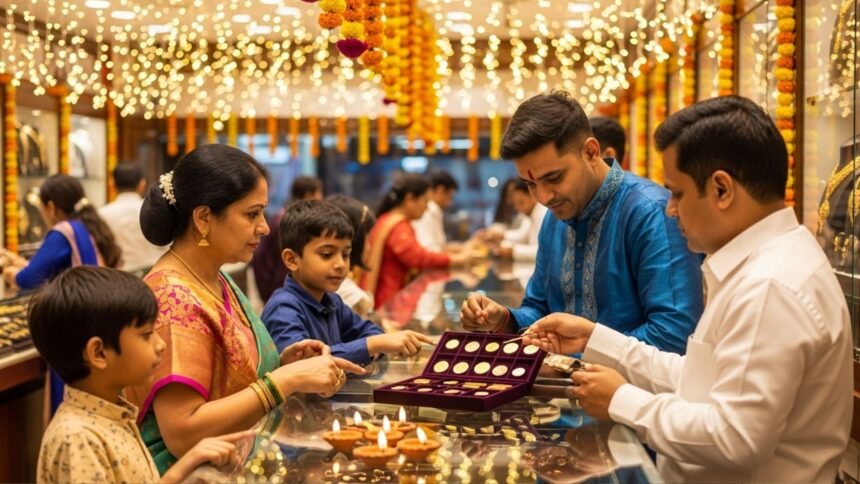
Mumbai, October 19, 2025: This year’s Dhanteras told a different story in India’s gold markets. While tradition kept buyers walking into stores, what they walked out with looked quite different from previous years.
Gold prices touched heights nobody saw coming. At ₹1.27 lakh per 10 grams—and briefly crossing ₹1.32 lakh—the yellow metal cost over 60% more than it did during last year’s festival. That kind of jump changes buying behavior, no matter how strong the cultural pull.
When Tradition Meets Economics
Dhanteras marks the opening of Diwali celebrations. For generations, Indian families have treated this day as the most auspicious time to buy gold. It’s not just about investment—it’s about inviting prosperity into the home.
But 2025 tested that tradition against some harsh financial realities.
“Gold jewellery demand took a hit,” admits Surendra Mehta, secretary at the India Bullion and Jewellers Association. “We saw it drop nearly 30% from last year. But here’s the interesting part—coins and bars were flying off the shelves.”
The numbers back him up. Overall gold sales volumes fell 10-15% during this Dhanteras compared to 2024. Yet total rupee value actually increased sharply. People bought less gold, but paid significantly more for what they did purchase.
The Manufacturing Charge Problem
Here’s what makes jewellery particularly expensive right now: it’s not just about the gold price. Indian buyers typically pay an extra 10-20% as manufacturing charges when they buy ornaments. On top of already record-high gold prices, that premium becomes hard to swallow.
Do the math. If you’re buying a traditional necklace at ₹1.27 lakh per 10 grams, you’re adding another ₹12,700-25,400 in making charges. For a 50-gram piece, that’s over ₹60,000 extra just for craftsmanship.
Coins and bars? You pay for the pure gold, nothing more.
“People who have weddings coming up are getting creative,” says Rajesh Rokde, chairman of the All India Gem and Jewellery Domestic Council. “They’re recycling old gold to manage costs. But those buying fresh are definitely preferring plain gold products.”
Cultural Pull Versus Price Reality
What’s remarkable isn’t that people changed their buying patterns. It’s that they kept buying at all.
Think about it—gold costs 60% more than twelve months ago. That’s a massive increase in any consumer category. Most products would see demand crater. But Dhanteras sales, while lower in volume, stayed resilient.
Why? Because for many Indian families, skipping the Dhanteras gold purchase isn’t really an option. It’s woven too deeply into the festival’s meaning.
“Buying gold during Diwali is considered auspicious, and it’s an investment,” explains Devras Bhai Parmar, a customer at Mumbai’s famous Zaveri Bazaar. “In times of emergency, we can get cash in exchange for gold. It’s been a tradition in my family to buy gold during every Diwali.”
So buyers adapted. They maintained the ritual while adjusting to the economics. Smaller quantities. Simpler forms. Maximum value.
The Jeweller’s Perspective
Standing in his shop in Zaveri Bazaar, Vrishank Jain watches the pattern playing out in real-time.
“Demand for jewellery has slowed, but people are buying gold bars and coins,” he observes. “We’re seeing a lot of demand for these in this festive season and ahead of the wedding season.”
Some buyers are locking in current prices through advance bookings. Others are choosing coins now with plans to convert them to jewellery later, hoping to avoid future price increases.
It’s a pragmatic approach to maintaining tradition within budget constraints.
What’s Driving These Prices?
The 60% year-over-year jump didn’t happen in a vacuum. Multiple factors converged to push gold to these levels:
Globally, gold crossed $4,000 per ounce for the first time in history last week. Economic uncertainty, inflation concerns, and central bank buying all contributed to the rally.
Domestically, the rupee’s weakness against the dollar made imported gold even more expensive. Since India imports most of its gold, international price movements hit local buyers directly.
Add festive demand to already elevated prices, and you get the current situation.
The Bigger Picture
India is the world’s second-largest gold consumer. When buying patterns shift here, it matters globally.
The move toward investment products (coins and bars) versus manufactured jewellery carries implications beyond individual purchases. It affects trade patterns, the domestic manufacturing sector, and employment in jewellery workshops.
Kumar Jain, spokesperson for the Indian Bullion Jewelers Association, confirms the trend isn’t limited to small buyers. “People who have weddings are coming in to recycle their old gold,” he notes. “There’s no slowdown in demand—it’s just taking different forms.”
Looking Ahead
Will this pattern continue? That depends largely on what happens with gold prices.
If prices stabilize or soften after the festive season—as they sometimes do—jewellery demand might recover. The cultural preference for ornaments hasn’t disappeared; it’s just been temporarily suppressed by pricing.
But if prices keep climbing, or even stay at current levels, the shift toward plain gold products could become more permanent. Younger buyers especially might get comfortable with coins and bars as their primary form of gold purchase.
For now, though, one thing remains clear: Dhanteras 2025 showed that while price affects how Indians buy gold, it doesn’t stop them from buying it. The tradition bends, but it doesn’t break.
Also Read | Adani Green Energy Gallery draws massive 1 Million Visitors in London