







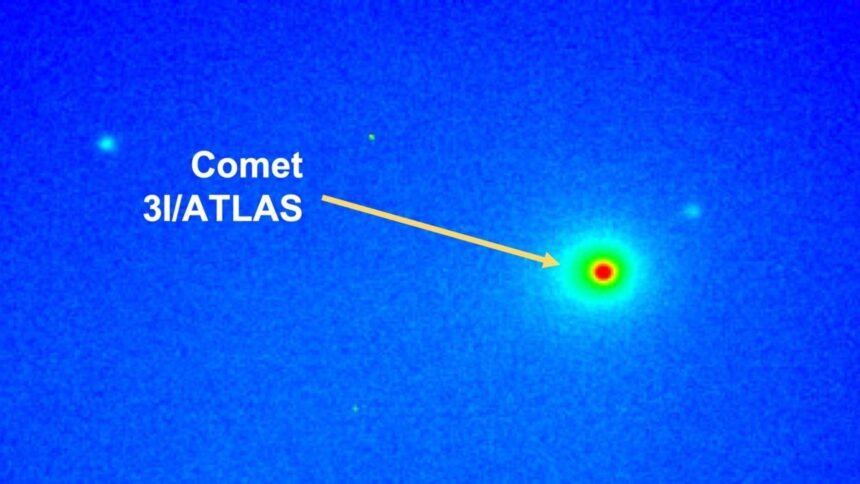
Ahmedabad/Mount Abu, November 20: Indian astronomers have captured rare and detailed observations of the interstellar comet 3I/ATLAS as it moves out of the inner Solar System, offering new clues about the chemical nature of objects formed around distant stars.
Scientists at the Physical Research Laboratory (PRL) used their 1.2-metre telescope in Mount Abu to study the comet between November 12 and 15. The object, which recently crossed its closest point to the Sun, is now travelling back toward the outer reaches of the Solar System.
Circular Coma Observed; Tail Geometry Yet to Be Confirmed
Using wide-field imaging, researchers recorded a bright, near-circular coma the large cloud of dust and gas that surrounds a comet’s nucleus when sunlight heats and vaporises its icy surface.
PRL scientists noted that the current viewing angle places any dust tail behind the comet from Earth’s perspective. Deeper, multi-band observations over the coming weeks could reveal a faint ion tail made of ionised gases pushed outward by the solar wind.
Spectral Analysis Shows Familiar Chemical Signatures
Along with imaging, the team obtained a pre-dawn spectrum of the comet using the LISA spectrograph.
The spectrum displayed strong emission bands of CN, C2 and C3 molecules patterns widely seen in comets native to the Solar System.
The presence of these molecular signatures suggests that the building blocks of 3I/ATLAS are not radically different from those of comets formed around our Sun.
Activity Level Comparable to Typical Solar System Comets
Researchers estimated the comet’s “production rate” — the volume of gas released per second from its nucleus — at roughly 10²⁵ molecules per second, based on emissions of key molecular species.
Production rate ratios, which help classify comet types, indicate that 3I/ATLAS falls within the range of “typical” Solar System comets rather than an unusually exotic interstellar object.
Mount Abu Observatory Plays Key Role
The observations were carried out from PRL’s 1.2-metre telescope situated at 1,680 metres near Gurushikhar in Mount Abu. The facility is known for its contributions to exoplanet studies, high-energy astrophysics and Solar System research.
Scientists say continued monitoring will be possible as the comet enters darker sky conditions, enabling deeper imaging and possibly the detection of its faint tails.
A Rare Chance to Study Material from Beyond the Solar System
Interstellar objects such as 3I/ATLAS are exceptionally uncommon, making each opportunity valuable for understanding how cometary material forms in other planetary systems.
The latest findings support the idea that the chemistry of comet formation may be broadly similar across different star systems — a clue that could help astronomers refine models of planetary and cometary evolution.
Also Read | ISRO’s CE20 Engine Starts Independently in Successful Trial at Mahendragiri