






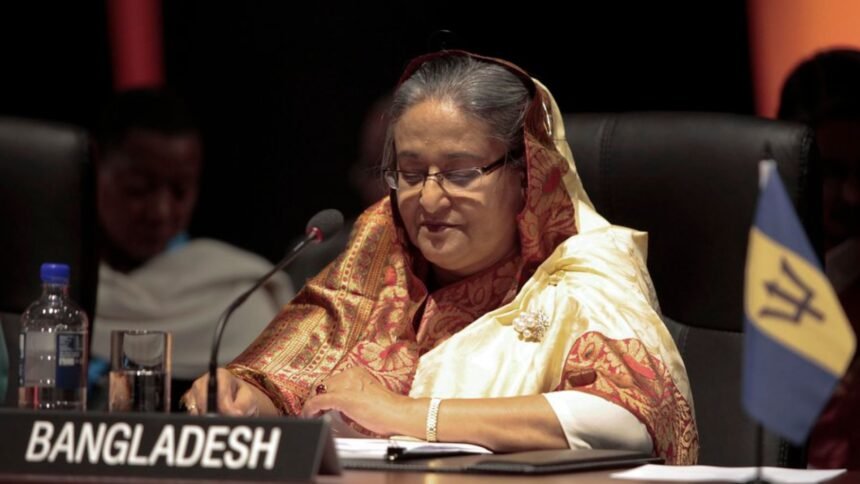
New Delhi, November 18: In a development that has sent shockwaves across South Asia, Bangladesh’s International Crimes Tribunal has sentenced former Prime Minister Sheikh Hasina to death in absentia for crimes against humanity related to last year’s deadly student protest crackdown. The verdict has placed India in a diplomatic quagmire, as Hasina has been living in exile on Indian soil since August 2024.
The Verdict and Charges
The three-judge tribunal in Dhaka held Hasina personally responsible for the deaths of hundreds of protesters during the July-August 2024 violence that eventually forced her to flee the country. The charges include incitement, extrajudicial killings, and criminal conspiracy.
Along with Hasina, her former Home Minister Asaduzzaman Khan has also been handed the death penalty by the tribunal.
Bangladesh Demands Extradition
The reaction from Dhaka was swift and unequivocal. The interim government led by Nobel laureate Muhammad Yunus formally requested India to extradite the former Prime Minister under the 2013 extradition treaty between the two nations. The language used in the formal communication was notably sharp, signaling the seriousness with which the Muhammad Yunus-led administration views the matter.
India’s Measured Response
Breaking its silence on the contentious issue, India’s Ministry of External Affairs (MEA) spokesperson Randhir Jaiswal released a carefully calibrated statement that neither commits to nor rules out extradition.
“India notes the verdict. We have provided shelter to Sheikh Hasina on humanitarian grounds, following our long-standing policy of offering refuge to those facing political persecution. Any decision on extradition will be guided by national interest, bilateral ties, and the principles of justice. We urge all sides to maintain calm and work towards stability,” Jaiswal stated.
The response is being interpreted as India keeping all options open while prioritizing its national security interests.
The Humanitarian Angle
Sources indicate that Hasina was airlifted out of Dhaka on August 5, 2024, and provided refuge in India because her life was under imminent threat. The decision to grant her sanctuary was described by officials as consistent with India’s humanitarian tradition of sheltering those fleeing political persecution.
Geopolitical Implications
The verdict has reopened historical wounds in India-Bangladesh relations. While India provided crucial support to Bangladesh’s independence movement and the Awami League in the 1970s, relations have fluctuated dramatically over the decades, particularly following Sheikh Mujibur Rahman’s assassination.
Strategic analysts warn that extraditing Hasina could:
- Trigger unrest among her massive support base in Bangladesh
- Destabilize India’s 4,000-kilometer eastern border
- Potentially fuel radicalization in the border regions
- Damage long-term bilateral ties with significant sections of Bangladeshi society
Divided Reactions in Bangladesh
The streets of Bangladesh are telling two contrasting stories. Parts of Dhaka University erupted in celebrations following the verdict, while Awami League strongholds remained tense and subdued.
The interim government has ramped up security nationwide and reportedly slowed internet speeds to prevent organized protests—a familiar tactic during times of political volatility.
Political Commentary in India
The issue has already sparked political debate in India. Congress MP Shashi Tharoor has called on the government to clarify its official position on Hasina’s continued stay in the country, reflecting growing pressure for transparency on the matter.
Hasina Fights Back
In a defiant statement, Sheikh Hasina dismissed the tribunal as “rigged” and “politically motivated,” questioning the legitimacy of an “unelected government with no democratic mandate.”
Her son, Sajeeb Wazed, echoed these sentiments, stating that the family would not dignify the tribunal with an appeal until a democratically elected government is restored in Bangladesh.
The Road Ahead
With Bangladesh preparing for elections expected in early 2026, the political landscape remains fluid. What is clear from India’s statement is its resolve: national interest will take precedence over external pressure.
As the situation unfolds, Delhi has signaled it will not be rushed into a hasty decision, while also acknowledging that Dhaka’s concerns cannot be entirely ignored.
For now, two neighboring nations with a shared history and a 4,000-kilometer border find themselves locked in a tense diplomatic standoff—one that could define the future trajectory of India-Bangladesh relations for years to come.
Also Read | India set to gain over $1 billion as Trump removes tariffs