







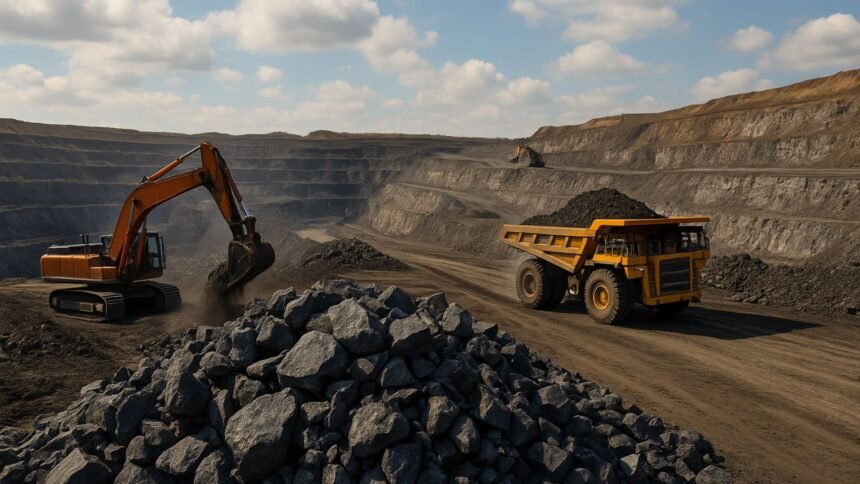
New Delhi, November 13: In a major policy update aimed at strengthening India’s green-energy supply chain, the Union Cabinet has approved a revised royalty framework for four strategically critical minerals — graphite, caesium, rubidium and zirconium. The move is expected to accelerate auctions, unlock fresh deposits and reduce dependence on imports.
Royalty Tweaked to Match Global Price Trends
Under the revised structure, the government has fixed royalty rates as follows:
- Caesium: 2% of average sale price
- Graphite: 2% for ≥80% fixed carbon; 4% for lower grades
- Rubidium: 2%
- Zirconium: 1%
The shift places graphite on an ad valorem mechanism, replacing the earlier per-tonne rate — a change expected to reflect global price swings more accurately.
Push to Unlock Lithium, REEs and Other Associated Minerals
Officials noted that the revised royalty structure will encourage competitive bidding for mineral blocks containing these minerals, which are often found alongside lithium, tungsten, rare-earth elements (REEs) and niobium. This could prove pivotal for India’s fast-expanding clean-tech sector, including EV batteries, solar components and high-end electronics.
Graphite: India’s Weak Link in the EV Value Chain
Graphite — the core anode material for EV batteries — remains a pressure point in India’s energy transition. The country imports nearly 60% of its demand despite having 9 active mines and 27 auctioned blocks. Another 20 blocks identified by GSI and MECL are ready for auction, with 26 more under exploration.
High-Tech Use Cases Driving Demand
- Zirconium: nuclear energy, aerospace, medical devices
- Caesium: atomic clocks, GPS, precision electronics, cancer therapy instruments
- Rubidium: fibre-optic glass, telecom systems, night-vision technology
These applications place the minerals at the heart of both India’s strategic programs and commercial innovation.
Sixth Tranche Auction Set to Gain Momentum
On September 16, the Centre had invited bids for the sixth tranche of critical mineral blocks, covering:
- 5 graphite blocks
- 2 rubidium blocks
- 1 caesium block
- 1 zirconium block
The revised royalty is expected to provide bidders clarity in financial modelling and improve participation.
A Step Toward Supply Chain Security
With most critical minerals globally concentrated in a few geographies, the Cabinet’s decision is seen as an attempt to secure domestic supplies, lower import risks and build an integrated green-energy manufacturing ecosystem.
Industry analysts believe the move will also create jobs, foster downstream processing, and support India’s ambitions in electric mobility and advanced electronics manufacturing.
Also Read | India Shifts Oil Strategy, Buys 5 Million Barrels from US and West Asia Amid Russia Sanctions