






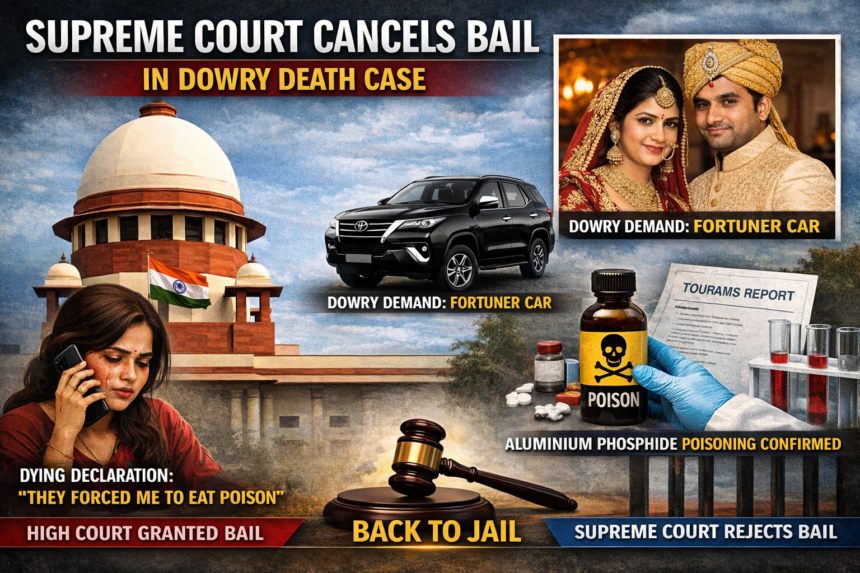
The Supreme Court cancelled the bail given to a man accused of killing his wife by poisoning her.
The couple had married on February 22, 2023. Just four months later, on June 5, 2023, the woman died. Before dying, she called her sister and said that her in-laws had forced her to eat a poisonous substance (aluminium phosphide) because they were demanding a Fortuner car as dowry.
The post-mortem report and witness statements supported what she had said in the call.
The Allahabad High Court had earlier given bail to the husband, but the Supreme Court said this was wrong and cancelled his bail, meaning he will go back to jail while the case continues.
why did the supreme court interfere?
The Supreme Court said the High Court made a serious mistake while giving bail.
The law clearly says that if there is proof a woman was harassed for dowry shortly before her death, the court must assume it is a dowry death. This rule is very strict.
But the High Court ignored:
- How serious the charge of dowry death is
- The woman’s dying statement
- The medical evidence
- The legal rule that dowry death must be presumed in such cases
Even though there was clear evidence of dowry harassment, the High Court still gave bail and treated the case lightly.
The Supreme Court said this was wrong and legally faulty. It cancelled that order and reminded courts that these important legal rules cannot be ignored or weakened.
NOTE:-
Section 304B of the Indian Penal Code deals with dowry deaths. In simple terms: If a married woman dies within 7 years of marriage and it is shown that she was harassed or tortured by her husband or his relatives overdowry, it is treated as a dowry death.
Punishment: Minimum 7 years up to life imprisonment.
Section 113B of the Indian Evidence Act works with Section 304B IPC to make proving dowry deaths easier. Automatic Assumption that the death was caused by that harrasment is known as statutory presumption and the court doesnt need seperate proof of intent to kill, unless the accused can prove otherwise.
“This Court cannot lose sight of the fact that marriage, in its true essence, is a sacred and noble institution founded on mutual trust, companionship, and respect. However, in recent times, this pious bond has regrettably been reduced to a mere commercial transaction. The evil of dowry, though often sought to be camouflaged as gifts or voluntary offerings, has in reality become a means to display social status and to satiate material greed.”,
observed a bench of Justices BV Nagarathna and R Mahadevan
The court says marriage should be a respectful and meaningful relationship, not a way to make money. What people often call “gifts” in marriage are usually given to show off wealth or because of greed.
When a woman dies because of dowry harassment, it is a very serious crime. It violates her basic rights to live with dignity and equality.
So, the court says that in dowry death cases, accused persons should not get bail easily. Judges must think about how serious the crime is and how it affects society, not just the accused person.
“The phenomenon of dowry deaths represents one of the most abhorrent manifestations of this social malaise, where the life of a young woman is extinguished within her matrimonial home – not for any fault of her own, but solely to satisfy the insatiable greed of others. Such heinous offences strike at the very root of human dignity and violate the constitutional guarantees of equality and life with dignity under Articles 14 and 21 of the Constitution of India. They corrode the moral fibre of the community, normalize violence against women, and erode the foundations of a civilized society.”
The court said that dowry deaths are extremely shocking and cruel because women are killed in their own homes just to satisfy others’ greed. These acts violate their right to life and equality and harm society by encouraging violence against women and weakening moral and social values.
WHAT HAD ACTUALLY HAPPENED?
THE TIMELINE
- The Supreme Court ruled the Allahabad High Court’s bail order was flawed because it ignored the mandatory presumption of dowry death under Section 304B IPC and Section 113B Evidence Act.
- The marriage took place on 22.02.2023.
- The woman told her family during the chhathi ritual that her in-laws were demanding a Fortuner and abusing her over dowry.
- She was sent back to her matrimonial home on 02.06.2023 after her husband assured that the harassment would stop.
- On 04.06.2023, during a family function at Kaushambi, she had a quarrel with her husband.
- Around 1:30 AM on 05.06.2023, she called her sister crying, saying her husband and his relatives had forced her to consume a foul-smelling substance.
- She was rushed to Sadar Hospital, Fatehpur, with froth from her mouth, and died while being shifted to Kanpur later on 05.06.2023.
- Her father lodged the FIR 10 days later, explaining the delay as shock and grief.
- The post-mortem on 05.06.2023 did not give a clear cause of death; the FSL report later confirmed aluminium phosphide poisoning.
- Despite the allegations, police delayed arresting the accused; the husband was arrested only after three months of the FIR.
- Charge sheet No. 557/2023 was filed on 30.10.2023, naming only the husband and excluding other in-laws.
- On 16.11.2023, the Assistant Prosecution Officer formally flagged major investigative lapses, leading to transfer of the probe to the CB-CID.
- The Sessions Court rejected bail on 20.10.2023, but the High Court later granted it.
- The defence argued the poison could have been self-ingested and claimed the deceased was unwilling to marry the accused because she loved her brother-in-law.
- The Supreme Court found risk of witness intimidation and evidence tampering, cancelled the bail, and directed the husband to surrender immediately.
Founding the High Court’s order to be legally wrong , the judgment authored by Justice Mahadevan said
“permitting alleged prime perpetrators of such heinous crimes to remain at liberty on bail, when evidence indicates active infliction of physical as well as mental cruelty, may not only jeopardize the fairness of the trial but also erode public faith in the administration of criminal justice.”
“It is well established that bail granted without due application of mind to relevant factors – such as the gravity of the offence, prima facie evidence, or the antecedents of the accused – may be annulled. Courts must consider the totality of circumstances, balancing the presumption of innocence against the seriousness of the crime, societal interest, and risk of the misuse of liberty.”,
the court said, adding that
“the High Court’s omission to consider the gravity of the offence, the corroborated dying declarations and the post-mortem evidence renders the impugned order perverse and unsustainable.”
Accordingly, the appeal was allowed.