







In November 2025, the Supreme Court endorsed a new definition of India’s Aravalli hills treating only landforms at least 100 metres above local ground level as protected hills. That height cutoff (followed by supporting slopes and valleys within 500m) was drawn from a technical panel’s report on mining regulation. Experts immediately warned it would strip nearly 90% of the range of legal protection.
For example, forest survey data showed only about 1,048 of 12,081 mapped hills (≈9%) exceed 100m, meaning most low hills and valleys would no longer count. Conservationists noted this exclusion “would open large tracts of the Aravali region to mining and construction” . Within weeks thousands of residents, students and activists across Rajasthan, Haryana and Delhi – NCR launched “Save Aravalli” protests and petitions. The government even paused new mining leases pending a “Sustainable Mining Plan“
Timeline of Key Events:
● Nov 20, 2025: A SC bench (led by CJI Surya Kant) approves the Union environment ministry panel’s “100m rule” for defining Aravalli hills. (Hills rising ≥100m above local relief would be Aravallis.) Critics immediately warn this could remove 90% of the range from protection.
● Dec 18 – 28, 2025: Protests erupt in Rajasthan, Haryana and Delhi. Politicians (e.g. ex-CM Ashok Gehlot) launch “Save Aravalli” campaigns. Environmentalists file petitions (notably R.P. Balwan, a former Haryana forest official) arguing the cutoff undermines ecology. The government announces a ban on all new mining leases until a scientific management plan is ready.
● Dec 29, 2025: In a surprise suo motu hearing, the SC stays its Nov 20 order. The Court notes the new definition’s interpretation is “being misconstrued” and orders it be kept “in abeyance” pending review. A High-Powered Expert Committee will be formed to re-examine and clarify the Aravalli definitions, mining rules and ecological impacts. (The next hearing is set for Jan 21, 2026.)
● Early Jan 2026: With the 100m rule on hold, no irreversible mining or construction can proceed without SC leave. The expert panel will decide how to define and protect hills in a more environmentally sound way. Meanwhile, the pause offers a temporary reprieve but leaves the range’s future unsettled.
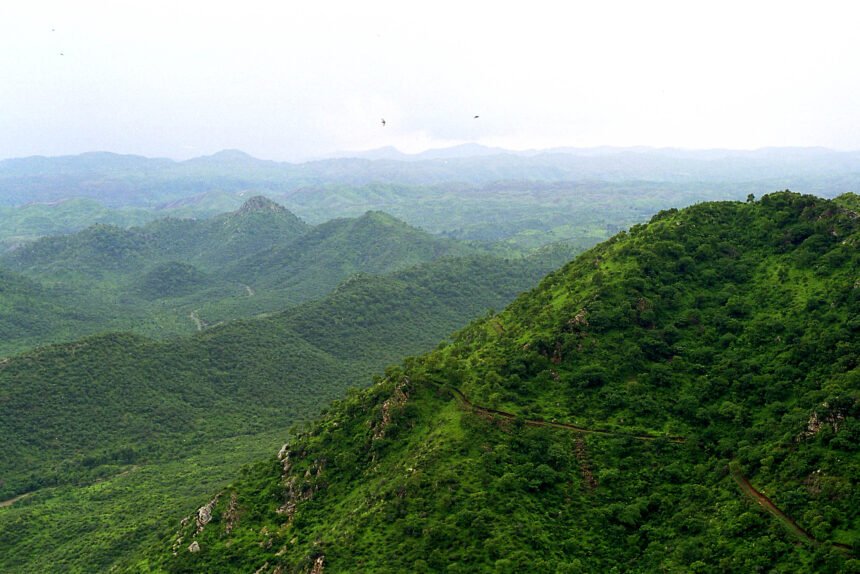
An Aravalli hill range near Udaipur, Rajasthan. The range’s forests act as a natural climate shield across north-west India. The Aravalli hills are among the world’s oldest mountains, running ~700 km from Delhi through Rajasthan to Gujarat. They form a green belt that moderates climate: blocking hot desert winds, trapping dust and pollutants, and guiding monsoon rains eastward. These forests recharge groundwater and regulate the hydrology of the entire Delhi – NCR region.
In fact, the Aravallis’ weathered rock formations have cracks that absorb rainwater into deep aquifers; studies estimate millions of litres per hectare are stored each year. Damage to this “green lung” would worsen Delhi’s notorious dust storms and water shortages. Experts warn that carving away the hills below 100m will sharply weaken these ecological services. Many smaller hills that shelter forests and wildlife would be excluded, fracturing habitats and letting more Thar Desert dust into the plains. A recent report notes that already 12 major “breaches” have opened in the Aravallis, sending desert dust into Delhi-NCR; undoing protections now could let more such gaps appear.
Wildlife in the Aravallis: Leopard and jackal in the southern Rajasthan hills. The range is a biodiversity hotspot (over 200 bird species and many mammals) and a critical water-recharge zone. The forests also preserve soil and wildlife. For example, the hills’ vegetation keeps humidity higher, moderates wind speed and encourages rainfall. They shelter leopards, hyenas, jackals and many birds that roam across northern India.
Environmentalists point out that nearly all of these benefits depend on the entire hill ecosystem, not just its peaks. If the 100m threshold were enforced, “much of the state’s notified forest lies within low-elevation hill systems, which do not meet the 100-metre criteria”. In other words, most Aravalli woodlands and slopes would be stripped of protection, threatening water tables, wildlife corridors and local climates. The court’s reversal drew starkly different reactions. Environmentalists and citizens hailed it as a vindication of their movement. Bhavreen Kandhari, a Delhi activist, said the stay “was much needed and came at the right time,” and urged that the new committee include ecologists, not just bureaucrats. Waterman Rajendra Singh warned that preserving the hills is vital to maintain clean groundwater and save the region from desertification. Congress leaders credited public pressure: Jairam Ramesh declared “Congress welcomes the Supreme Court’s order,” noting the government had tried to alter “a highly sensitiveecological region.” He even called for Environment Minister Yadav’s resignation for defending the 100m cutoff. Former Rajasthan CM Ashok Gehlot praised the court’s stay and said it showed the government needed to heed people’s “sentiments” on the issue. Even opposition leader Aaditya Thackeray (Shiv Sena) tweeted that the pause is only temporary relief and cautioned against any “misinformation campaign” claiming the Aravallis are safe.
By contrast, ruling party voices downplayed the crisis. BJP leaders accused the opposition of politicizing the issue. Union Minister Gajendra Singh Shekhawat called it “Congress creating an issue out of a non-issue,” and said the matter was already clarified by the court. Rajasthan BJP’s Rajendra Rathore claimed the new definition is actually stricter: under it “all hills of 100m or more, their slopes, and terrain within 500m” remain off-limits to mining, which he said leaves about 99% of hilly areas protected. Environment Minister Bhupender Yadav similarly reassured that a complete mining ban (on new or renewed leases) stays in effect. In sum, the BJP argued that only a tiny fraction of the range (2–3%) was even in active mining use, so the policy posed no real threat. These conflicting claims fueled the controversy: conservationists point out that even “scientific” criteria must still protect connectivity and recharge zones, not just high tops.
For now, the 100m rule is suspended and no new mining can proceed without court permission. The Supreme Court has asked the High-Powered Expert Committee to map out exactly which lands would count as Aravalli hills and which would fall outside protection. It must also study how regulated mining (in the gaps between hills) could be done without breaking ecological continuity, and assess the short- and long-term impacts of any definition. The bench has set the matter for further hearing on Jan 21, 2026. After that, the expert panel’s recommendations will likely guide a final judgment. The outcome remains uncertain. Activists stress the Court must prioritize science and ecology in its new definition, not just administrative convenience. They note that past protections (e.g. the 2009 ban on Aravalli mining near Delhi) helped restore greenery and recharge, and they want similarly strong safeguards now. Until then, the Aravalli hills are on pause: briefly spared large-scale development by the Court’s stay, but still awaiting a legally rock-solid definition that keeps the entire range intact.
The Aravalli dispute builds on decades of legal action. In 1996, in the long-running Godavarman case, the Supreme Court held that any land appearing as forest must be protected under law. Years later the Court banned all mining in the Aravalli hills of Delhi-NCR (M.C. Mehta v. Union of India, 2009), recognizing that “environmentaldamage caused by unregulated extraction is irreversible”. These rulings treated the hills as a vital ecological buffer. The recent controversy arose when the government sought a uniform, “objective” rule on paper (the 100m height test) to regulate mining across four states. Whether the new expert committee can craft a definition that satisfies both legal clarity and ecological needs without undoing prior safeguards will decide the Aravallis’ fate.
ALSO READ | Legal Capacity Over Longevity