








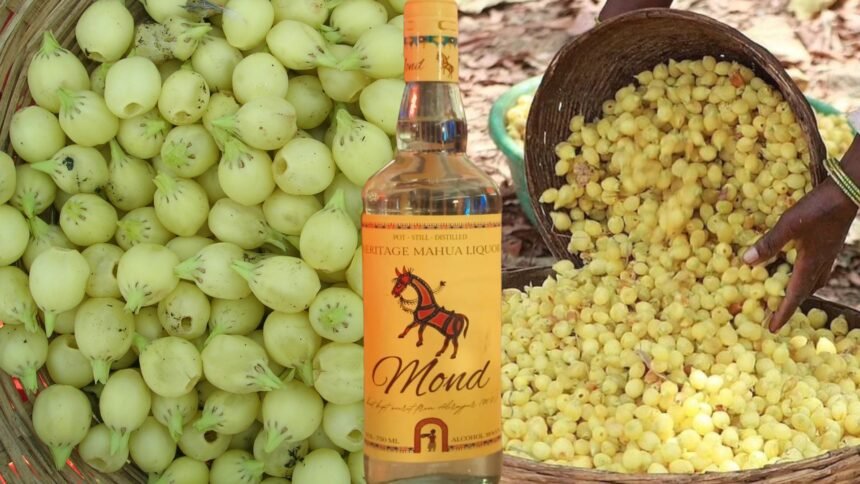
Bhopal, November 21: The ambitious plan to transform tribal livelihoods through legalized Mahua-based alcohol production has encountered significant roadblocks, with only minimal commercial success nearly three years after its inception in Madhya Pradesh.
Understanding the Heritage Alcohol Concept
The state government’s 2021-2022 initiative centered on legitimizing a centuries-old tribal tradition: brewing alcohol from Mahua flowers. Former Chief Minister Shivraj Singh Chouhan announced the framework in November 2021, with Cabinet approval following in January 2022. The vision was to convert what had been an illegal cottage industry into a regulated, profitable venture that could uplift indigenous communities.
Unlike bootleg varieties, this sanctioned version requires specific production standards—copper distillation vessels instead of makeshift containers, quality controls, and proper licensing. The end product was branded as “heritage liquor” to distinguish it from both premium imports and cheap country spirits.
The Government’s Motivations
State authorities had multiple objectives when green-lighting this unconventional policy:
Economic Empowerment: Tribal populations, who have brewed and consumed Mahua alcohol for generations, suddenly had a path to legal income. Self-help groups comprising 10-20 members—mandated to include at least half women and a quarter with basic education—received manufacturing rights across 18 districts.
Cultural Recognition: By legalizing rather than prohibiting this practice, the government acknowledged tribal heritage while attempting to modernize it. The policy essentially said: “Your traditions have value in the marketplace.”
Revenue Potential: Beyond helping tribal communities, the state expected excise tax revenue from a newly regulated sector.
The framework even included VAT exemptions and plans to stock heritage liquor in tourism department establishments and mandate its presence in certain bars.
Ground Reality Tells a Different Story
Implementation has been disappointing. Of the numerous facilities envisioned, only two materialized—one in Alirajpur and another in Dindori. The latter ceased operations roughly eight months ago.
Ankita Bhabar, working at the Alirajpur facility that produces “Mond” brand heritage liquor, describes a struggling operation. The capital city Bhopal provides most orders, while other regions show almost no interest. Production capacity sits half-utilized because buyers are scarce.
The economics don’t work either. Shipping small quantities over long distances eats into already thin margins. The product costs more than competing brands, limiting local sales. Demand spikes only during cold months, creating cash flow problems the rest of the year.
The Dindori closure resulted from a perfect storm: inadequate sales volume coupled with buyers who didn’t pay promptly. Rajkumar, affiliated with that self-help group, recounts an inventory of unsellable stock and bar owners from Gwalior and Jabalpur who kept delaying payments until the operation became financially untenable.
Policy Support Versus Market Dynamics
Government support, while well-intentioned, remained confined to regulatory encouragement rather than demand creation. Officials promoted heritage liquor stocking at bars and menu inclusion, but couldn’t force consumer preference.
By late 2024, the excise department attempted a course correction through modified rules that compelled hotel bars to stock at least two cases and list the beverage on their menus, though these measures came after the damage was largely done.
Lessons from a Failed Experiment
This case study reveals the limitations of top-down initiatives that underestimate market forces. Several factors contributed to failure:
- Price-sensitive consumers won’t choose expensive heritage options when cheaper alternatives exist
- Distribution infrastructure for small-scale producers can’t compete with established supply chains
- Marketing and brand building require resources beyond what tribal self-help groups can marshal
- Seasonal business models are inherently unstable without diversification
- Payment discipline in the liquor trade proved unreliable for small producers lacking leverage
The policy also highlights a broader challenge: honoring cultural traditions while making them commercially viable requires more than legal permission—it demands market development, consumer education, quality assurance, and sustained financial support through the vulnerable early phase.
For Madhya Pradesh’s tribal communities, the heritage liquor policy represented hope for legitimate income from ancestral knowledge. Three years on, that promise remains largely unfulfilled, with most aspiring producers deterred by the cautionary tale of the two struggling units.
Without fundamental restructuring—perhaps including government procurement guarantees, marketing subsidies, or direct-to-consumer sales channels—this initiative risks becoming another example of policy ambition disconnected from implementation reality.
Also Read | Telangana’s ₹3,366 Crore Liquor Debt Crisis Deepens: Festive Season Shortage Looms