





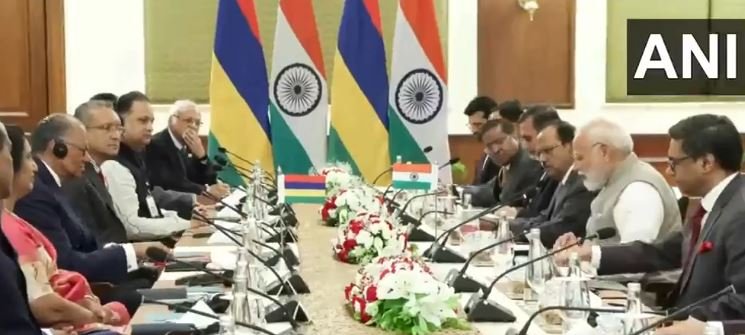
During a state visit marked by warmth and symbolism, Prime Minister Narendra Modi announced a Special Economic Package for Mauritius, emphasizing that this move is “not assistance, but investment in our shared future.” The announcement came during Mauritian PM Navinchandra Ramgoolam’s visit to Varanasi, part of a bilateral meeting held under the banner of strengthened strategic partnership.
The joint package, designed per the priorities identified by the Mauritian government, allocates approximately USD 215 million on grant basis and USD 440 million as grant-cum-Lines of Credit (LOC). Projects include founding a new Sir Seewoosagur Ramgoolam National Hospital, an AYUSH Centre of Excellence, a veterinary school and animal hospital, and provision of helicopters. On the infrastructure side, civil aviation, road development, ring road expansion, and port equipment acquisitions also feature prominently.
Beyond financial investment alone, India and Mauritius also announced strategic cooperation. Key agreements include upgrading infrastructure like the ATC Tower at SSR International Airport, development of Motorway M4 and Ring Road Phase II, and joint stewardship of marine resources, including surveillance of the Exclusive Economic Zone (EEZ) and the Chagos Marine Protected Area.
PM Modi also underscored the cultural and civilizational ties binding the two nations. He described the relationship as one where “India and Mauritius are not just partners but family,” celebrating shared heritage that spans centuries. He also reiterated India’s support for Mauritius’ sovereignty claims and hailed the recently concluded Chagos Agreement, calling it a historic achievement.
One practical outcome already in action is the establishment of the first Jan Aushadhi Kendra outside India in Mauritius. Also, India will aid in capacity-building: refitting of Mauritius’ coast guard vessel, training of officers in hydrography, and cooperation in navigation and mapping work over an agreed five-year plan.
India’s package for Mauritius goes beyond mere diplomacy. It reflects a multi-dimensional strategy: investing in infrastructure, public health, education, maritime security, and shared values. More than an aid program, it is a statement of intent of how two neighbouring democracies can align their growth, not through charity, but through partnership. As the Chagos issue, cultural diplomacy, and strategic cooperation feature prominently, this partnership appears poised to deepen—anchored in both geopolitical necessity and historical kinship.