




Varanasi: A powerful call for linguistic pride and cultural self-confidence echoed at the Bharatiya Bhasha Samagam 2025 in Varanasi, where Jammu and Kashmir Lieutenant Governor Manoj Sinha described Indian languages as “the strongest bonds of national unity.”
The event, themed “Panch Pran: Swabhasha aur Viksit Bharat” (Native Language and Developed India), was organized by the Hindusthan Samachar Group at Mahatma Gandhi Kashi Vidyapith. It brought together scholars, policymakers, educators, and cultural leaders from across the country to celebrate India’s linguistic heritage and its role in building a self-reliant future.
Unity Through Language
In his keynote address, Sinha emphasized that Indian culture draws strength from the sacred vibrations of the Vedas and Puranas, rooted in Varanasi “the first and eternal city on earth.” He underscored that the soul of a nation resides in its mother tongue, and without respect for native languages, the dream of a developed India will remain incomplete.
“Indian languages inspire us with the spirit of oneness amid diversity. In the coming years, they will be the key to self-reliance and self-confidence,” Sinha said.
Education Rooted in Culture
Former Uttar Pradesh minister Neelkanth Tiwari highlighted the urgency of embedding Indian values into education. He noted that since 2014, under Prime Minister Narendra Modi’s leadership, “a new self-confidence and national pride have emerged.”
RSS ideologue Atul Bhai Kothari, National Secretary of Shiksha Sanskriti Utthan Nyas, insisted that “motherland and mother tongue cannot be substituted.” He stressed that Indian languages must flourish in literature, science, and technology to secure cultural continuity and national unity.
Academics echoed similar concerns. Prof. Anand Kumar Tyagi, Vice-Chancellor of Mahatma Gandhi Kashi Vidyapith, remarked that India failed to rank among the world’s leading nations in the past 75 years due to its neglect of native-language education. Prof. Ajit Kumar Chaturvedi, Vice-Chancellor of BHU, praised the New Education Policy for fostering awareness of Swa (self-identity) and hailed Hindusthan Samachar’s role in giving Indian languages a national voice since 1948.
Honoring Language Scholars
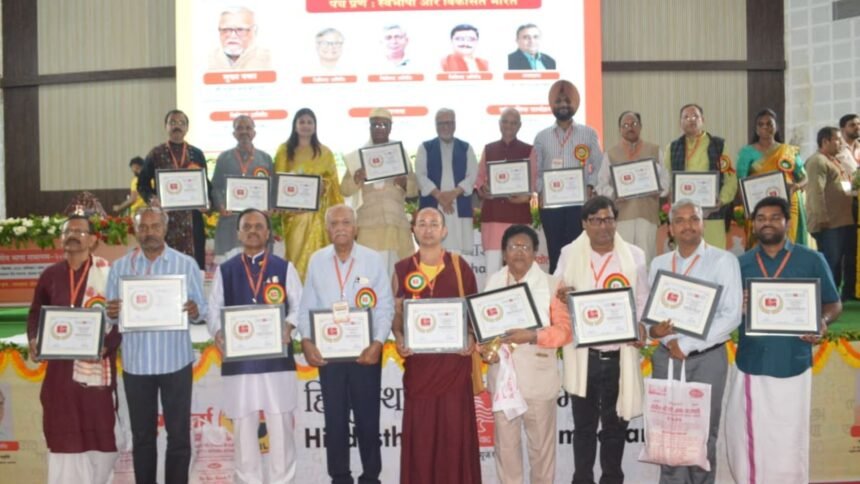
A highlight of the conclave was the Bharatiya Bhasha Samman, awarded to scholars and contributors representing 22 Indian languages. Honorees included:
- Dr. Anil Kashinath Sarje (Marathi)
- Dr. M. Santosh Kumar (Tamil)
- Dr. Kuldeep Singh (Punjabi)
- Dr. Motilal Gupta ‘Aditya’ (Hindi)
- Prof. Devashish Patra (Odia)
- Prof. B. Vishwanath (Telugu)
- Prof. Brijbhushan Ojha (Sanskrit)
- Vinayak Banerjee (Bengali)
- Dr. Bhagyesh Vasudev Jha (Gujarati)
- Manoj ‘Bhavuk’ (Bhojpuri)
- Dr. Premraj Nupane (Nepali)
- Dr. Bikash Jyoti Borthakur (Assamese)
- Dr. Shivani B. (Malayalam)
- Dr. Tenzin Nima Negi (Tibetan)
- Dr. Ramkumar Jha (Maithili)
- Sundar Das Goharani (Sindhi)
Awards also recognized contributors in Law & Justice, Journalism, and Civil Services, reflecting the expansive role of Indian languages in public life.
A Cultural Milestone
Chaired by Arvind Bhalchandra Mardikar, Chairman of Hindusthan Samachar Group, the program celebrated not just languages but the unity they embody. Editor Jitendra Tiwari conducted the session, while Director Pradeep Madhok ‘Baba’ delivered the welcome address.
The Samagam underscored that in India, language is not just communication it is consciousness, culture, and continuity. As Manoj Sinha reminded the audience, “Until we accord due respect to our mother tongues, the vision of a truly developed India will remain incomplete.”