







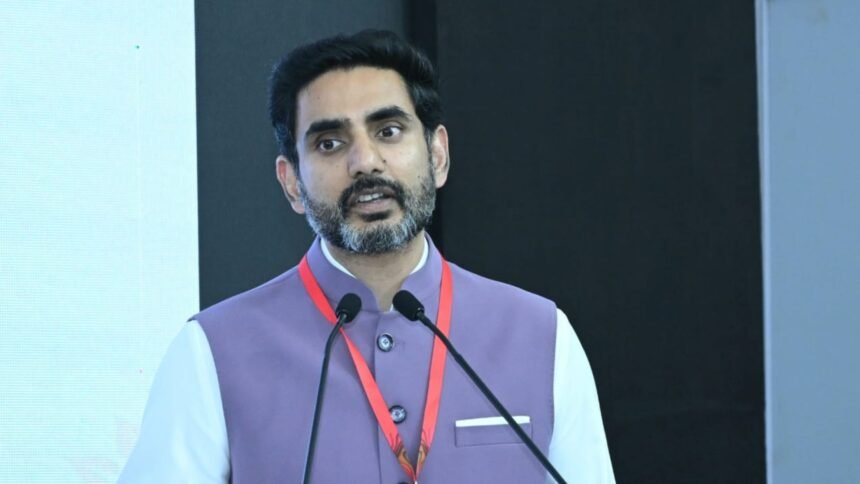
Visakhapatnam, November 19: While most Indian states struggle to attract even modest foreign investments, one southern state is quietly emerging as the country’s investment powerhouse, and at the center of this dramatic transformation is a 42-year-old Stanford MBA with an ambitious vision and unparalleled political connections.
Nara Lokesh, son of Andhra Pradesh Chief Minister Chandrababu Naidu and the state’s IT and Industries Minister, has pulled off what many thought impossible: securing a staggering $120 billion in firm investment commitments over just 16 months — far outpacing every other Indian state and union territory combined.
The Google Coup That Shook India
The crown jewel in Lokesh’s investment portfolio came in October when Google announced a $15 billion commitment to build its largest data center and AI hub outside the United States in Visakhapatnam. According to Reuters, Google Cloud CEO Thomas Kurian called it “the largest AI hub that we are going to be investing in anywhere in the world outside of the U.S.”
The investment, which will roll out between 2026 and 2030, represents India’s single largest foreign direct investment in history and is expected to create over one lakh jobs, both direct and indirect.
What makes this particularly remarkable is that Google wasn’t initially looking at Andhra Pradesh. The tech giant was evaluating multiple states, including Karnataka — home to India’s tech capital Bengaluru. But Lokesh and his team’s aggressive pursuit, combined with what he describes as “clear assurances” from the central government, sealed the deal.
“We worked closely with the central government and received clear assurances,” Lokesh said in a recent interview. “This process has ultimately benefited India. Andhra had the first-mover advantage.”
Speed Over Ease: A New Investment Philosophy
Unlike other states that focus on “ease of doing business,” Lokesh has pioneered what he calls the “speed of doing business” model — a approach that has caught the attention of India’s biggest industrialists.
“Your mantra of ‘Speed of Doing Business’ is not just a slogan, it is a lived experience for investors like us,”
Karan Adani of the Adani Group said at a recent conference, as reported by Bloomberg.
This philosophy recently paid off in spectacular fashion when ArcelorMittal Nippon Steel committed nearly $17 billion (₹1.4 trillion) to build India’s largest steel plant in Andhra Pradesh a project that will be developed across multiple phases with a capacity of 17.8 million tonnes.
The steel giant had been evaluating several states, including one governed by Prime Minister Narendra Modi’s own BJP. But according to Lokesh, the deal was clinched when the TDP convinced Modi to approve a 200-kilometer slurry pipeline to transport iron ore from a neighboring state. “It was done within a second,” Lokesh said of Modi’s approval.
The Modi Connection: Coalition Politics Meets Investment
Lokesh’s success is inseparable from his party’s political positioning. The Telugu Desam Party (TDP), led by his father, is now a crucial ally in Modi’s coalition government after the BJP failed to secure an outright majority in the 2024 general elections.
This proximity to power has allowed Lokesh to cut through India’s notorious bureaucratic red tape a complaint that has long plagued foreign investors trying to operate in the country.
“We don’t go into a meeting where we just do this dog and pony show, exchange memorandums of understanding, take a nice picture and then forget,”
Lokesh emphasized, distinguishing his approach from the traditional Indian model of signing non-binding MOUs that rarely materialize.
The Spicy Competition
Lokesh’s success has sparked intense interstate rivalry, particularly with Karnataka. After securing the Google investment, he took a not-so-subtle dig at his neighbors on social media: “They say Andhra food is spicy. Seems some of our investments are too. Some neighbors are already feeling the burn,” he posted on X (formerly Twitter).
Karnataka’s Deputy Chief Minister DK Shivakumar fired back, defending Bengaluru’s infrastructure and accusing Andhra of offering “unsustainable incentives.” According to Business Today, Karnataka’s IT Minister Priyank Kharge alleged that Andhra lured Google with ₹22,000 crore in subsidies and waivers.
But Lokesh remains unapologetic.
“All states offer incentives… Our ability to foster relationships and ensure tangible results at record speed are what’s showing,” he told Mint magazine.
The Trillion-Dollar Dream
With $120 billion already committed, Lokesh has set his sights even higher. “I’ll sleep well the day when we have a firm commitment of a trillion dollars’ worth of investments in Andhra Pradesh,” he declared in a recent interview.
At the upcoming Partnership Summit in Visakhapatnam, the state expects to sign 410 more MOUs worth over $100 billion, potentially creating 700,000 jobs.
A Model or a Warning?
While investment consultants praise Andhra’s aggressive approach for putting development at the center of politics and sparking healthy competition among states, questions remain about sustainability and whether corners are being cut to fast-track approvals.
Lokesh and his aides categorically deny any procedural shortcuts. “The leadership is very clear: Try to see how we can streamline the process, how we can run things in parallel and save time, but don’t deviate from the process,” said Saikanth Varma, CEO of the Andhra Pradesh Economic Development Board.
Whether Lokesh’s model represents a replicable blueprint for Indian states or a unique political moment remains to be seen. But one thing is clear: the young Stanford graduate has positioned Andhra Pradesh as the go-to destination for multinationals looking to invest in India and he’s just getting started.
Also Read | Sundar Pichai Says AI Boom Shows “Irrationality” but Will Remain Transformative