







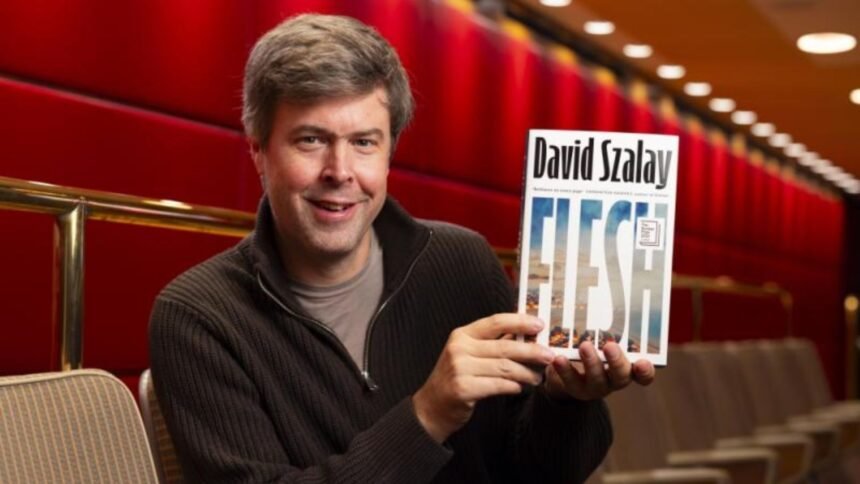
London: There’s something refreshingly unconventional about this year’s Booker Prize winner. David Szalay, a 51-year-old writer with Hungarian and British roots, just claimed one of literature’s most prestigious awards for his novel ‘Flesh’. And honestly? It’s not your typical prize-winning book.
The announcement came on November 10th at Old Billingsgate in London, and with it came a historic moment. Szalay became the first Hungarian-British author ever to win the Booker. Along with the trophy came £50,000 not a bad evening’s work.
Roddy Doyle, who chaired the judging panel, didn’t mince words.
We had never read anything quite like it,” he said. “It is, in many ways, a dark book but it is a joy to read.”
That’s quite a statement, especially considering the panel spent over five hours debating before reaching their decision.
A Story That Speaks Through Silence
So what’s this book actually about? Well, ‘Flesh’ follows István, a Hungarian man whose life we witness across five decades. But here’s the thing – Szalay doesn’t tell this story the way you’d expect.
We meet István in 1980s Hungary. He’s just 15, recently moved to a new town with his mother, and struggling to fit in. Then he gets involved with a married woman twice his age. It doesn’t end well. There’s violence, tragedy, and István winds up in a juvenile detention center.
Fast forward. He’s out, but nobody will hire him because of his criminal record. So he joins the military, serves in Iraq, comes back. Works as a bouncer. Then a bodyguard. Eventually, he marries a wealthy client and climbs his way into London’s elite circles as a property developer. From poverty to riches and – well, you’ll have to read to find out.
But here’s where it gets interesting. Szalay doesn’t actually show us most of these big moments. The time in detention? Happens off-page. The Iraq service? Between chapters. Major life events just… exist in the white space.
Less Words, More Impact
The real star of this novel is what’s NOT there. Szalay’s writing is incredibly sparse. Pages have huge amounts of white space. István barely talks – mostly just “yeah,” “okay,” and “not sure.” That’s about it.
Some readers might find this frustrating. Where’s the detail? Where’s the drama? But that’s precisely the point. Doyle explained: “I don’t think I’ve read a novel that uses the white space on the page so well. It’s as if the author is inviting the reader to fill the space, to observe – almost to create – the character with him.”
The Financial Times loved it, calling it “refreshing, illuminating and true… a moving work of art.” The Observer went even further:
It’s been a long time since I’ve been swallowed whole by a novel the way I was by this one… It’s a masterpiece.”
But let’s be real – this style won’t work for everyone. Critics noted that some readers felt frustrated by the novel’s refusal to fill in gaps. Major chunks of István’s life just aren’t there on the page. You have to imagine them, piece them together yourself.

A Historic Win on Multiple Fronts
This victory matters for several reasons. Born in Montreal in 1974, Szalay becomes the first Canadian-born Booker winner since 2019. His publisher, Jonathan Cape, just scored their 10th Booker Prize – a record – and their second win in a row after Samantha Harvey’s ‘Orbital’ last year.
It’s also not Szalay’s first rodeo. Back in 2016, his novel ‘All That Man Is’ made the shortlist too. So this win represents years of dedication, not an overnight success.
This year’s shortlist was particularly strong. Kiran Desai (who won the Booker back in 2006) was on it with ‘The Loneliness of Sonia and Sunny’. Andrew Miller’s ‘The Land in Winter’ was there. So were novels by Katie Kitamura, Susan Choi, and Ben Markovits. All established voices. In fact, this was the most experienced shortlist in Booker history – not a single debut author among them.
The panel’s debate lasted more than five hours. Besides Doyle (who won the Booker himself in 1993), the judges included actress Sarah Jessica Parker, among others. Parker said the experience made her “understand why you dedicated your life to literature in the first place.”
The Author’s Take on Risk and Writing
During his acceptance speech, Szalay talked about taking chances.
Throughout the process of writing the book there was a sense of risks being taken,” he explained. “And I think it’s very important that we did take those risks.”
He revealed something amusing: while writing, he asked his editor whether she could imagine a novel called ‘Flesh’ actually winning the Booker. Even he had doubts about the provocative title and challenging approach.
But he stayed true to his vision.
Fiction can take aesthetic risks, formal risks, perhaps even moral risks, which many other narrative forms can’t quite do to the same extent,”
Szalay argued. That philosophy clearly paid off.
From Montreal to Vienna via London
Szalay’s background is as international as his protagonist’s journey. Born in Canada, raised in London after his family fled the Lebanese Civil War, Oxford-educated, and now living in Vienna with his second wife – he’s truly a European writer in the broadest sense.
He’s published six novels since his 2008 debut ‘London and the South-East’, which won two prizes. In 2013, Granta magazine named him one of Britain’s Best Young Novelists. His work has been translated into over 20 languages.
For Szalay personally, the Booker Prize means more than prestige. After his 2016 shortlisting, he said: “It made it possible to live and work as a writer. The Booker is a precious thing.” This full win will likely secure that future even more firmly.
The numbers back that up. When ‘Flesh’ made the shortlist, sales jumped 302%. Now that it’s won? Expect that figure to skyrocket. Last year’s winner ‘Orbital’ sold over 20,000 copies in the week following its victory – the fastest-selling Booker winner since records began.
What This Win Really Means
Beyond the prize money and sales boost, Szalay’s victory sends a message. Experimental fiction still has a place. Stories don’t need to spell everything out. Silence can speak volumes. White space on a page isn’t emptiness – it’s possibility.
The judges emphasized how the novel examines masculinity through the lens of a working-class man who operates through silence rather than expression. It’s about class mobility that comes at a cost. It’s about trauma that echoes across a lifetime.
Most importantly, it’s about trusting readers to be active participants in the story, not passive consumers. That’s a bold approach, and the Booker Prize just validated it.
As literary critic Chris Power, one of the judges, might say – this is fiction that respects its audience. It doesn’t hold your hand. It invites you in and asks you to work for the experience. And for those willing to meet it halfway, the rewards are substantial.
David Szalay’s ‘Flesh’ proves that sometimes the most powerful stories are the ones that know when to shut up and let the reader’s imagination do the talking.
Also Read | Uttarakhand Foundation Day 2025: Where Faith Flows Into Conservation