





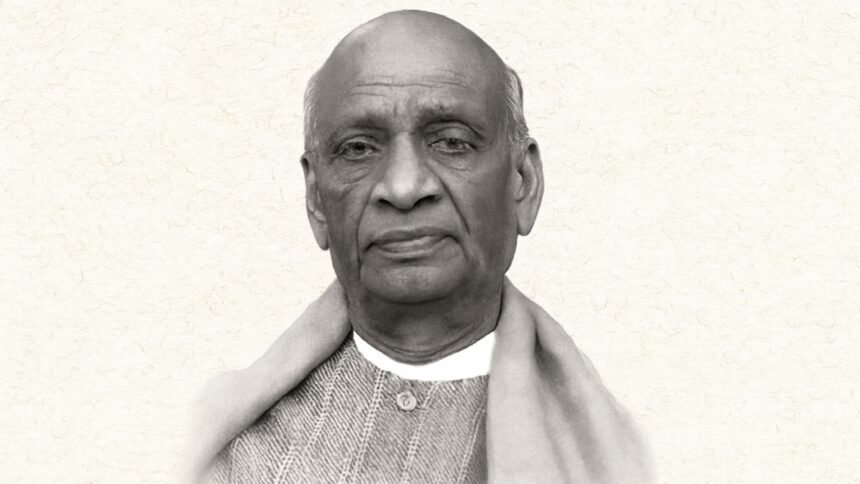
New Delhi: At the mid-night of 1947, August 15, when the world slept, India awoke to its freedom. The air was filled with both celebration and uncertainty. The British had left, but what remained behind was a country broken into hundreds of pieces. Nearly 562 princely states, each with its own ruler, flag and ambitions. The idea of one India was almost impossible. Sardar Vallabhbhai Patel, known as the Iron Man of India, took it upon himself to unite a land that was divided not only by borders, but by centuries of difference in language, art and culture.
Born in Nadiad, Gujarat, on October 31, in 1875, Patel was a man of strong will and quiet determination. Before joining politics, he had been a lawyer, known for his clear mind and practical approach. The freedom struggle had shaped him into a leader who valued discipline and unity above everything else. When the British left, Patel became the Deputy Prime Minister and the first Home Minister of independent India. It was then that he began his greatest mission. The dream to turn a land of fragments into a single nation.
At that time, the princes who ruled their territories were given the choice to join India or Pakistan or to remain independent. The situation was dangerous. If even a few states had chosen to stay separate, India would have been a map of chaos rather than a country. Patel saw this clearly. With his trusted aide V. P. Menon, he began a long and patient process of convincing each ruler to accede to the Indian Union.
Some rulers, like those of Mysore, Bikaner, and Baroda, joined willingly. While the Nizam of Hyderabad dreamed of independence. And Kashmir faced its own painful uncertainty, torn between the two independent nations. Patel handled each situation differently either with persuasion, firmness or decisive actions whenever needed. He believed in peace, but he was never afraid to act when peace failed.
One-by-one in a short span, almost all the princely states became part of India. His handling of the Hyderabad crisis in 1948, known as Operation Polo, was a remarkable example of leadership. By the time of his death in December 1950, Sardar Patel had given shape to the India we know today. A nation united, strong, and whole.
But for Patel, unity was not just about political boundaries. It was also about the spirit of togetherness among people who spoke different languages, practiced different religions and lived different ways of life. He often said that India’s strength lies in its ability to stay united despite these differences. For him, cultural diversity was not a problem to be solved but a treasure to be protected.
Today, when India continues to debate identity, language and regional pride, Sardar Patel’s dream reminds us what truly holds this country together. He believed that the foundation of unity must be trust and mutual respect. Every region, from Kashmir to Kanyakumari, from Gujarat to Assam, adds its own colour to India’s vast canvas. To remove any one part would be to dull the whole.
His legacy stands tall not just in history books, but also in the heart of every Indian who believes in the power of togetherness. The Statue of Unity in Gujarat, the tallest in the world, is not just a monument of stone and steel. It is a symbol of his vision — that a nation as diverse as India can stand as one when guided by courage, wisdom, and compassion.
A marathon known as Run of Unity is organised by every state in Indian on October 31, 2025, by the Government of India.
Sardar Vallabhbhai Patel’s life teaches us that unity is not built by force, but by faith. It is not the absence of diversity, but the respect for it, that makes a nation strong. His dream was an India where every voice mattered and every culture belonged. And though decades have passed since his time, that dream continues to shape the soul of our nation.
He gave India not just its map, but its meaning and soul. He turned India into a beautiful mosaic of one country and countless cultures, bound together by the belief that unity in diversity is our greatest strength.
Also read | Piyush Pandey, the legendary Adman of India, dies at just 70