






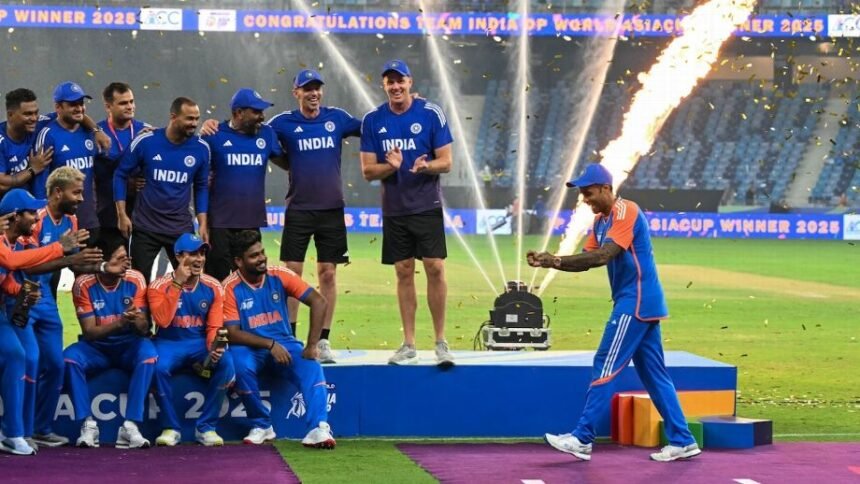
Dubai: In Dubai, under the shadow of political hostilities and heightened cross-border tensions, India edged Pakistan by five wickets to claim their ninth Asia Cup crown. The contest was not just about runs and wickets—it was a battle of temperament, patience, and the ability to rise above the noise.
A Stuttering Chase and a Young Man’s Calm
Chasing 146, India found themselves gasping at 20 for 3. The middle-order, shuffled to accommodate Shubman Gill, wavered under Pakistan’s early intensity. But Tilak Varma stood still in the storm. Unhurried and unflustered, he rebuilt with discipline, moving to 24 off 26 with little concern for the scoreboard pressure. His innings was not built on power but on timing and judgement. A perfectly struck back-foot punch off Faheem Ashraf announced his composure.
By the time Haris Rauf returned for the 15th over, Tilak had read the conditions like a seasoned campaigner. With 64 required off 36, he launched into pace-on deliveries with precision, plundering 17 runs in the over. His unbeaten 69 became the axis around which India’s fortunes turned. And when he struck Rauf for a six over square leg with eight needed, it was the knockout blow. The outburst of celebration—fists, shouts, and heart-shaped gestures—belied the stoicism he had carried all innings.
Pakistan’s Collapse of Nerves
Pakistan’s batting narrative mirrored their uncertainty. Sahibzada Farhan’s adventurous fifty and Fakhar Zaman’s brisk 46 set them up at 107 for 1, with 44 balls still in the bank. But what followed was a spectacular unraveling. Varun Chakravarthy dismissed both set batters, Axar Patel chipped in, and Kuldeep Yadav, after a rough start, returned with three wickets in one over. The collapse read nine wickets for 39 runs. From dominance to despair, Pakistan squandered their foundation, bowled out with five balls to spare.
Dube’s Cameo, More Than Just Runs
India’s balance looked skewed without Hardik Pandya. In stepped Shivam Dube—returning after a rest and trusted with dual responsibility. His unbeaten 33 off 22 balls added steel to Tilak’s artistry, the pair stitching a match-turning 60-run partnership. Two audacious sixes—one down the ground against spin, another improvised over wide long-on against Ashraf—displayed his game sense. Asked to open the bowling, he held his nerve even without wickets, conceding just 23 in three overs.
The Atmosphere Beyond Cricket
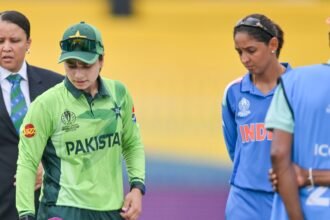
This was no ordinary final. Earlier military conflict between the two nations, captains avoiding eye contact, and bowlers mimicking gestures laced with political symbolism—everything spilled into the contest. Jasprit Bumrah’s send-off to Rauf was as much geopolitical theatre as sporting banter. Coaches Gautam Gambhir and Mike Hesson animatedly directed their wards from the dugout, intensifying the pressure cooker atmosphere.
A Victory Beyond the Scoreboard
In the end, India’s triumph was not merely statistical. It symbolized resilience, composure, and the ability to find clarity in a cauldron of noise. For Tilak Varma, it was a coming-of-age moment; for India, a vindication of their depth. For Pakistan, it was another painful reminder that bold starts and intent must be matched by discipline.
This was an India–Pakistan final that lived up to the 41-year wait. Cricket was the stage, but Tilak’s bat was the voice of calm that cut through the chaos.